
An 80% carotid stenosis sounds like an emergency waiting to happen. If you have never had a stroke or TIA, however, the percentage is only the beginning of the decision – not the end.
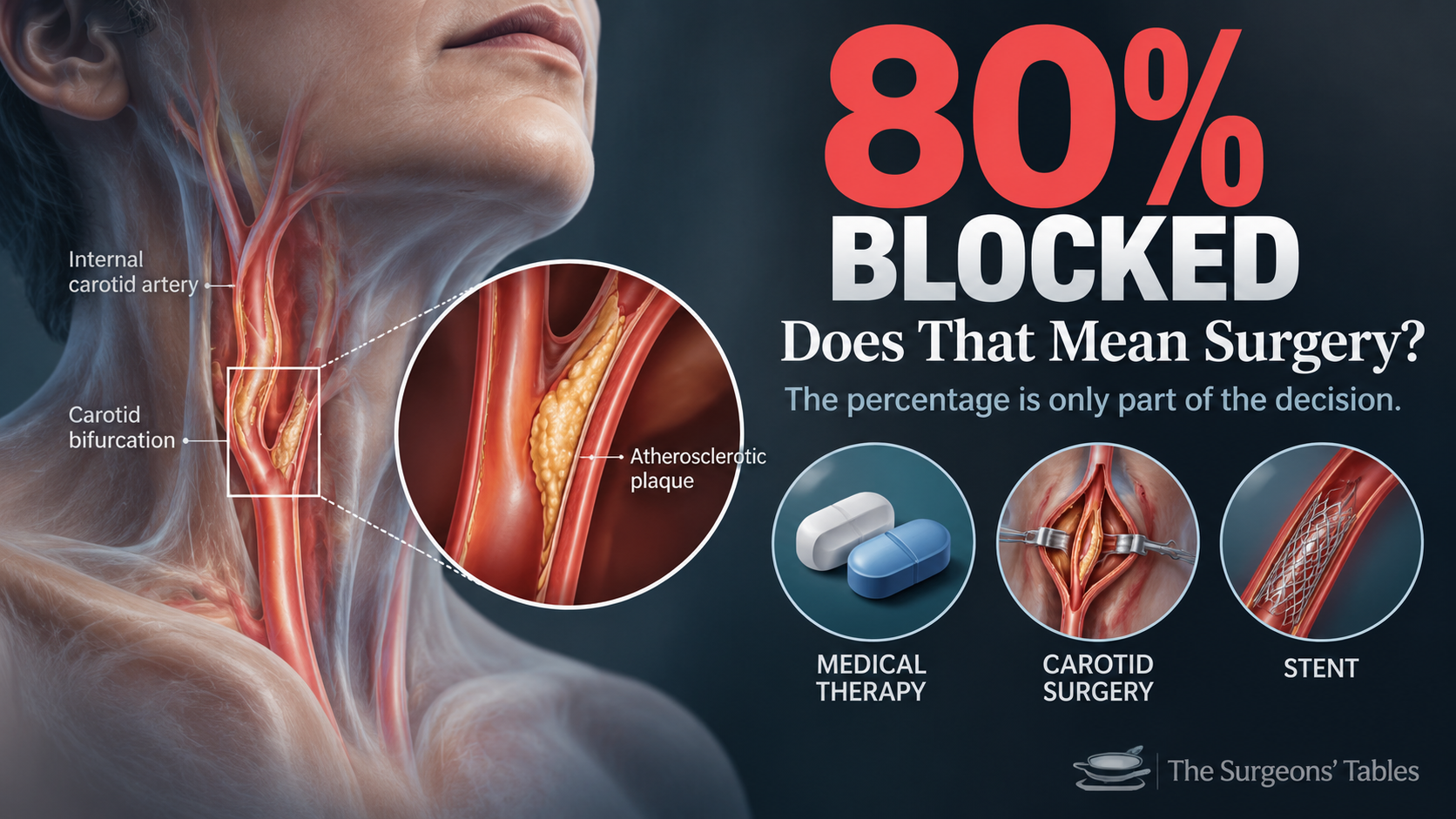
In my clinic, patients who have no symptoms often ask, “Could I suddenly have a stroke? Does this need to be fixed right now?” An ultrasound report showing severe narrowing can make someone who feels well suddenly feel unsafe. These are usually the first concerns we need to discuss.
An ultrasound report can show approximately 80% carotid stenosis even when you have had no weakness, speech problems, or stroke. The finding deserves careful assessment, but the number alone does not determine treatment.
For someone who has never had a stroke, transient ischemic attack (TIA), or temporary loss of vision from that artery, the decision depends on the likelihood that the plaque will cause a stroke and whether a preventive procedure can reduce that risk enough to justify its own risks.
Am I really asymptomatic?
This is the first question because it can completely change the treatment pathway.
In carotid disease, being “asymptomatic” does not merely mean you feel normal today.
Think back carefully. Have you recently had sudden:
- weakness or numbness on one side of the body,
- facial drooping,
- trouble speaking or understanding speech, or
- painless dimming or loss of vision in one eye?
Even if the episode lasted only a few minutes and disappeared completely, it may have been a TIA.
A patient with symptoms related to the carotid artery is not managed in the same way as someone whose stenosis was discovered incidentally.
So before debating medications versus surgery, the treating team needs to establish something surprisingly basic:
Was this stenosis truly asymptomatic?
New sudden neurologic symptoms should be treated as an emergency, not saved for the next routine vascular appointment.
How certain are we that it is really 80%?
This is another question patients often do not realize matters.
Carotid duplex ultrasound does not simply measure the artery with a ruler. It uses blood-flow velocities together with ultrasound findings to estimate the severity of narrowing.
That estimate is very useful, but it can be affected by laboratory criteria, calcification, anatomy, technique, and other vascular conditions.
That means an ultrasound report saying “80%” should not always be treated as an isolated absolute number when a preventive operation is being considered.
A vascular specialist may review the duplex images and velocity measurements themselves. In some cases, CT angiography or MR angiography is used to clarify the anatomy.
Before accepting the risk of a preventive procedure, make sure the disease is truly as severe as the number suggests.
Does progression since an earlier scan matter?
Yes.
A stable severe stenosis and a stenosis that has clearly worsened over time may not carry the same level of concern.
Progression does not automatically mean that surgery is required. But it is one of the pieces of information physicians may use when judging whether a plaque appears to be behaving more aggressively. (1)
That is why an old ultrasound can be surprisingly useful.
Instead of looking at one report in isolation, a specialist may ask:
Was this 60% two years ago and now 80%, or has it remained essentially unchanged for years?
The trend can matter almost as much as the snapshot.
Does 80% blocked mean a stroke could happen at any moment?
Not necessarily.
I sometimes explain that a narrowed hose can still let water through: an artery can be severely narrowed without causing noticeable symptoms. I also use a road analogy. If the main highway is narrowed but the alternate roads remain open, traffic may still reach its destination. Well-developed collateral circulation can similarly help maintain blood flow to the brain. That helps explain why the percentage alone does not tell the whole story, although it does not eliminate the risk of a clot or plaque material traveling to the brain.
Many strokes related to carotid atherosclerosis occur when material from an unstable plaque or associated clot travels downstream into an artery in the brain. The brain also has collateral circulation – alternative pathways that may help maintain blood flow.
That is why two people can both have an “80% stenosis” yet not necessarily have the same future stroke risk.
The percentage tells us how narrow the artery is.
It does not tell us everything about how dangerous the plaque is behaving.
Can imaging tell whether my plaque is more dangerous?
Sometimes – but not perfectly.
To explain why two similar percentages can lead to different discussions, I sometimes compare rock with mud. The amount of material is only part of the picture; how easily it breaks away also matters. This is a simplified analogy, but it helps explain why I look beyond the percentage and examine the plaque’s characteristics on imaging.
Some findings associated with higher future stroke risk include:
Intraplaque hemorrhage. Specialized MRI can detect bleeding within the carotid plaque.
Plaque ulceration or irregularity. The surface of the plaque may appear disrupted rather than smooth.
Silent brain infarction. Brain imaging may show evidence of a previous embolic event even though the patient never recognized a stroke.
Microembolic signals. Transcranial Doppler can sometimes detect tiny embolic signals traveling toward the brain.
Progression of stenosis. Disease that is clearly worsening over time may increase concern. (1)
But there is an important limitation.
We do not currently have one universally accepted “dangerous plaque score” that tells doctors:
Score above X = operate. Score below X = medication only.
These findings add context. They do not replace clinical judgment.
That is why two patients with the same 80% stenosis can reasonably receive different recommendations.
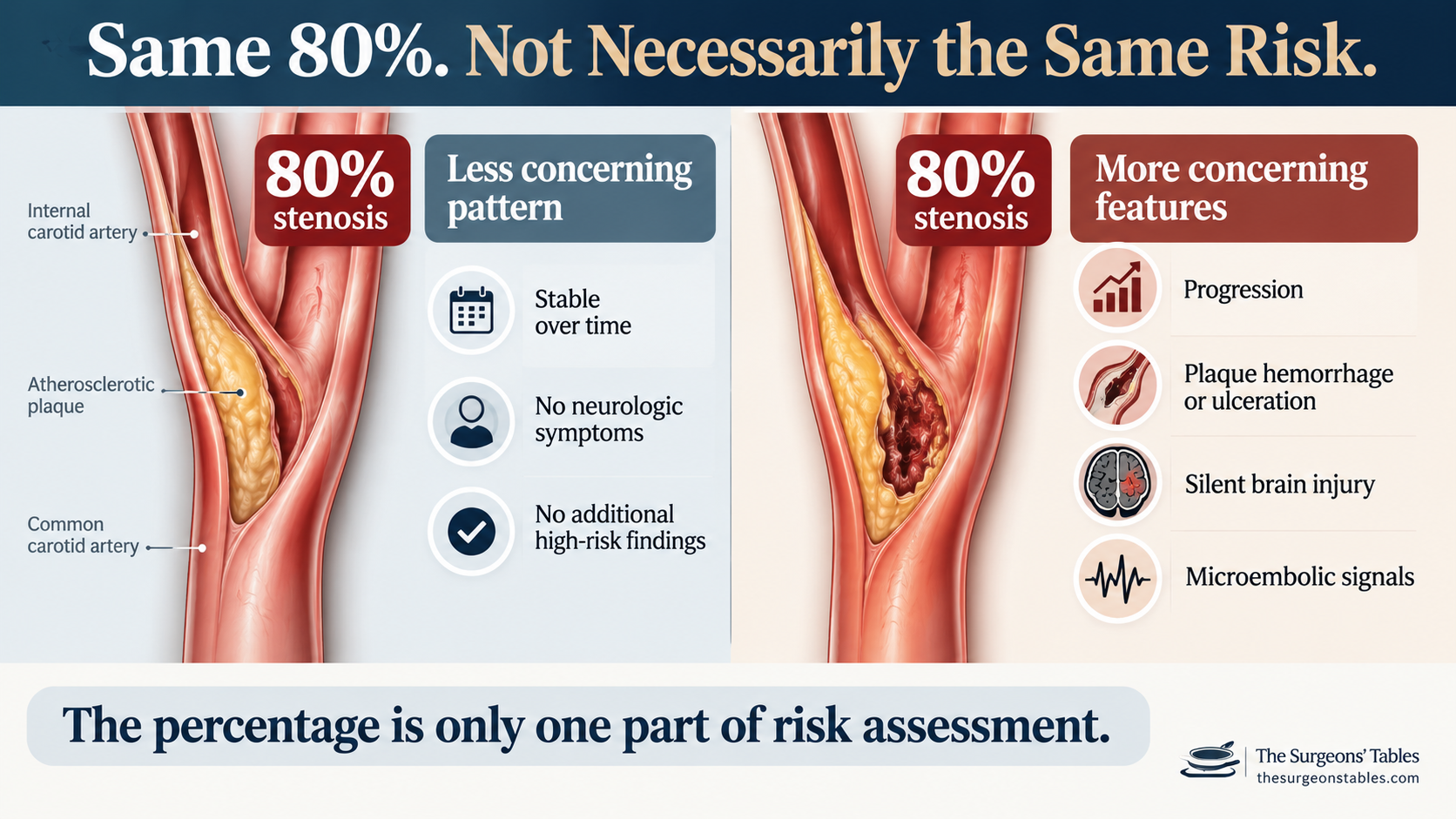
Two people can both have an 80% carotid stenosis and still have very different reasons for – or against – a preventive procedure.
When is intensive medical therapy alone a reasonable choice?
This is where the discussion has changed dramatically compared with 30 years ago.
Older carotid trials were performed when cholesterol treatment, blood-pressure management, smoking cessation, and broader cardiovascular prevention were much less effective than they are today.
Modern treatment is not “waiting for the artery to get worse.”
It is active stroke prevention.
Depending on the patient, intensive medical management may include:
- aggressive LDL cholesterol reduction,
- good blood-pressure control,
- appropriate antiplatelet therapy,
- diabetes management when needed,
- smoking cessation,
- exercise and dietary measures, and
- broader cardiovascular risk reduction.
Medication usually does not make an 80% plaque disappear.
That is not the goal.
The goal is to reduce the chance that the plaque becomes unstable, forms thrombus, or sends embolic material toward the brain.
And this treatment remains necessary even if carotid endarterectomy or stenting is ultimately performed.
An operation treats one carotid plaque. Atherosclerosis is a disease of the entire vascular system.
So when might a procedure be better than medical therapy alone?
A preventive carotid procedure becomes more attractive when the expected long-term reduction in stroke risk is large enough to outweigh the immediate risk of the intervention.
That calculation depends on more than stenosis percentage.
Doctors may lean more strongly toward revascularization when several factors line up:
- the stenosis is confirmed to be genuinely severe,
- the patient’s expected lifespan is long enough to realize a preventive benefit,
- the procedural risk is very low,
- the anatomy is suitable,
- the treating center has excellent documented outcomes, and
- the overall clinical or imaging picture suggests enough future stroke risk to justify intervention.
This is also why professional guidelines do not all sound identical.
Society for Vascular Surgery guidance supports carotid endarterectomy with best medical therapy in appropriately selected low-surgical-risk patients with asymptomatic stenosis greater than 70%, provided the expected perioperative stroke and death risk is sufficiently low and life expectancy is adequate. (2)
European Society for Vascular Surgery guidance takes a more selective approach in many asymptomatic patients, emphasizing additional clinical or imaging features associated with a higher future stroke risk before preventive intervention is considered. (1)
These approaches are not as contradictory as they first appear.
They are asking slightly different versions of the same question:
How much additional benefit will this particular patient gain from intervention now that medical treatment has improved?
What did CREST-2 change?
CREST-2 was designed specifically around the modern treatment dilemma in severe asymptomatic carotid stenosis. (3)
It consisted of two parallel randomized trials.
One compared carotid stenting plus intensive medical management with intensive medical management alone.
The other compared carotid endarterectomy plus intensive medical management with intensive medical management alone.
At four years, the primary outcome occurred in 2.8% of the stenting group versus 6.0% of its medical-management group. (3)
In the separate endarterectomy trial, the corresponding rates were 3.7% with CEA plus intensive medical management versus 5.3% with intensive medical management alone. That difference did not reach statistical significance. (3)
There are two mistakes to avoid when interpreting this.
The first is:
“CREST-2 proved stents are better than surgery.”
It did not. Stenting and CEA were tested in separate trials against their own medical-treatment control groups. They were not randomized directly against each other in CREST-2.
The second mistake is:
“CREST-2 proved CEA no longer helps.”
It did not establish that either.
The larger message is more useful to patients:
Preventive procedures now have to prove their value against much better medical therapy than existed when the original carotid surgery trials were performed.
If I need a procedure, why CEA, TCAR, or transfemoral stenting?
Once the decision has been made that revascularization is worthwhile, there is a second decision:
How should it be done?
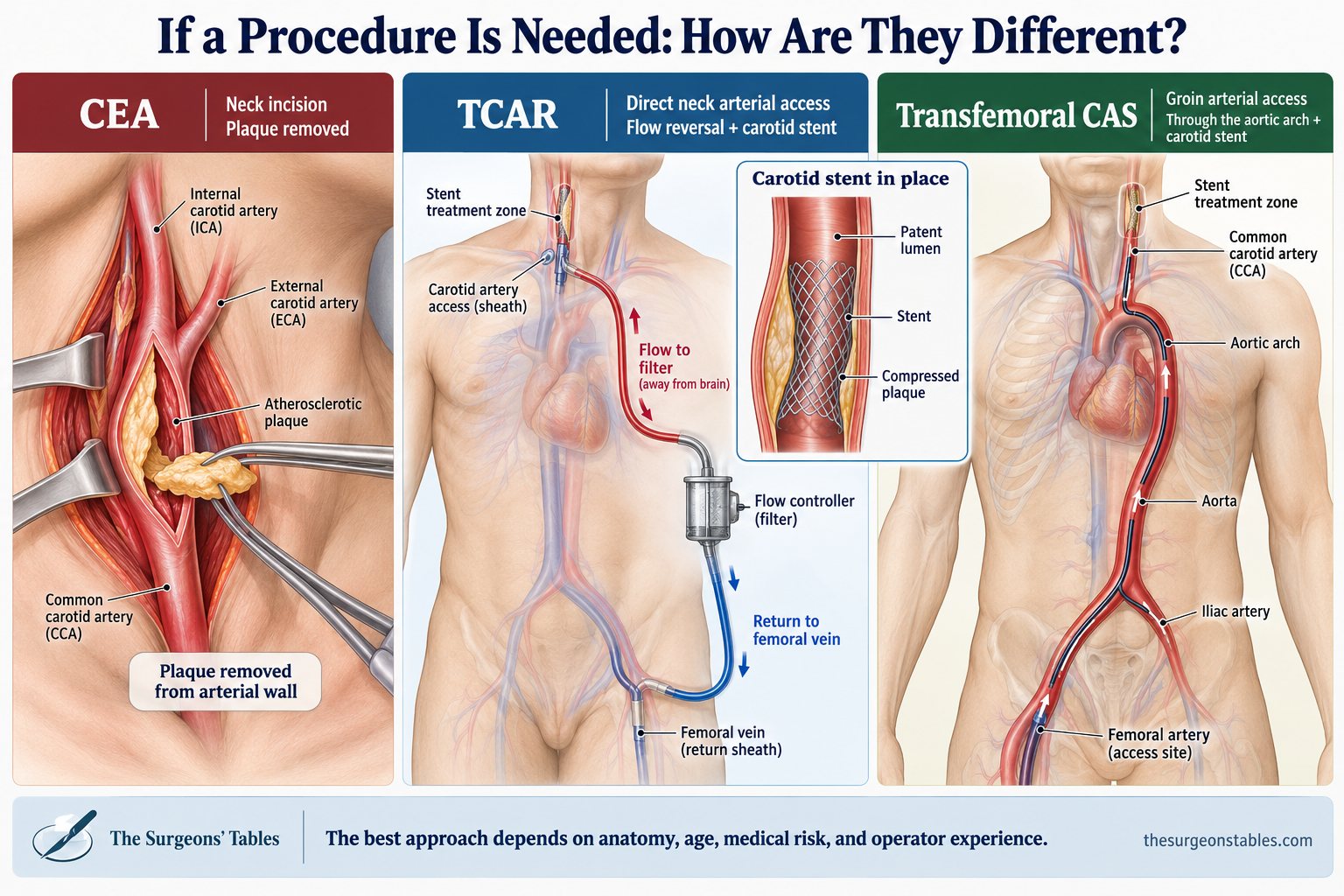
CEA: remove the plaque
Carotid endarterectomy, or CEA, is an open operation through an incision in the neck.
The surgeon opens the carotid artery and physically removes the atherosclerotic plaque.
CEA has the longest clinical history and extensive evidence behind it.
Its tradeoffs include the neck incision, wound complications, and the possibility of injury to nearby cranial nerves.
TCAR: direct neck access, flow reversal, and a stent
TCAR also treats the carotid lesion with a stent, but the route is different.
The common carotid artery is accessed through a small incision near the base of the neck.
During the protected portion of the procedure, blood is redirected from the carotid artery through an external filtering system and returned through a femoral vein while the carotid stent is placed.
The important distinction is that TCAR avoids navigating treatment devices through the aortic arch.
That can be useful when arch anatomy makes transfemoral access less attractive.
Observational registry data have also shown low stroke rates and lower cranial nerve injury rates than CEA in selected populations, but those data should not be interpreted as proving that TCAR is universally superior to CEA. (4)
Transfemoral carotid stenting: reach the carotid through the aortic arch
Traditional transfemoral carotid artery stenting usually starts from an artery in the groin.
The catheter travels through the iliac arteries and aorta, around the aortic arch, and then into the carotid artery, where a stent is deployed.
That avoids an open neck operation.
But the route through the aortic arch matters.
In an older patient with marked calcification or tortuous arch vessels, manipulating catheters through that anatomy may increase embolic risk.
So “a stent is less invasive” does not automatically mean “a stent is safer.”
| Procedure | What it does | What may influence the choice |
|---|---|---|
| CEA | Neck incision; the artery is opened and the plaque is physically removed. | Long evidence base, surgical anatomy, overall operative risk, and cranial nerve or wound considerations. |
| TCAR | Direct carotid access through a small lower-neck incision; filtered flow reversal is used during the protected portion of stent placement. | Aortic arch anatomy, prior neck procedures or radiation, surgical risk, carotid anatomy, and center experience. |
| Transfemoral CAS | Groin arterial access; devices travel through the aorta and aortic arch to place a carotid stent. | Need to avoid open neck surgery, age, arch tortuosity, calcification, vascular anatomy, and operator experience. |
Which procedure is best for me?
There is no universal winner.
A surgeon thinks about several things simultaneously.
| Factor | Why it matters |
|---|---|
| Age | The balance between open surgery and stenting can change with age and vascular anatomy. |
| Aortic arch anatomy | Especially important when considering transfemoral carotid stenting. |
| Previous neck surgery or radiation | May make conventional open surgery technically more difficult. |
| Carotid lesion anatomy | Determines whether a particular surgical or stenting approach is technically suitable. |
| Heart and lung risk | Can affect tolerance of surgery and influence the risk-benefit calculation. |
| Cranial nerve considerations | Particularly relevant to open carotid surgery. |
| Life expectancy | Preventive benefit takes time to accumulate. |
| Operator and center outcomes | A small increase in procedural stroke or death risk can erase much of the expected preventive benefit. |
Ask which approach offers the lowest overall stroke and procedural risk for your anatomy and health. A newer technique is not necessarily the best fit.
Why should I ask about the hospital’s 30-day stroke and death rate?
Because this is preventive treatment.
You walk into the hospital without a stroke.
Any stroke caused by the procedure itself therefore counts heavily against the benefit you hope to gain years later.
Society for Vascular Surgery guidance states that the perioperative stroke and death risk for asymptomatic carotid intervention must remain below 3% for the procedure to retain its expected benefit. (2)
European guidance similarly uses a less-than-3% perioperative stroke/death threshold when revascularization is considered in selected asymptomatic patients and emphasizes sufficient life expectancy to realize a longer-term benefit. (1)
That threshold is not an administrative detail.
It is part of the mathematics of whether preventive treatment helps.
Imagine two hospitals performing the same procedure. If one has an exceptionally low complication rate and another has a substantially higher one, the same procedure may offer a different net benefit.
So asking:
“What is your actual 30-day stroke and death rate for asymptomatic carotid patients like me?”
is not rude.
It is one of the most clinically important questions you can ask.
What if my neurologist says medication and my vascular surgeon recommends surgery?
Do not reduce the disagreement to:
“Which doctor is right?”
Ask what each doctor believes your future stroke risk is without a procedure, and why.
The vascular surgeon may be giving more weight to severe anatomy, progression, plaque characteristics, life expectancy, technical suitability, and a very low procedural risk.
The neurologist may be giving more weight to the improved outcomes achievable with contemporary medical therapy.
Both can be interpreting legitimate evidence.
What you need is the reasoning connecting the evidence to your specific case.
A particularly useful question is:
“What is it about my case – beyond the 80% number – that makes a procedure better for me than intensive medical therapy alone?”
If the answer is specific and individualized, you are having the right conversation.
If the only answer is:
“Because it is 80% blocked,”
there is still more to discuss.
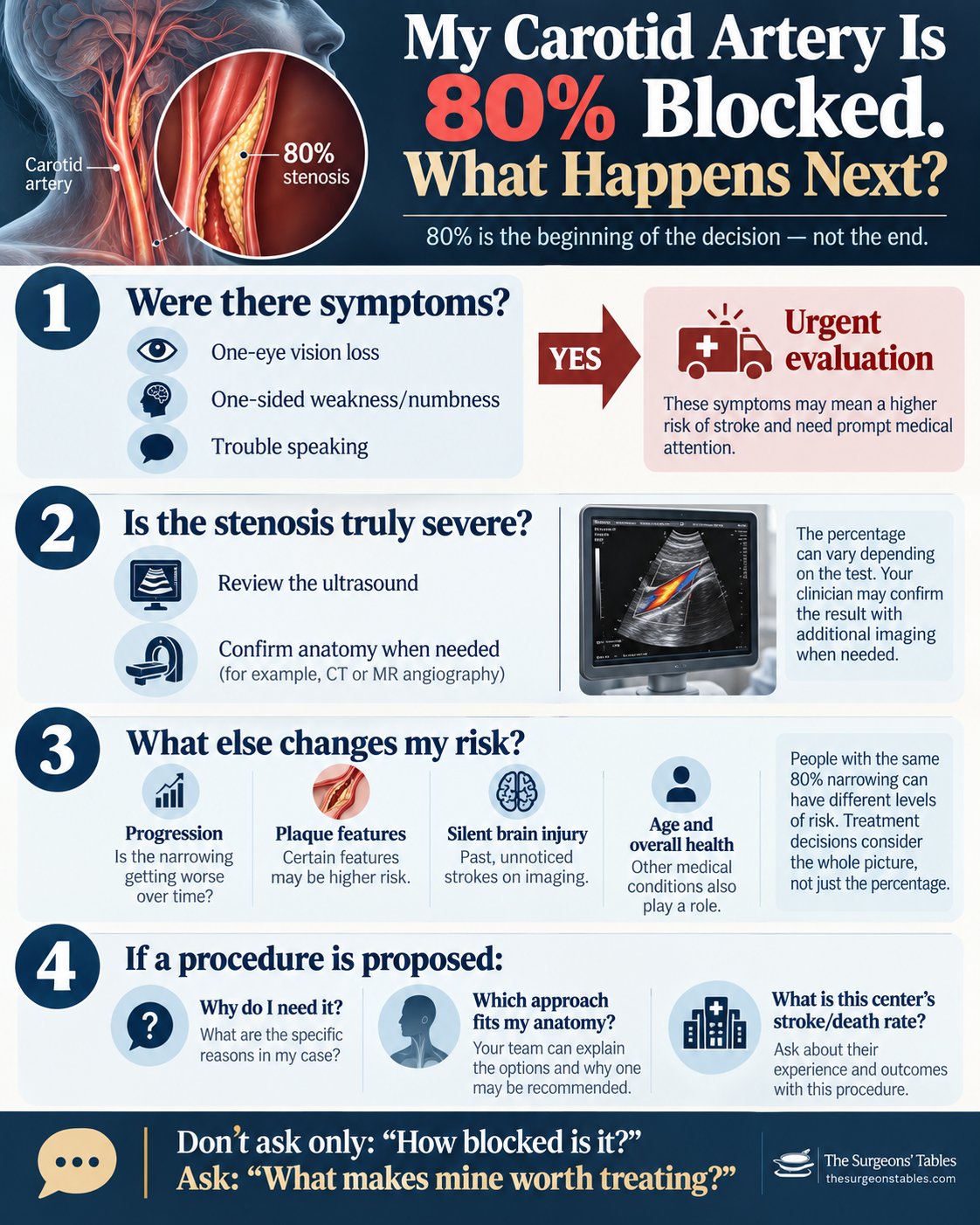
What should I do after an asymptomatic 80% result?
You do not need to choose CEA, TCAR, or a stent from an internet diagram.
You need to establish the sequence of decisions correctly.
- First: confirm whether you are truly asymptomatic.
- Second: make sure the stenosis is genuinely severe.
- Third: look at the bigger risk picture, including progression, plaque characteristics, brain imaging when relevant, age, overall health, anatomy, and life expectancy.
- Fourth: optimize medical treatment regardless of whether a procedure is ultimately chosen.
- Fifth: decide whether intervention adds enough benefit to justify its immediate risk.
- Only then: decide which procedure, if any, fits you best.
One last point: should everyone be screened for carotid blockage?
No.
The U.S. Preventive Services Task Force recommends against screening the general asymptomatic adult population for carotid artery stenosis because the potential harms of screening and the downstream cascade can outweigh the benefits. (5)
That recommendation is different from deciding what to do after a severe stenosis has already been found for a clinically appropriate reason.
Once an 80% stenosis is known, the question is no longer whether to screen.
It is how to interpret the finding correctly and whether intervention adds enough benefit for that particular patient.
Making the Carotid Treatment Decision
An asymptomatic 80% carotid stenosis is not something to ignore.
But it is also not a diagnosis that automatically means:
“You need surgery now.”
The percentage tells you how narrow the artery is.
The treatment decision also depends on whether you have actually had symptoms, whether the measurement is reliable, whether the disease is progressing, whether the plaque has additional concerning features, how healthy you are, how long you are likely to benefit, and how safely the proposed procedure can be performed.
The most useful question is therefore not simply:
“How blocked is my artery?”
It is:
“What makes my particular carotid plaque worth treating with a procedure – and if it is, which procedure gives me the best balance of benefit and risk?”
If you develop sudden one-eye vision loss, facial drooping, one-sided weakness or numbness, or difficulty speaking, seek emergency medical evaluation.
References
- (1) Naylor R, Rantner B, Ancetti S, et al. European Society for Vascular Surgery 2023 Clinical Practice Guidelines on the Management of Atherosclerotic Carotid and Vertebral Artery Disease. Eur J Vasc Endovasc Surg. 2023;65(1):7-111. DOI | PubMed
- (2) AbuRahma AF, Avgerinos ED, Chang RW, et al. Society for Vascular Surgery clinical practice guidelines for management of extracranial cerebrovascular disease. J Vasc Surg. 2022;75(1S):4S-22S. DOI | PubMed
- (3) Brott TG, Howard G, Lal BK, et al. Medical Management and Revascularization for Asymptomatic Carotid Stenosis. N Engl J Med. DOI | PubMed
- (4) Malas MB, Dakour-Aridi H, Kashyap VS, et al. In-hospital outcomes of transcarotid artery revascularization and carotid endarterectomy in the Society for Vascular Surgery Vascular Quality Initiative. J Vasc Surg. 2020;71(1):87-95. DOI | PubMed
- (5) US Preventive Services Task Force. Screening for Asymptomatic Carotid Artery Stenosis: US Preventive Services Task Force Recommendation Statement. JAMA. 2021;325(5):487-489. DOI | PubMed | USPSTF Recommendation
- (6) Reiff T, Eckstein HH, Mansmann U, et al; SPACE-2 Investigators. Carotid endarterectomy or stenting or best medical treatment alone for moderate-to-severe asymptomatic carotid artery stenosis: 5-year results of a multicentre, randomised controlled trial. Lancet Neurol. 2022;21(10):877-888. DOI | PubMed