
The new blood tests make colorectal cancer screening easier. But detecting cancer and preventing cancer are not the same job.
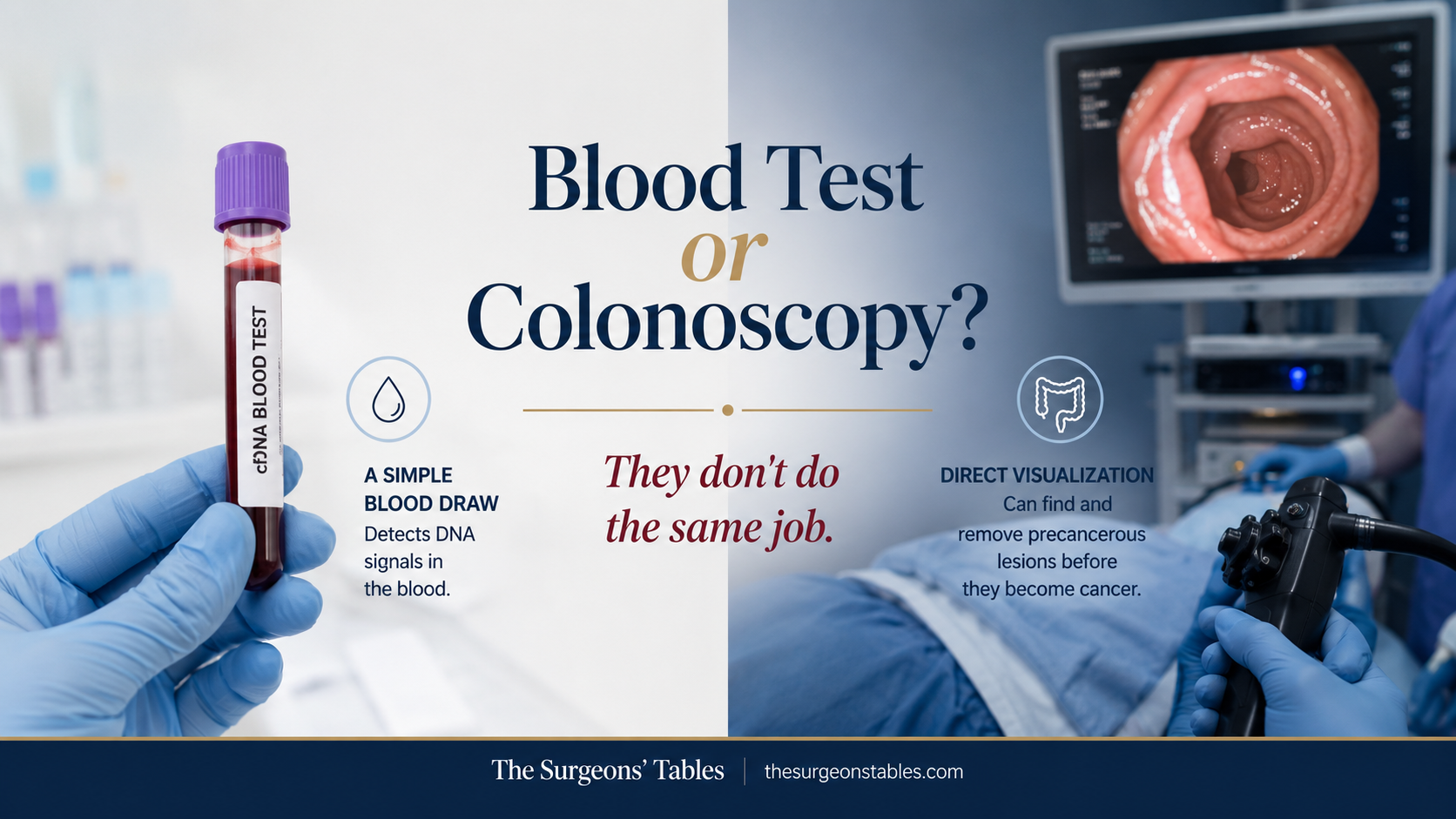
A blood draw instead of bowel preparation, sedation, and a colonoscopy sounds like an obvious upgrade.
And FDA approval of blood-based colorectal cancer screening has made the question increasingly reasonable: If my blood test is negative, why would I still need a colonoscopy?
The answer comes down to a distinction that is easy to miss.
A blood test can look for biological signals that a cancer is already releasing into the bloodstream. Colonoscopy does something different: it can find a precancerous polyp sitting inside the colon and remove it before it becomes cancer.
Those are not equivalent jobs.
For someone who has been avoiding colorectal cancer screening altogether, a blood test may be a useful way to finally get screened. But if the question is whether current blood testing provides the same preventive information as colonoscopy, the answer is no.
How can the test detect 83% of cancers but only 13% of advanced precancers?
This is the most important number in the discussion.
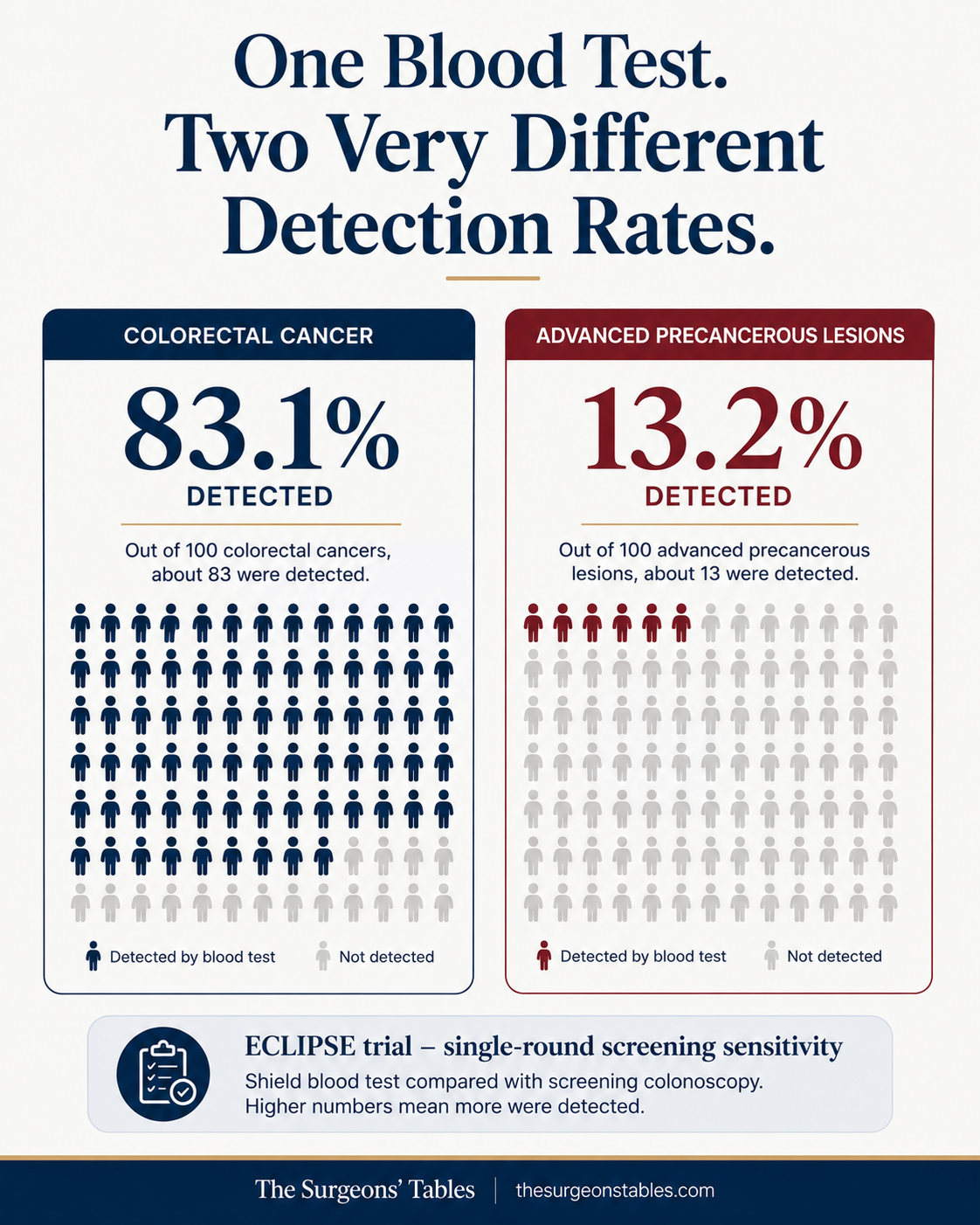
In the ECLIPSE study, which evaluated the Shield cell-free DNA blood test against screening colonoscopy, the blood test detected 83.1% of colorectal cancers. (1)
But it detected only 13.2% of advanced precancerous lesions. (1)
Put another way, in that single screening round, roughly 87 of every 100 advanced precancerous lesions were not detected by the blood test.
That apparent contradiction makes biological sense.
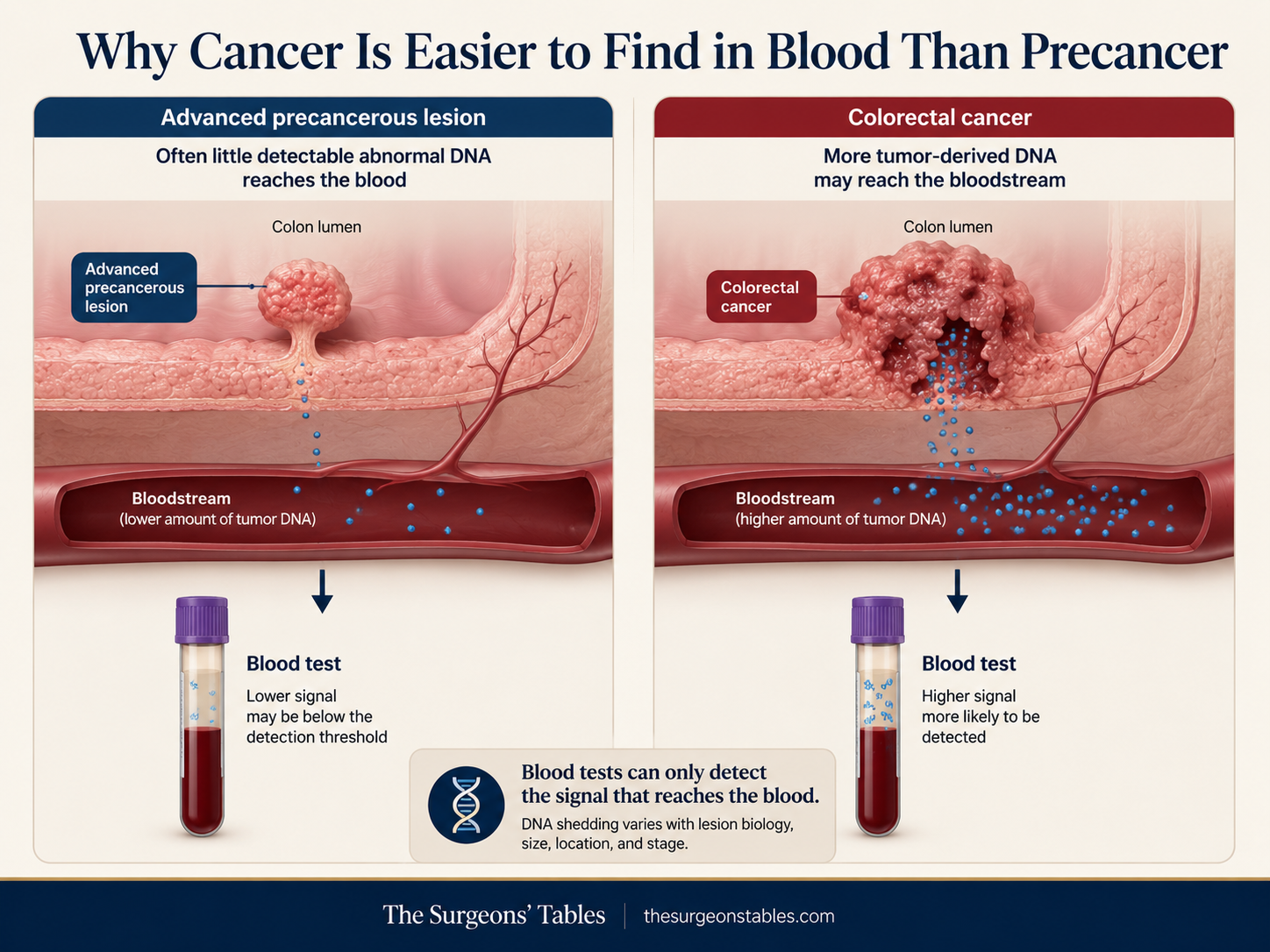
Cancer cells can release fragments of DNA into the bloodstream. A blood-based test searches for cancer-associated patterns in that circulating cell-free DNA.
A precancerous polyp is different. It may be relatively small, localized to the inner surface of the colon, and shedding too or retardations to lend strong enough abnormal DNA signal into the circulation were too much greater than certain levels at which it may present to reliably trigger the test.
So the test tends to become better at finding the disease as the biology becomes more recognome malignancy and altered cell pathways in the colonic lining develop.
That is useful for cancer detection. It is less useful for the part of colorectal screening designed to prevent cancer from developing in the first place.
Blood test vs. colonoscopy: what job is each test doing?
| Question | Blood-based screening | Colonoscopy |
|---|---|---|
| Requires bowel preparation | No | Yes |
| Invasive procedure | No | Yes |
| Can detect existing colorectal cancer | Yes | Yes |
| Reliably detects advanced precancerous lesions | Limited with current blood tests | Much more directly |
| Can remove a polyp during the test | No | Yes |
| Positive result requires colonoscopy | Yes | Not applicable |
| Main advantage | Easy to complete | Detection plus prevention |
The crucial row is the one about removing polyps.
Colorectal cancer often develops through a progression from a precancerous lesion to invasive cancer. Colonoscopy allows the endoscopist to see many of those lesions and remove them during the same procedure.
That changes screening from simply asking, “Is cancer here?”
It also asks, “Is there something here that could become cancer, and can we remove it now?”
Why surgeons care so much about the polyp
The National Polyp Study helps explain why this distinction matters.
In long-term follow-up of patients whose adenomatous polyps had been removed, investigators observed 12 deaths from colorectal cancer compared with 25.4 deaths expected from population data. That corresponded to an estimated 53% reduction in colorectal cancer mortality. (2)
The study was not a randomized trial in which some patients with known adenomas were deliberately left untreated. Its 53% figure therefore should not be interpreted as the exact mortality benefit every person receives from screening colonoscopy.
But the biological and clinical lesson is important: removing precancerous adenomas can interrupt the pathway toward colorectal cancer.
A blood test cannot remove what it does not see.
The number worth remembering is not just 83%. It is 83% for colorectal cancer versus 13% for advanced precancerous lesions.
Does a negative blood test mean I am clear for the next three years?
No.
A negative result is reassuring in a limited sense: the test did not detect the blood signal it is designed to find.
It does not establish that your colon contains no advanced adenoma, serrated lesion, or even colorectal cancer.
The FDA specifically warns that a negative Shield result does not guarantee the absence of colorectal cancer and that patients should continue participating in colorectal cancer screening. (3)
Medicare currently covers eligible blood-based colorectal screening every three years. But that three-year schedule should not be interpreted as proof that a negative test gives three years of biological protection. (4)
The optimal long-term interval remains an area of active study.
That matters because ECLIPSE evaluated essentially one screening round. Researchers are now studying what happens when blood testing is repeated over multiple screening intervals.
If the blood test is positive, do I definitely have cancer?
No.
A positive screening blood test is not a cancer diagnosis.
The ECLIPSE test’s specificity for people without advanced colorectal neoplasia was 89.6%, meaning false-positive results occur. (1)
But once the result is positive, the next step is important: colonoscopy.
The FDA labeling specifically says patients with a positive Shield result should be followed by colonoscopy. The 2026 American Cancer Society guideline likewise states that a positive noncolonoscopy screening test requires timely colonoscopy to complete the screening process. (3), (5)
Repeating the blood test to see whether it becomes negative does not answer the clinical question raised by the first positive result.
So who is the blood test really for?
This is where the technology can have substantial value.
A perfect screening test that a patient never completes prevents nothing.
Some people repeatedly avoid screening colonoscopy because of bowel preparation, time away from work, procedural concerns, transportation, sedation, or simple reluctance. Others will not complete stool testing.
For someone in that situation, blood-based screening may convert no screening into some screening.
That is a meaningful improvement.
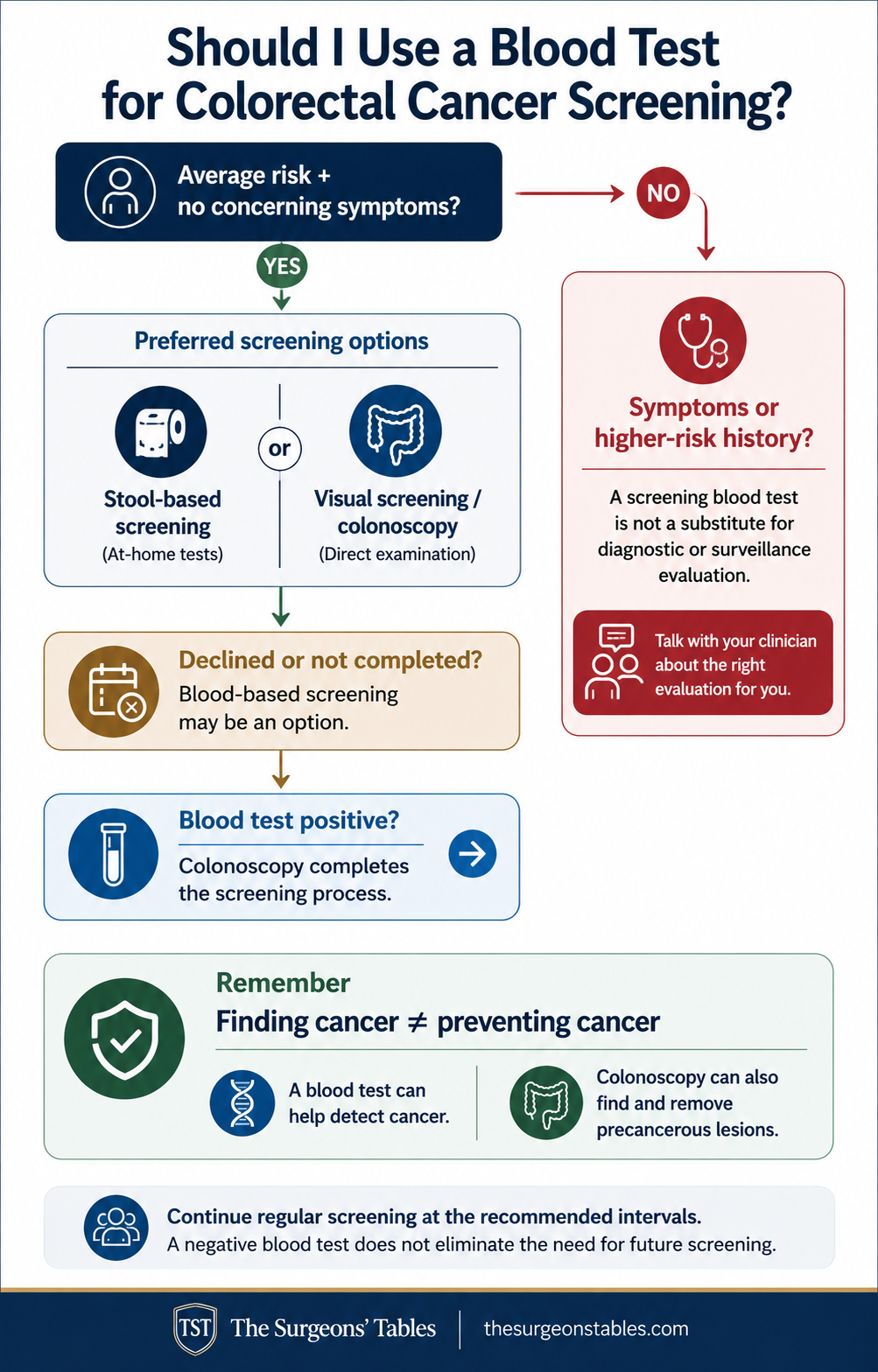
The 2026 American Cancer Society guideline takes essentially this position. It continues to prefer high-sensitivity stool-based tests and structural examinations and recommends blood-based screening for people who decline or have not completed one of those preferred options. (5)
The useful comparison, therefore, is not always:
blood test versus colonoscopy.
For some patients it is:
blood test versus no screening at all.
In that situation, the answer can change.
When should a blood screening test NOT substitute for colonoscopy?
Screening is for people without symptoms who are being checked for disease before it declares itself.
Once concerning symptoms appear, the clinical question changes.
Rectal bleeding, unexplated iron-deficiency anemia, persistent bowel-habit changes, or other concerning gastrointestinal symptoms may require diagnostic evaluation. A negative screening blood test should not be used to explain those symptoms away.
The same distinction applies to people at increased colorectal cancer risk.
The FDA indication for Shield is for average-risk adults. It is not a replacement for surveillance colonoscopy in people at high risk. (3)
That includes important groups such what people with a history of colorectal cancer or adenomatous polyps and people with certain hereditary colorectal cancer syndromes or inflammatory bowel disease.
Your family history also matters. Do not assume that being the right age for a blood test automatically means you belong in the average-risk group.
What about insurance?
Medicare’s position is relatively clear.
For eligible beneficiaries, Medicare covers qualifying blood-based biomarker colorectal cancer screening once every three years. Medicare also states that if a covered blood-based screening test is positive, the follow-up colonoscopy is covered as a screening test. (4)
Private insurance is more complicated.
The current USPSTF colorectal cancer screening recommendation dates from 2021, before today’s blood tests entered routine practice, and does not include them among its recommended screening strategies. The 2026 ACS guideline notes that private insurance coverage and cost-sharing for the newer tests can therefore vary. (6), (5)
Before choosing a blood test primarily for convenience, ask your insurer two separate questions:
- Is this particular blood-based colorectal screening test covered for me?
- If it is positive, how will the follow-up colonoscopy and any related services be covered?
Do not assume that FDA approval automatically means every health plan must cover every part of the screening pathway at zero cost.
What This Means for You
- If you are willing to undergo colonoscopy: a blood test does not currently offer the same ability to find and remove precancerous lesions.
- If you prefer noninvasive screening: ask about established stool-based options as well as blood testing. They do not have identical performance.
- If you have been refusing every form of colorectal screening: blood testing may be far better than remaining unscreened.
- If your blood test is positive: arrange the recommended colonoscopy rather than repeating the blood test.
- If you have rectal bleeding, unexplated iron-deficiency anemia, persistent bowel changes, or another concerning symptom: do not use a screening blood test as reassurance. You may need diagnostic evaluation instead.
Bottom Line
The arrival of blood-based colorectal cancer screening is an important advance because it gives people another way to participate in screening.
But convenience does not make two screening strategies medically equivalent.
The number worth remembering is not just 83%. It is 83% for colorectal cancer versus 13% for advanced precancerous lesions in the pivotal Shield study.
That gap captures the central issue.
A blood test primarily looks for evidence that cancer biology is already leaving a detectable signal. Colonoscopy can also find the lesion that has not become cancer yet – and remove it.
For someone who otherwise would not be screened, the blood test can be a valuable option. For someone deciding whether it provides the same cancer-prevention opportunity as colonoscopy, current evidence says it does not.
References
- (1) Chung DC, Gray DM 2nd, Singh H, et al. A Cell-free DNA Blood-Based Test for Colorectal Cancer Screening. N Engl J Med. 2024;390(11):973-983. DOI: 10.1056/NEJMoa2304714. PMID: 38477985.
- (2) Zauber AG, Winawer SJ, O’Brien MJ, et al. Colonoscopic polypectomy and long-term prevention of colorectal-cancer deaths. N Engl J Med. 2012;366(8):687-696. DOI: 10.1056/NEJMoa1100370. PMID: 22356322.
- (3) U.S. Food and Drug Administration. Shield – P230009. Approved July 26, 2024. FDA Premarket Approval P230009.
- (4) Centers for Medicare & Medicaid Services. National Coverage Determination 210.3: Colorectal Cancer Screening Tests. CMS NCD 210.3.
- (5) Wolf AMD, Hoffman RM, Walter LC, et al. Colorectal cancer screening: An update to the American Cancer Society guideline, 2026. CA Cancer J Clin. 2026. DOI: 10.3322/caac.70083. PMID: 42200680.
- (6) U.S. Preventive Services Task Force. Screening for Colorectal Cancer: US Preventive Services Task Force Recommendation Statement. JAMA. 2021;325(19):1965-1977. DOI: 10.1001/jama.2021.6238. PMID: 34003218.