
The biopsy says cancer. The next appointment is for drug treatment, not surgery. For some people with resectable, locally advanced stomach or gastroesophageal junction (GEJ) adenocarcinoma, treatment before surgery is part of a plan intended to cure the cancer. The tumor remains in place for now, but treatment has begun. The plan should include a date for reassessment and a route to surgery, not an open-ended wait. (1, 2)
This is not the sequence for every stomach cancer. Some early tumors can be removed first, sometimes through an endoscope. A person who is very ill, cannot eat or drink, or has a different tumor type may need another approach. The first question for your team is why your stage and condition favor treatment before an operation. (1)
What is the treatment doing before the surgeon operates?
Surgery removes the tumor and nearby lymph nodes that can be reached. It cannot remove cancer cells that may already be too small to see elsewhere. Systemic treatment travels through the body, and giving it before surgery begins that treatment while a patient has not yet had to recover from a major operation. It may also shrink the tumor. These are reasons for the sequence, not a claim that every person already has distant spread. (1, 3)
The evidence behind this approach developed in steps. An older randomized trial found better survival with chemotherapy before and after surgery than with surgery alone. A later trial found that the FLOT chemotherapy regimen produced better survival than an older perioperative regimen. Neither trial proved that the preoperative portion alone caused the benefit, but together they explain why immediate surgery followed by a promise to “do the drugs later” is not automatically equivalent to a planned treatment course around surgery. (3, 4)
Treatment after gastrectomy can be hard to complete. In the recent MATTERHORN trial, 61% of patients assigned to durvalumab plus FLOT completed the planned postoperative FLOT. That number does not mean the other 39% all had cancer progression, and it does not prove that starting with surgery would have been worse for any one patient. It does show why the team should plan both sides of the operation before the first treatment begins. (5)
Will the cancer spread while I wait for surgery?
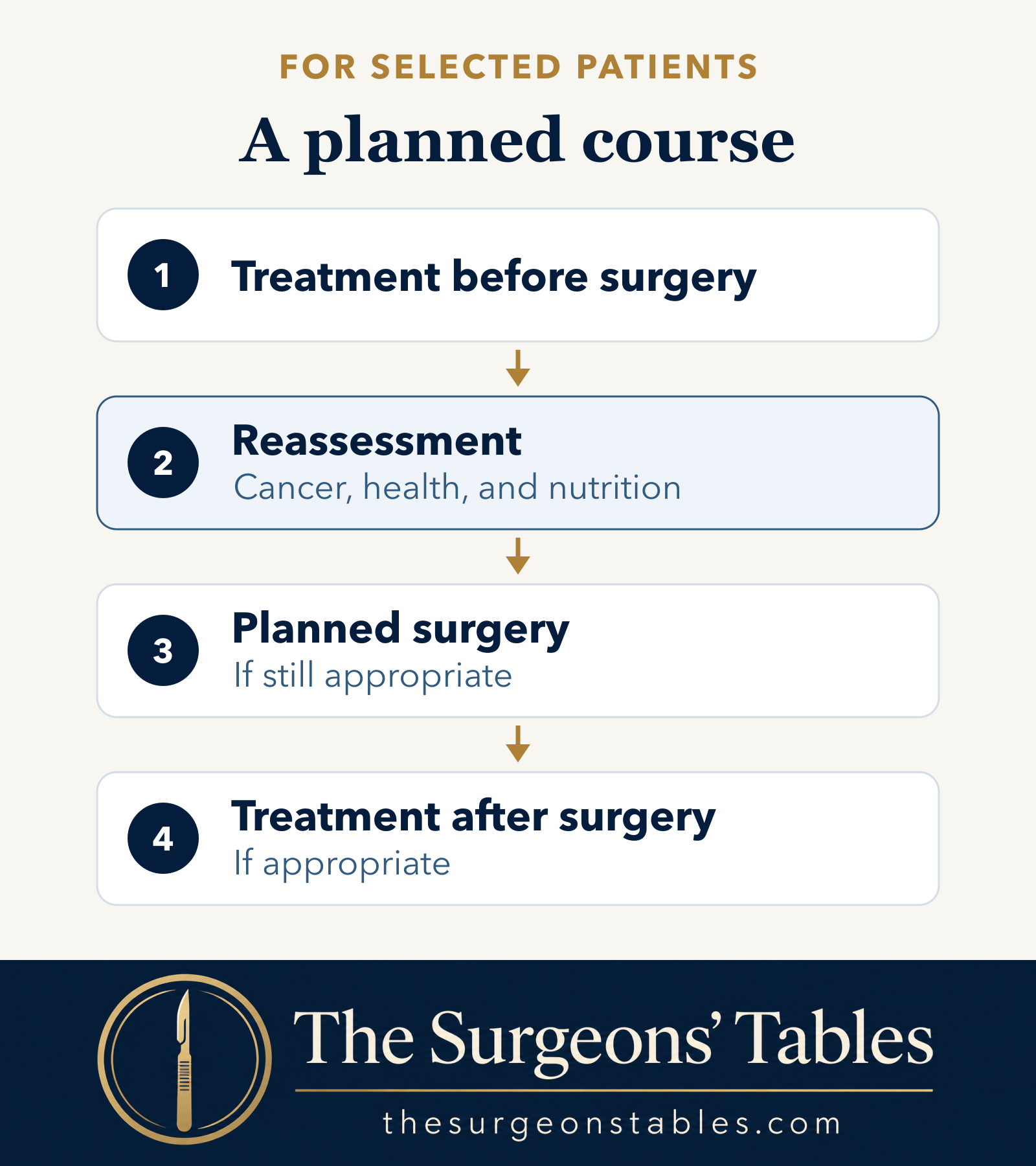
No trial can promise that a particular tumor will remain operable. The important distinction is between waiting without treatment and receiving a scheduled course of treatment before a planned operation.
MATTERHORN enrolled 948 adults with resectable stage II through selected stage IVA stomach or GEJ adenocarcinoma. Both groups received FLOT chemotherapy before and after a planned operation. One group also received durvalumab, an immunotherapy drug, before and after surgery and then as maintenance; the other received placebo. In the FDA’s analysis, 87% of patients assigned to durvalumab and 84% assigned to placebo completed surgery with curative intent. Those figures do not tell us that the remaining patients all progressed, and the study did not compare this plan with going straight to surgery. (5, 6)
Ask when your team will check the tumor again and what finding would change the operation date or the treatment. If eating becomes harder, vomiting increases, or your strength or weight falls, tell the team promptly. A schedule that made sense at diagnosis may need to be changed if your condition changes. (1, 5)
What did adding immunotherapy change?
The final overall survival analysis of MATTERHORN favored durvalumab plus FLOT over placebo plus FLOT: the hazard ratio for death was 0.78 (95% confidence interval, 0.63–0.96). This describes an estimated 22% lower relative hazard of death during follow-up, not a 22-percentage-point increase in survival and not a prediction for one person. The rate of pathological complete response—no viable cancer found by the trial’s pathology assessment after treatment—was 19.2% with durvalumab and 7.2% with placebo. Surgery was still planned in both groups, including for patients whose tumor appeared to respond very well. (2, 6)
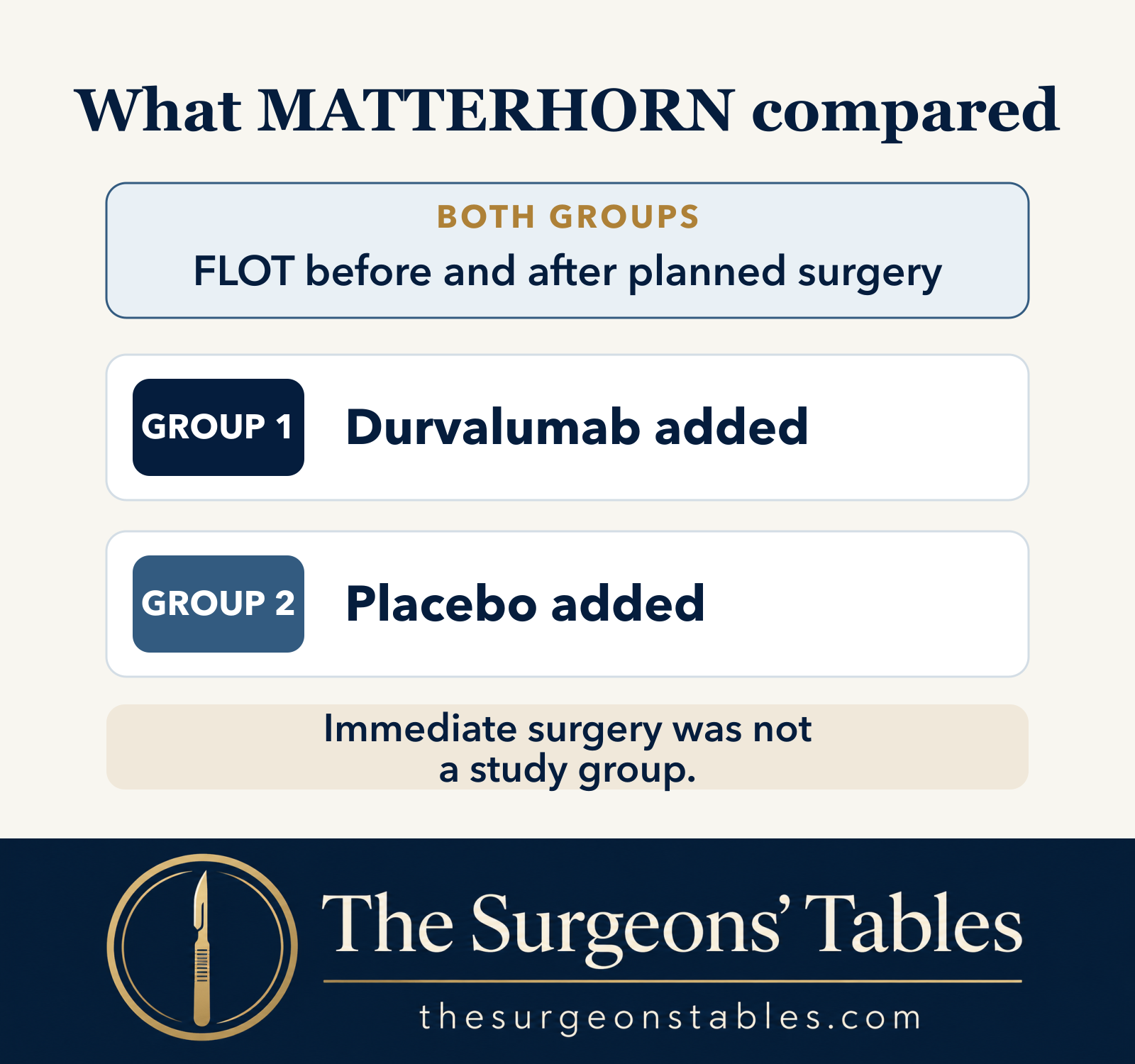
The FDA approved the durvalumab-plus-FLOT sequence in November 2025 for adults with resectable stomach or GEJ adenocarcinoma. The 2026 survival publication adds a fuller report of the trial; it is not a new approval. The trial tested the whole sequence. It cannot tell us how much of the survival advantage came from durvalumab before surgery rather than after it. (2, 6)
Does treatment first make the operation more dangerous?
It can cause problems that affect an operation or its timing. Chemotherapy can lower blood counts and cause diarrhea, fatigue, or neuropathy. Durvalumab can cause immune reactions in organs such as the lungs, bowel, liver, and hormone-producing glands. These risks need monitoring and sometimes require a change in treatment. In the final trial report, events leading to death that investigators considered possibly related to any trial treatment were reported in 6 of 475 people in the durvalumab safety group and 2 of 469 in the placebo safety group. Small numbers do not establish an individual’s risk, but they belong in the discussion of benefit and harm. (5, 6)
A 2026 MATTERHORN conference abstract reported serious events possibly related to surgery in 12.8% versus 13.0% of the two safety groups, and margin-clear (R0) resection in 91.5% versus 92.3% of those who completed surgery. The abstract did not show a large difference in these measures after adding durvalumab to FLOT. It did not prove identical surgical risk, and it did not compare treatment first with immediate surgery. The abstract also reported 90-day postoperative mortality of 3.1% versus 2.0%; that difference should not be erased by calling the outcomes “the same.” (7)
When should the plan change?
Before committing to a preoperative course, the team needs to know whether the cancer is truly resectable, whether there is distant spread, and whether you are strong enough for the proposed treatment. MATTERHORN enrolled people with good functional status and excluded some with autoimmune or inflammatory conditions or recent immune-suppressing medicines. Its average benefit cannot simply be assigned to someone outside that group. Early-stage disease, tumor biology, nutrition, other illnesses, and the exact location of a GEJ tumor can also change the plan. (1, 5)
New bleeding or an obstruction is a separate, immediate problem. If you vomit blood, pass black stools, cannot keep liquids down, or develop severe new abdominal pain, seek urgent medical assessment. The response may involve fluids, endoscopy, a procedure to relieve blockage or bleeding, or surgery, depending on what is happening; these symptoms do not automatically mean that an emergency gastrectomy is the right operation. During chemotherapy, a fever of 100.5°F (38°C) or higher or signs of infection warrant an urgent call to the treating team. (1, 8, 9)
At the next visit, ask for the plan in writing: What stage do I have? Why is treatment before surgery recommended for me? When will you reassess the cancer, and what would make you operate sooner or change course? Also ask which symptoms require an immediate call, and how your team will support nutrition during treatment. The point of starting with medicine is to improve the whole treatment plan, while keeping surgery and your ability to reach it firmly in view.
References
- National Cancer Institute. Gastric Cancer Treatment (PDQ®), Health Professional Version. “Treatment of Stages I–III Gastric Cancer,” especially stage I options and stages II–III treatment options, surgical resection and perioperative chemotherapy.
- U.S. Food and Drug Administration. FDA approves durvalumab for resectable gastric or gastroesophageal junction adenocarcinoma. November 25, 2025. Opening paragraph; “Efficacy and Safety.”
- Cunningham D, et al. Perioperative chemotherapy versus surgery alone for resectable gastroesophageal cancer. New England Journal of Medicine. 2006;355:11–20. doi:10.1056/NEJMoa055531. Abstract: Methods, Results, Conclusions. The regimen was ECF, not FLOT.
- Al-Batran S-E, et al. Perioperative FLOT versus ECF/ECX for resectable gastric or GEJ adenocarcinoma. The Lancet. 2019;393:1948–1957. doi:10.1016/S0140-6736(18)32557-1. Abstract: Methods and Findings. PMID 30982686.
- U.S. Food and Drug Administration. Imfinzi (durvalumab) prescribing information. 2026 label. Section 14.7, PDF pp. 83–85 (eligibility, dosing sequence, surgery completion and postoperative treatment); section 5 and gastric/GEJ safety section.
- Janjigian YY, et al. MATTERHORN final overall survival analysis. The Lancet. 2026;408:1114–1128. doi:10.1016/S0140-6736(26)01254-7. PubMed abstract: Methods, Findings, Interpretation, Funding. Abstract-level review; full publisher article was not accessible for this audit.
- Molena D, et al. Surgical journey for participants in MATTERHORN. Journal of Clinical Oncology. 2026;44(2 suppl):353. doi:10.1200/JCO.2026.44.2_suppl.353. Meeting abstract: Methods and Results; no full paper in this source.
- National Cancer Institute. Stomach Cancer Treatment by Stage. Section on relieving bleeding or blockage.
- National Cancer Institute. Infection and Neutropenia during Cancer Treatment. “Signs of infection” and “Call your health care team.”