
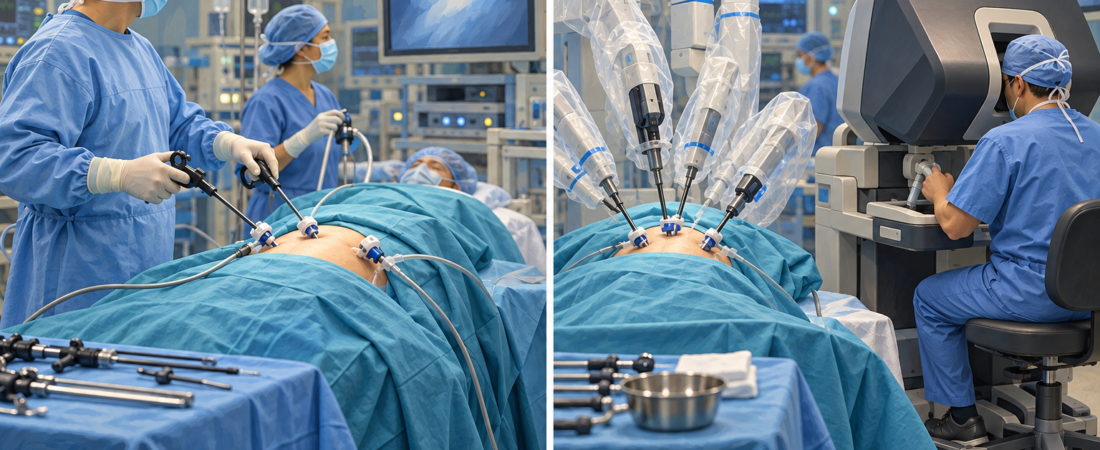
Both operations remove the gallbladder through small incisions. The important difference is not the robot’s name, but whether the approach fits your disease and your surgeon’s experience.
First, are we choosing an operation, or choosing the equipment?
Your surgeon recommends gallbladder removal. Then a second choice appears: standard laparoscopic surgery or robotic-assisted surgery. The newer option can sound like the safer one, especially when a hospital describes better vision and more precise instruments.
The practical answer: robotic surgery can be reasonable, but the evidence does not justify calling it better for everyone. Standard laparoscopy is not an outdated, large-incision operation. Both approaches are minimally invasive. The decision should rest on the difficulty of your gallbladder disease, the surgeon’s experience with each approach, and the outcomes that actually matter to you. (1), (2), (3), (4), (5), (6), (7)
This article assumes you and your team have already established a reason to remove the gallbladder. If your stones have never caused convincing symptoms, the first question may instead be whether you need surgery at all. See our separate article on silent gallstones.
What does the robot actually change?
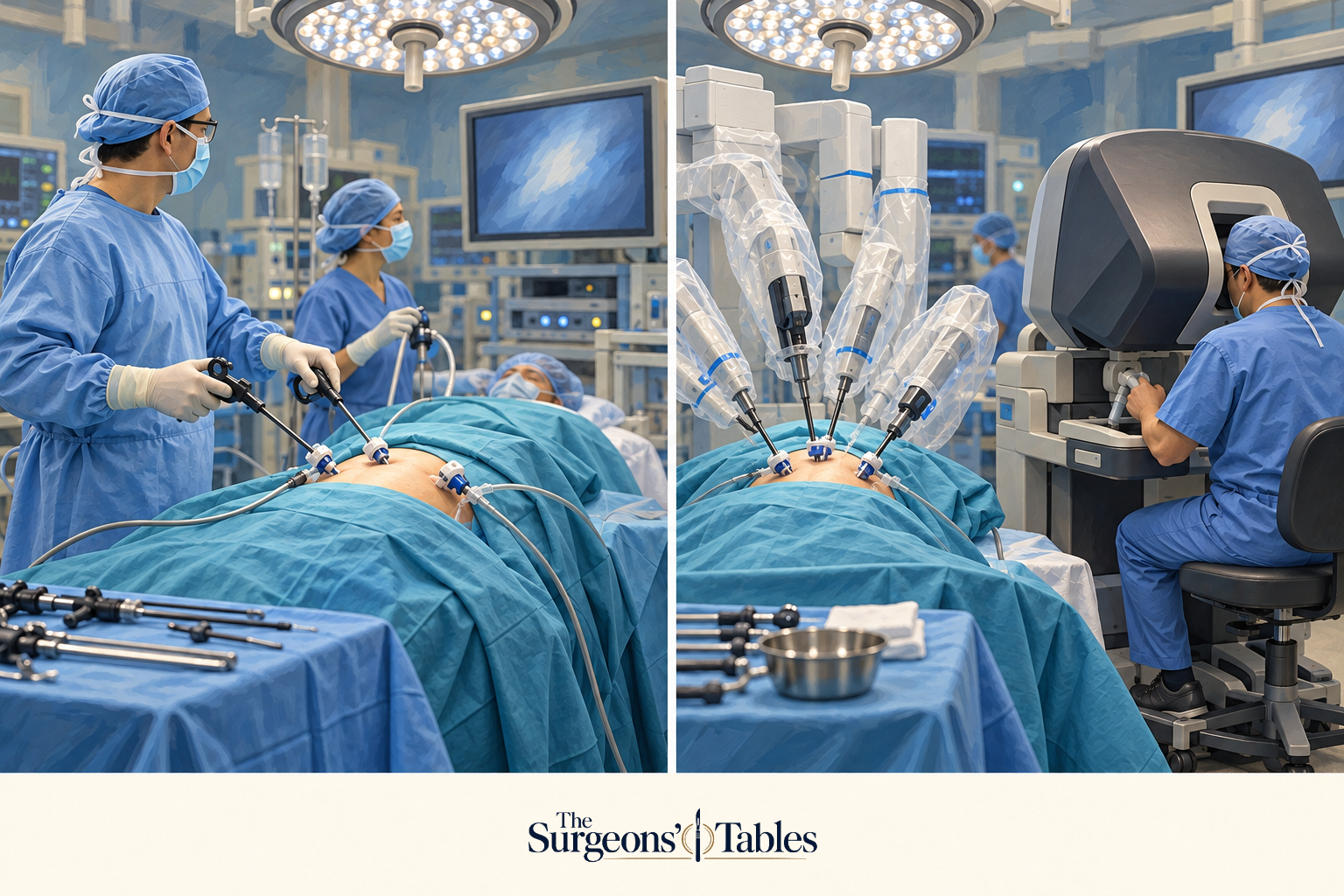
In standard laparoscopy, the surgeon directly moves long instruments through small abdominal incisions while watching a camera image. In robotic-assisted surgery, the surgeon controls instruments from a console, usually with a three-dimensional view and wristed instrument movement. The robot does not decide what to cut or perform the operation independently. (1)
Both approaches usually involve general anesthesia, inflating the abdomen with gas, identifying the gallbladder’s duct and artery, and removing the gallbladder. The number and size of incisions depend on the technique. “Robotic” does not automatically mean single-incision surgery, no scar, or a different organ being removed. (1), (11)
Laparoscopic, robotic, or open: what are the trade-offs?
Robotic-assisted surgery is another minimally invasive approach, not an operation performed independently by a machine. Open surgery remains an important option when it is the appropriate or safer route for the individual case.
| What matters | Conventional laparoscopy | Robotic-assisted laparoscopy | Open surgery |
|---|---|---|---|
| How it is done | The surgeon directly controls instruments through several small incisions. | The surgeon controls robotic instruments from a console, through small incisions. | The surgeon operates through a larger abdominal incision. |
| Main advantages | Established minimally invasive approach; smaller wounds and usually quicker recovery than open surgery. | Wristed instruments and a 3D view; possible benefits in selected complex cases with an experienced team. | Direct surgical access; an important option when a minimally invasive operation cannot safely proceed. |
| Main limitations | Instrument movement can be challenging in difficult anatomy or dense scarring. | Extra equipment and training; routine superiority over laparoscopy is not established. | Larger wound, usually more incisional discomfort and a longer recovery than minimally invasive surgery. |
| Safety evidence | Bile duct injury is uncommon but remains possible. Safe identification and a bailout plan still matter. | Large Medicare studies raise injury concerns; some newer specialist-center studies report benefits in selected cases. No universal safety advantage. | An open incision does not replace safe anatomical identification. Conversion is a safety option, not automatically a failure. |
| Hospital stay and recovery | Many uncomplicated patients go home the same day; recovery depends on the operation and the patient. | May allow early discharge, but consistently less pain or faster recovery than laparoscopy is not established. | Usually a longer hospital stay and recovery. Avoid treating any return-to-work date as a guarantee. |
| Cost and choice | Often lower operating-room costs than robotics. A well-established choice for many routine cases. | Often higher hospital costs; total costs may differ in complex cases. Ask what benefit is expected for you. | Cost depends on the illness, hospital stay and complications. May be planned or used after conversion. |
How to read this table: These are general trade-offs, not a ranking or a prediction of your personal risk. Patients selected for open surgery often have different or more difficult disease, so crude complication rates should not be compared as though the operations had been randomly assigned.
Sources: technique and recovery (1), (8), (11), (12); safety and difficult-case selection (2), (3), (4), (5), (6), (7), (9); hospital costs (6), (7). Hospital costs are not the same as your personal bill.
Why have headlines about safety pointed in opposite directions?
The complication that deserves particular attention is injury to the bile ducts, the channels that carry bile from the liver to the intestine. A small leak may be managed with drainage or an endoscopic procedure; a major injury can require complex reconstructive surgery. Counting these together, or counting only injuries requiring reconstruction, produces very different rates. (2), (5), (9)
A 2023 study of 1,026,088 Medicare beneficiaries aged 66-99 found that robotic surgery was associated with more bile duct injuries requiring definitive surgical reconstruction within one year: 0.7% versus 0.2% with laparoscopy. That is approximately 7 versus 2 per 1,000 in this study, not the predicted risk for every patient. A separate analysis designed to address unmeasured differences still found a higher robotic rate, although the difference was smaller. (2)
A 2025 analysis found that the concern was not confined to patients classified as high risk. But these are observational claims studies, not randomized assignments. Claims do not show every detail of inflammation, anatomy, surgeon judgment, or technical performance. (3) The 2023 and 2025 Medicare analyses use overlapping data, so they should not be counted as two fully independent patient populations.
Newer studies are important too. A 2026 Mayo Clinic cohort reported lower overall bile duct injury rates with robotic surgery, and a 2026 eight-hospital study of surgeons experienced in both techniques found fewer combined adverse outcomes with robotics, particularly in selected difficult cases. These findings cannot simply erase the national safety signal, but the national studies cannot prove that every experienced robotic team has worse outcomes either. (5), (7) A 2026 analysis using more contemporary Medicare data also reported a continuing bile duct injury concern, so it would be too simple to dismiss the entire signal as an early-adoption problem. (4)
What do the newer favorable studies actually show?
The Mayo study included 23,513 operations from 2014-2025. Overall bile duct injuries were reported in 23 of 3,515 robotic cases (0.65%) and 204 of 19,998 laparoscopic cases (1.02%). The analysis adjusted for disease severity and surgeon-related factors. This is encouraging, especially for acute cholecystitis, but it is a retrospective health-system study using a different injury definition from the Medicare reconstruction endpoint. Do not compare its percentages directly with the 2023 study as though they were the same test. (5)
In the eight-hospital study, 1,828 patients were treated in 2020-2021. Robotic surgery was associated with fewer adverse outcomes: 3.3% versus 8.7%. Crucially, that endpoint combined conversion to open surgery with major complications within 90 days. It was not a 3.3% versus 8.7% rate of bile duct injury. The apparent advantage depended on operative difficulty and body mass index; it did not establish a blanket benefit for routine, lower-risk patients. (7)
Another 2026 referral-center study found fewer unplanned endoscopic or radiology interventions after robotic surgery in a narrowly defined complex elective group, such as patients with a prior aborted operation or a gallbladder drainage tube. That is a useful reason for a specialist discussion, not a reason to label every elective gallbladder case complex. (6)
These favorable studies were also observational, so statistical adjustment cannot eliminate all differences between patients, surgeons, or treatment selection. (5), (6), (7)
| What you hear | What it does not prove |
|---|---|
| Fewer conversions to open surgery | Not automatically fewer major bile duct injuries. The reason for conversion and other complications matter. |
| Better visibility with fluorescent dye | Not a guarantee against injury, and not a feature limited to robotic surgery. |
| Higher hospital costs | Not the same as the extra amount you personally pay. Ask for your own estimate. |
| No statistically significant difference | Not proof that two operations have equal safety, especially for rare injuries. |
Will I have less pain or recover faster?
A technical advantage for the surgeon is not automatically a benefit you can feel. A systematic review of 44 studies found no detected differences in hospital stay, wound infection, or readmission, while operative time was usually longer with robotic surgery. Only four studies were randomized, and many comparisons also differed in incision technique. (8)
A later meta-analysis searching through August 2025 found fewer conversions with robotic surgery, but no statistically significant difference in major bile duct injury. The confidence interval for that injury estimate was wide, so “not statistically different” does not establish equal safety. It also predates the 2026 studies discussed above. (12)
Many uncomplicated laparoscopic patients already go home the same day. Inflammation, an unexpected complication, another illness, and the physical demands of your job may matter more than which instruments were used. Ask for a realistic recovery plan rather than a promise based on the word “robotic.” (11)
What matters more than the platform when the operation gets difficult?
A safe operation depends on recognizing anatomy before dividing structures. The multi-society safe cholecystectomy guideline suggests using the critical view of safety to identify the cystic duct and artery. This is a surgical identification method, not a technology brand, and the recommendation is based on expert opinion rather than randomized proof. (9)
If severe scarring prevents safe identification, the plan may need to change. Options can include additional imaging, calling for help, leaving part of the gallbladder behind in a subtotal operation, or changing the operative approach. The guideline specifically suggests considering subtotal removal rather than pursuing a total top-down removal when the critical view cannot be obtained and other methods cannot define the anatomy. Subtotal removal has its own risks, including bile leak and later biliary problems. (9)
Conversion to open surgery can therefore be a safety decision, not simply a failure. A lower conversion rate is useful only when it is not achieved by taking unsafe risks. Fluorescent dye imaging can help show anatomy, but it is not exclusive to robotics and does not replace careful dissection. Imaging choices also have different strengths; a fluorescence image is not the same examination as an X-ray cholangiogram. (9), (10) For laparoscopic gallbladder removal for benign biliary disease, the 2025 SAGES imaging guideline conditionally favors X-ray cholangiography over ICG fluorescence; that is a low-certainty recommendation, not proof that one method must be used in every patient. (10)
Does robotic surgery necessarily cost me more?
Hospital costs and your bill are not the same thing. In the eight-hospital 2026 study, robotic surgery had approximately $2,200-$2,400 higher variable encounter costs across risk groups. Those are health-system estimates, not a quoted price or extra copayment for you. (7)
Costs also depend on what is counted. In the complex-elective referral-center study, robotic operating-room costs were higher, but total hospital costs in the complex group were not significantly different. That finding does not establish equal costs for routine cases, other hospitals, or your insurance plan. (6)
Before deciding, request an estimate based on your actual procedure, facility, surgeon and anesthesia team, network status, deductible, and coinsurance. Ask whether the proposed approach changes your expected out-of-pocket amount. U.S. hospital cost figures should not be transplanted into Korean self-pay prices or coverage advice.
Before your consultation, gather these details
- Your actual diagnosis: repeated biliary attacks, acute inflammation, a prior drainage tube, a previous incomplete operation, or another reason for removal.
- Your ultrasound or CT report and any previous operative report, especially if surgery was stopped or only part of the gallbladder was removed.
- Your medication and supplement list, previous abdominal operations, and any new fever, jaundice, or worsening pain.
- Your priorities: avoiding complications, returning to a particular job, recovery support at home, and the amount you may need to pay.
When should symptoms take priority over shopping for a platform?
Persistent or worsening upper abdominal pain, fever, yellowing of the eyes or skin, or repeated vomiting needs prompt medical assessment, whether you are awaiting surgery or recovering from it. Contact your surgical team urgently after an operation if these develop. Severe or rapidly worsening abdominal pain, fainting, confusion, breathing difficulty, or rapid deterioration warrants emergency assessment. Do not delay urgent evaluation while trying to arrange a preferred robot or hospital. (11)
Bottom Line
Robotic gallbladder surgery is a tool, not a guarantee. Standard laparoscopy remains a well-established option, while selected complex cases may benefit from a robotic approach in experienced hands. Large national studies still raise an important bile duct injury concern, and the newer favorable studies do not settle the question for every patient.
Choose the plan that best fits your disease and the team’s demonstrated experience. The most useful question is not “Is the robot newer?” It is “What benefit should I expect in my case, and how will you keep the operation safe if things are harder than expected?”
References
- MedlinePlus. Robotic surgery. Medical Encyclopedia. Accessed October 27, 2026. Original source
- Kalata S, Thumma JR, Norton EC, Dimick JB, Sheetz KH. Comparative Safety of Robotic-Assisted vs Laparoscopic Cholecystectomy. JAMA Surg. 2023;158(12):1303-1310. Original source doi:10.1001/jamasurg.2023.4389
- Mullens CL, Sheskey S, Thumma JR, Dimick JB, Norton EC, Sheetz KH. Patient Complexity and Bile Duct Injury After Robotic-Assisted vs Laparoscopic Cholecystectomy. JAMA Netw Open. 2025;8(3):e251705. Original source doi:10.1001/jamanetworkopen.2025.1705
- Mullens CL, Lee EY, Thumma JR, Dimick JB, Sheetz KH. Comparative Safety of Robotic-Assisted vs Laparoscopic Cholecystectomy in Contemporary Practice. JAMA Surg. 2026;161(7):748-750. Published online May 27, 2026. Original source doi:10.1001/jamasurg.2026.1585
- Kandil O, Rehman N, Saleeb A, et al. Robotic vs Laparoscopic Cholecystectomy: Preoperative and Intraoperative Severity-Adjusted Outcomes with Strasberg-Classified Bile Duct Injury. J Am Coll Surg. Published online August 7, 2026. Original source doi:10.1097/XCS.0000000000002118
- Caldwell KE, Threlkeld E, Litrel J, et al. Outcomes and Costs After Robotic vs Laparoscopic Complex Elective Cholecystectomy. JAMA Surg. 2026;161(9):909-915. Original source doi:10.1001/jamasurg.2026.2650
- Chopra A, El Asmar R, Hodges JC, et al. Comparative Analysis of Robotic and Laparoscopic Cholecystectomy. JAMA Surg. Published online September 16, 2026. Original source doi:10.1001/jamasurg.2026.4128
- Shenoy R, Mederos MA, Ye L, et al. Intraoperative and postoperative outcomes of robot-assisted cholecystectomy: a systematic review. Syst Rev. 2021;10:124. Original source doi:10.1186/s13643-021-01673-x
- Brunt LM, Deziel DJ, Telem DA, et al. Safe Cholecystectomy Multi-Society Practice Guideline and State of the Art Consensus Conference on Prevention of Bile Duct Injury During Cholecystectomy. SAGES; 2020. Original source
- Kumar SK, Shehata DG, Cetrulo LN, et al. SAGES guidelines for the use of intraoperative imaging of the common bile duct. Surg Endosc. 2025;39(11):7091-7102. Original source doi:10.1007/s00464-025-12142-0
- American College of Surgeons. Cholecystectomy. Patient education. Updated 2024. Accessed October 27, 2026. Original source
- Qadri M, Habib E, Ghawas AA, et al. Clinical outcomes of laparoscopic versus robotic cholecystectomy approaches: a systematic review and GRADE assessment meta-analysis. J Robot Surg. Published online December 8, 2025;20(1):61. Original source doi:10.1007/s11701-025-03022-9