
Bright red blood is often caused by hemorrhoids or an anal fissure. But your age and the color of the blood cannot prove where it came from. The important question is whether the source has actually been identified—and whether the bleeding behaves the way a benign problem should.
You are 29, or 34, or 41. You have a bowel movement, wipe, and see a streak of bright red blood. Maybe there is a little blood in the bowl.
A search online produces two completely different messages: “It is probably hemorrhoids” and “rectal bleeding can be colon cancer.” Both statements can be true.
The useful question is not simply, “How red is the blood?” It is whether a believable source has actually been identified, whether other warning features are present, and whether the bleeding stops and stays stopped when that source is treated.
Does bright red blood usually mean hemorrhoids?
Often, it does point toward a source close to the anus or lower rectum. Blood that appears on the toilet paper, drips into the bowl after a bowel movement, or streaks the outside of a formed stool is commonly seen with hemorrhoids or an anal fissure. Internal hemorrhoids often bleed without much pain. A fissure more commonly causes sharp pain during or after passing stool.
But the pattern only gives a clue. Rectal tumors can also bleed bright red. Inflammatory bowel disease, proctitis, polyps, infections, and other colorectal conditions can produce visible bleeding as well.
That is why a proper evaluation usually begins with a history and an actual anorectal examination. The 2024 American Society of Colon and Rectal Surgeons guideline recommends inspection and digital rectal examination; anoscopy can be used to inspect internal hemorrhoids and other anal-canal disease. (1)
| What you notice | What it may suggest |
|---|---|
| A small streak of bright red blood on the paper or outside the stool | Often an outlet source such as hemorrhoids or a fissure, particularly after constipation or straining. It does not prove the diagnosis. |
| Blood repeatedly mixed with stool, mucus, or a persistent change in bowel habits | Makes disease inside the rectum or colon more important to consider. |
| Black, sticky, tar-like stool | More often points to bleeding higher in the gastrointestinal tract and requires a different evaluation. |
| Large-volume red or maroon bleeding with fainting, marked weakness, or dizziness | May represent significant gastrointestinal bleeding and warrants urgent evaluation. |
If my doctor sees a hemorrhoid, am I done?
Not necessarily.
This is an important clinical point that gets missed because hemorrhoids are so common: a hemorrhoid can be real without being the entire explanation for the bleeding.
The next question a colorectal surgeon asks is whether the finding actually fits the story.
Suppose a 27-year-old develops a small streak of blood after several hard bowel movements. Examination shows a fissure. There is no anemia, no meaningful family history, and no other bowel symptoms. The constipation is treated, the fissure heals, and the bleeding disappears.
That is a very different situation from a 39-year-old who has recurring bleeding for months despite treatment for hemorrhoids.
ASCRS guidance specifically recommends further investigation when no obvious anorectal source is seen, when concerning abdominal symptoms accompany the bleeding, or when hematochezia continues after otherwise successful hemorrhoid treatment. (1)
So a hemorrhoid does not automatically mean you need a colonoscopy. But it also does not automatically mean you do not need one.
How worried should I be about colorectal cancer in my 20s or 30s?
The answer needs proportion. Colorectal cancer in a person in their 20s or 30s remains much less common than hemorrhoids or fissures. One episode of bright red blood does not mean you have cancer.
At the same time, age can no longer be used as a reason to ignore a persistent colorectal symptom.
In U.S. mortality data through 2023, colorectal cancer rose to become the leading cause of cancer death among people younger than 50 when males and females were considered together. Colorectal-cancer mortality in this age group increased by an average of 1.1% per year beginning in 2005. (2)
That population trend should not be used to frighten an individual patient. It does explain why persistent bleeding deserves more attention than it sometimes received in the past.
A 2024 systematic review and meta-analysis involving 81 studies found that visible rectal bleeding, or hematochezia, occurred in about 45% of people ultimately diagnosed with early-onset colorectal cancer. In studies measuring the association, hematochezia was associated with at least a fivefold greater likelihood of early-onset colorectal cancer. Diagnostic delays of roughly four to six months were common. (3)
Those numbers do not mean that 45% of young people with rectal bleeding have cancer, or that seeing blood gives an individual person a fivefold absolute chance of cancer. They tell us that rectal bleeding is a symptom clinicians should take seriously in younger adults.
When does a colonoscopy become more important?
There is no single rule based only on age. The decision becomes clearer when you look at whether the bleeding has a convincing benign explanation, whether it resolves, and whether other findings raise the probability of colorectal disease.
| Situation | Why it changes the decision | What may come next |
|---|---|---|
| Clear fissure or hemorrhoidal source, low-risk history, symptoms resolve | The examination and clinical course agree with a benign outlet source. | Treatment and follow-up may be reasonable without immediate full colonoscopy. |
| No definite source is found | The bleeding remains unexplained. | Endoscopic evaluation becomes more important. |
| Bleeding continues or returns after successful hemorrhoid treatment | The assumed diagnosis no longer explains the clinical course. | Further investigation rather than repeated hemorrhoid treatment. |
| Iron deficiency or otherwise unexplained anemia | Raises concern for chronic gastrointestinal blood loss. | Diagnostic gastrointestinal evaluation. |
| Persistent bowel-habit change, abdominal symptoms, unexplained weight loss, or a mass | Multiple findings make a simple anorectal explanation less convincing. | Prompt diagnostic evaluation, often colonoscopy. |
| Strong family history, hereditary cancer syndrome, or inflammatory bowel disease | Baseline colorectal-cancer risk is higher. | Earlier and often more complete colon evaluation. |
Bright red blood is a clue—not a diagnosis
Blood color can suggest that bleeding is coming from the lower gastrointestinal tract, but it cannot tell you whether the cause is a hemorrhoid, fissure, inflammation, polyp, cancer, or something else.
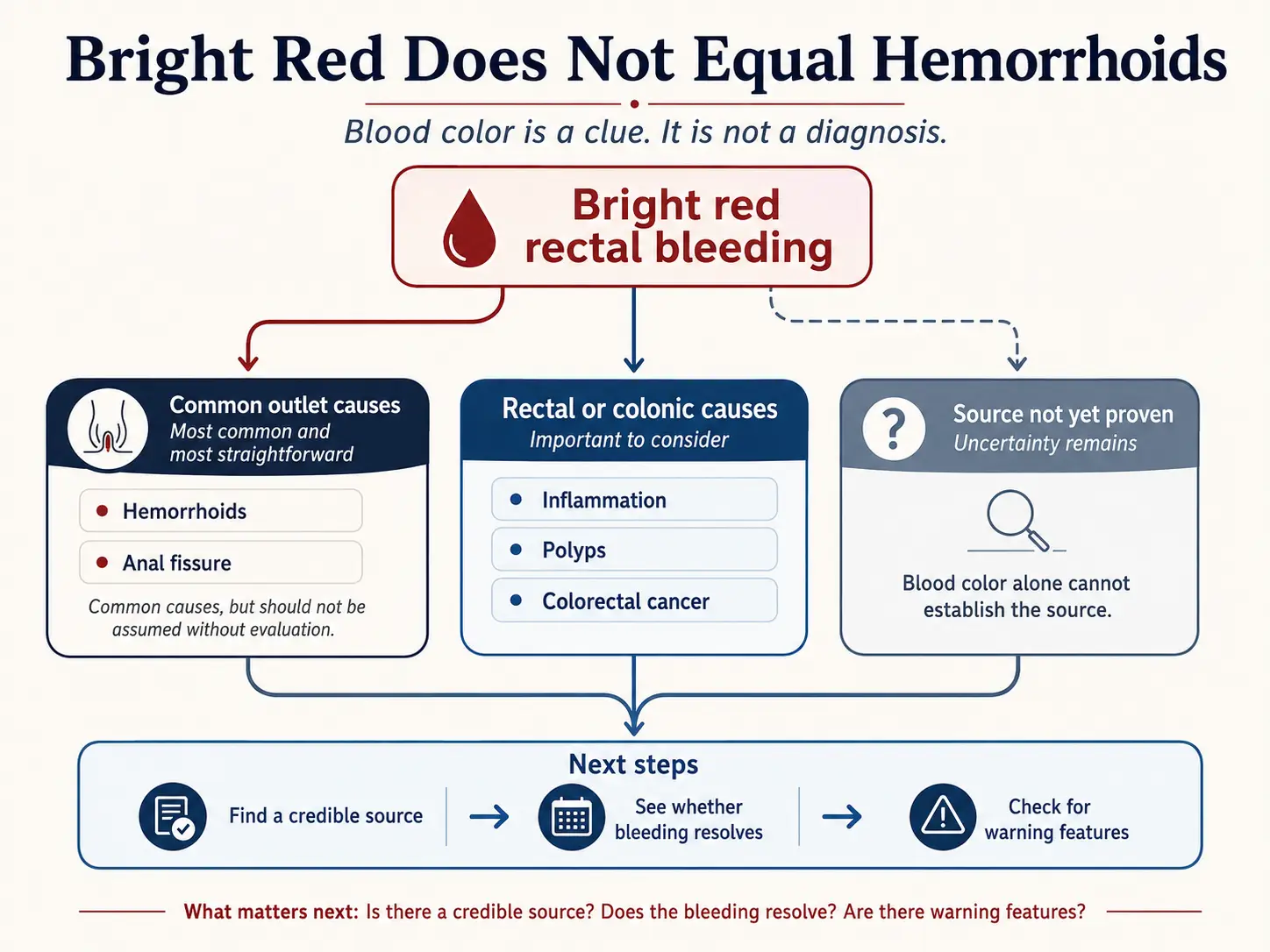
The more useful clinical question is whether a credible source has been identified. If a fissure or hemorrhoid clearly fits the bleeding pattern and the bleeding disappears when that problem heals, the clinical story becomes more reassuring.
If the bleeding persists or comes back, the story has changed. Continued bleeding after treatment is a reason to reassess the diagnosis rather than repeatedly assuming the same benign cause.
“Bright red blood can suggest where bleeding is coming from. It cannot tell you, by itself, why you are bleeding.”
What does the “1 in 10” colonoscopy statistic really mean?
A 2023 meta-analysis examined 4,162 people younger than 50 who had rectal bleeding and underwent colonoscopy. About 10% had a neoplastic lesion—an adenoma or colorectal cancer. Forty patients, roughly 1%, had adenocarcinoma. (4)
But that does not mean every 25-year-old who notices a spot of blood has a 10% chance of a tumor. These were people who had already been selected for colonoscopy. That population is different from every young adult who experiences one minor episode of bleeding.
Age mattered too. The pooled neoplasia yield was about 7% in patients younger than 40 and about 15% between ages 40 and 49. Most lesions were distal, but almost 30% were proximal to the splenic flexure—outside the reach of a standard flexible sigmoidoscopy. (4)
That last finding explains a genuine clinical dilemma: a limited examination may be enough for some carefully selected young patients, but a full colonoscopy can find lesions that a sigmoidoscopy cannot see.
Do I need a full colonoscopy, or could a sigmoidoscopy be enough?
There is not a universal answer.
Historically, flexible sigmoidoscopy has been considered a reasonable first test in some younger, otherwise low-risk patients whose bleeding looks strongly like an outlet problem. ASGE guidance supports a limited distal evaluation in selected younger patients without alarm features, while recommending colonoscopy when the source remains unclear or concerning features are present. (5)
More recent evidence complicates that approach. The 2023 meta-analysis found that nearly 30% of neoplastic lesions identified in colonoscoped patients under 50 were proximal. (4)
The practical distinction is therefore not simply “under 40 versus over 40.” It is whether the patient truly has a low-risk, convincingly explained outlet bleed.
A clinician may reasonably lean toward a full colonoscopy when no definite anorectal source is identified, bleeding persists or recurs, the patient is approaching the usual screening age, iron deficiency or anemia is present, bowel habits have persistently changed, abdominal symptoms or unexplained weight loss are present, or family or personal history raises colorectal-cancer risk.
This is also why two thoughtful physicians may give different advice to the same 32-year-old with scant rectal bleeding. The evidence does not establish that every such patient benefits from immediate total colonoscopy, but it also does not support dismissing ongoing bleeding because of age alone.
What if my doctor says, “You’re too young for colon cancer”?
Ask what diagnosis actually explains the bleeding.
A useful conversation sounds less like, “Could this theoretically be cancer?” and more like: “What finding makes you confident that you have identified the source?”
You can also ask whether a digital rectal examination or anoscopy is appropriate, whether your blood counts or iron levels need checking, and what the follow-up plan is if bleeding continues.
A 2023 U.S. case-control study illustrates why those questions matter. Among several potential warning signs in younger adults, rectal bleeding had the strongest individual association with early-onset colorectal cancer, with an odds ratio of 5.13. Abdominal pain, diarrhea, and iron-deficiency anemia were also associated with increased risk, and combinations of warning signs carried stronger associations than a single symptom alone. (6)
Again, those are relative associations in a study population, not individual cancer probabilities. The practical lesson is simpler: the whole symptom pattern matters.
Can I use a FIT stool test instead?
Not as a home test to reassure yourself that visible bleeding is harmless.
In the United States, FIT is primarily used as a colorectal-cancer screening test in people without symptoms. The USPSTF recommendation to begin average-risk screening at age 45 specifically applies to asymptomatic adults. (7)
A person who can already see blood is no longer asking a screening question. They are asking a diagnostic one.
The United Kingdom provides an interesting contrast. Current NICE guidance uses quantitative FIT as part of a structured primary-care diagnostic pathway for certain symptomatic patients, including people under 50 who have rectal bleeding together with unexplained abdominal pain or weight loss. (8)
That is not the same as purchasing a screening FIT and using a negative result to declare visible bleeding benign.
What should I do next?
If you are under 45 and notice rectal bleeding, do not try to diagnose the cause from blood color alone. A few details can make your appointment much more useful.
- Notice whether the blood is on the paper, coating the stool, mixed with the stool, or occurring separately.
- Keep track of whether the bleeding happens once or keeps returning.
- Tell your clinician about constipation, diarrhea, abdominal pain, weight loss, fatigue, or a persistent change in bowel habits.
- Bring a specific family history if you can: which relative had colorectal cancer or an advanced polyp, and at what age?
- If a hemorrhoid or fissure is diagnosed, pay attention to whether the bleeding actually disappears as that problem improves.
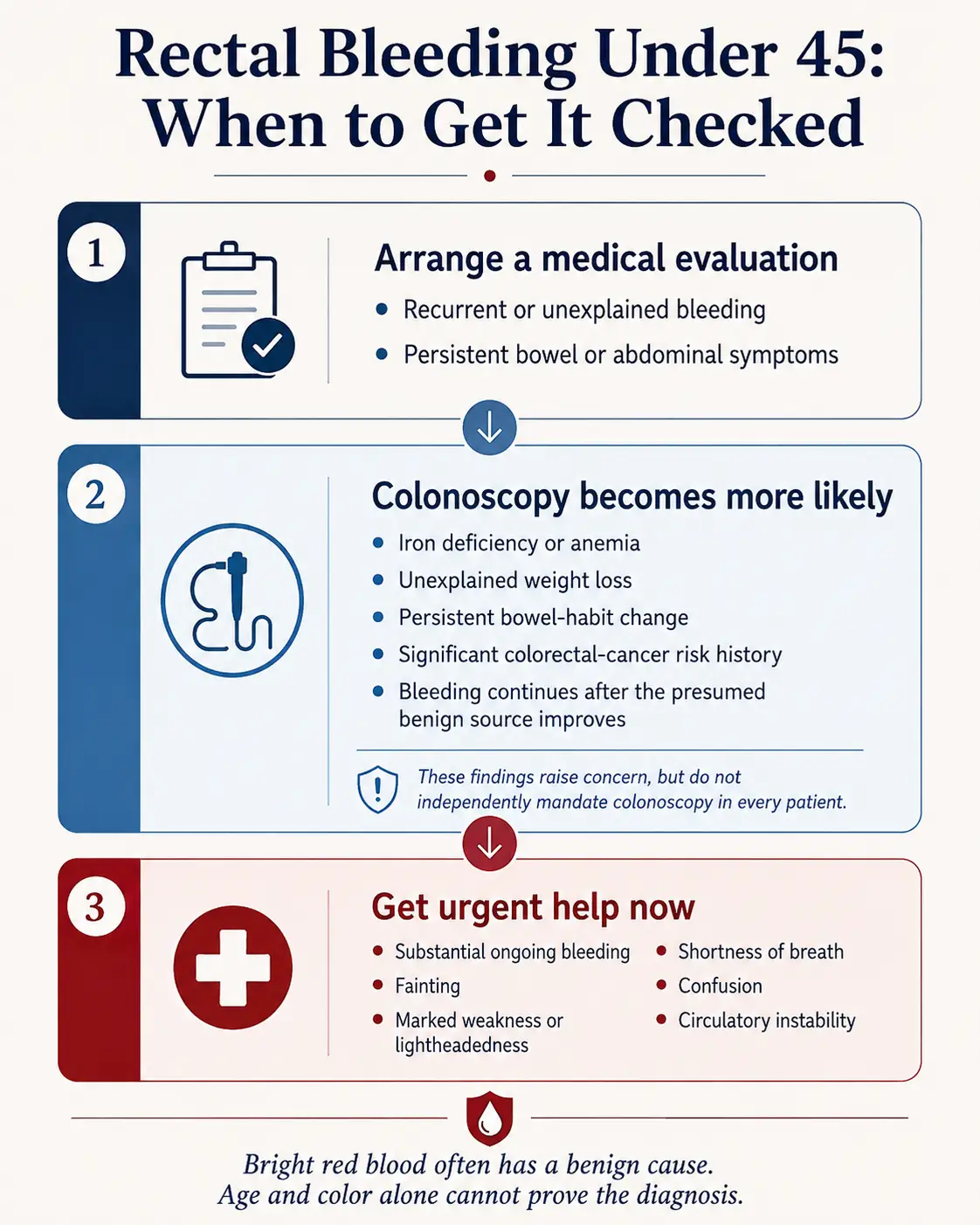
Most small-volume outlet bleeding is not an emergency. Seek urgent medical care for substantial or continuing bleeding accompanied by fainting or near-fainting, severe weakness, marked lightheadedness, shortness of breath, confusion, or signs of low blood pressure. Large-volume or repeated passage of substantial red or maroon blood also warrants prompt assessment.
Bottom Line
Bright red rectal bleeding in a young adult is often caused by hemorrhoids or a fissure. But neither youth, bright-red color, nor the presence of a hemorrhoid proves the diagnosis.
Identify a credible source, look for features that change risk, and make sure the bleeding actually resolves. If the source is unclear, the bleeding persists or returns, or anemia, persistent bowel changes, abdominal symptoms, weight loss, or important colorectal-cancer risk factors are present, age alone should not be a reason to avoid further diagnostic evaluation.
References
- (1) Hawkins AT, Davis BR, Bhama AR, et al. The American Society of Colon and Rectal Surgeons Clinical Practice Guidelines for the Management of Hemorrhoids. Dis Colon Rectum. 2024;67(5):614–623. DOI · PubMed PMID 38294832
- (2) Siegel RL, Wagle NS, Jemal A. Leading Cancer Deaths in People Younger Than 50 Years. JAMA. 2026;335(7):632–634. DOI · PubMed PMID 41569583
- (3) Demb J, Kolb JM, Dounel J, et al. Red Flag Signs and Symptoms for Patients With Early-Onset Colorectal Cancer: A Systematic Review and Meta-Analysis. JAMA Netw Open. 2024;7(5):e2413157. DOI · PubMed PMID 38787555
- (4) Colles T, Ziegelmann PK, Damin DC. The role of colonoscopy in young patients with rectal bleeding: a systematic review and meta-analysis. Int J Colorectal Dis. 2023;38(1):230. DOI · PubMed PMID 37712988
- (5) ASGE Standards of Practice Committee, Pasha SF, Shergill A, et al. The role of endoscopy in the patient with lower GI bleeding. Gastrointest Endosc. 2014;79(6):875–885. DOI · PubMed PMID 24703084
- (6) Fritz CDL, Otegbeye EE, Zong X, et al. Red-flag signs and symptoms for earlier diagnosis of early-onset colorectal cancer. J Natl Cancer Inst. 2023;115(8):909–916. DOI · PubMed PMID 37138415
- (7) US Preventive Services Task Force. Screening for Colorectal Cancer: US Preventive Services Task Force Recommendation Statement. JAMA. 2021;325(19):1965–1977. DOI · USPSTF recommendation
- (8) National Institute for Health and Care Excellence. Suspected cancer: recognition and referral. NICE guideline NG12. NICE NG12