
A “wellness” infusion can look routine until fever, chills, or chest pain begin afterward. The 2026 recall was not a ban on every glutathione product: it identified six compounded injectable lots, while also exposing a separate problem—the weak evidence behind many IV wellness claims.
At a Glance
- The 2026 FDA action involved specific compounded injections made with a dietary-supplement-grade glutathione ingredient and specific recalled lots with elevated endotoxin. It was not a recall of every glutathione product (1), (2).
- FDA was aware of adverse-event reports involving at least 30 patients across products from different compounding pharmacies. Centric separately reported nine reactions in its recall notice; those figures may overlap and should not be added together (1), (2).
- Fever, chills, pain, dizziness, low blood pressure, and sepsis-like illness after an infusion need prompt medical attention (1).
- A contamination recall cannot prove or disprove every proposed use of glutathione. The evidence for IV glutathione as a cosmetic or general “wellness” treatment remains weak (3).
Two questions are being mixed together
When an IV product is recalled, readers often hear two very different messages: “this treatment is dangerous” or “the ingredient is fine; it was only one bad batch.” Neither is precise enough.
The first question is whether the prepared injection was suitable for sterile intravenous use. The second is whether putting glutathione into a vein produces a meaningful health benefit for the reason it was sold. The 2026 FDA notices chiefly answer the first question. They do not turn an unproven wellness claim into an effective treatment, and they do not show that every form of glutathione is contaminated.
What FDA actually reported
On August 27, 2026, FDA warned compounders not to use dietary-supplement-grade glutathione to prepare injectable drugs. The agency described reports involving at least 30 patients who received IV glutathione alone or in combination products prepared by different compounding pharmacies using Medisca ingredient lot 229536. Reported reactions included fever, chills, pain, dizziness, shock-like or sepsis-like illness, and hospitalization (1).
A later recall notice covered six lots from Centric Compounding: glutathione injection, Myers Cocktail, and Tri-Immune Boost products. Testing had found elevated endotoxin. Centric reported nine reactions that included fever, chills, chest pain, nausea, vomiting, headache, and malaise (2). FDA did not say whether those nine were separate from the broader group of at least 30 patients, so the counts should not be added. The affected products and lot information matter. “Glutathione was recalled” is too broad; “these compounded injectable lots were recalled during an endotoxin investigation” is accurate.
Why injection grade matters
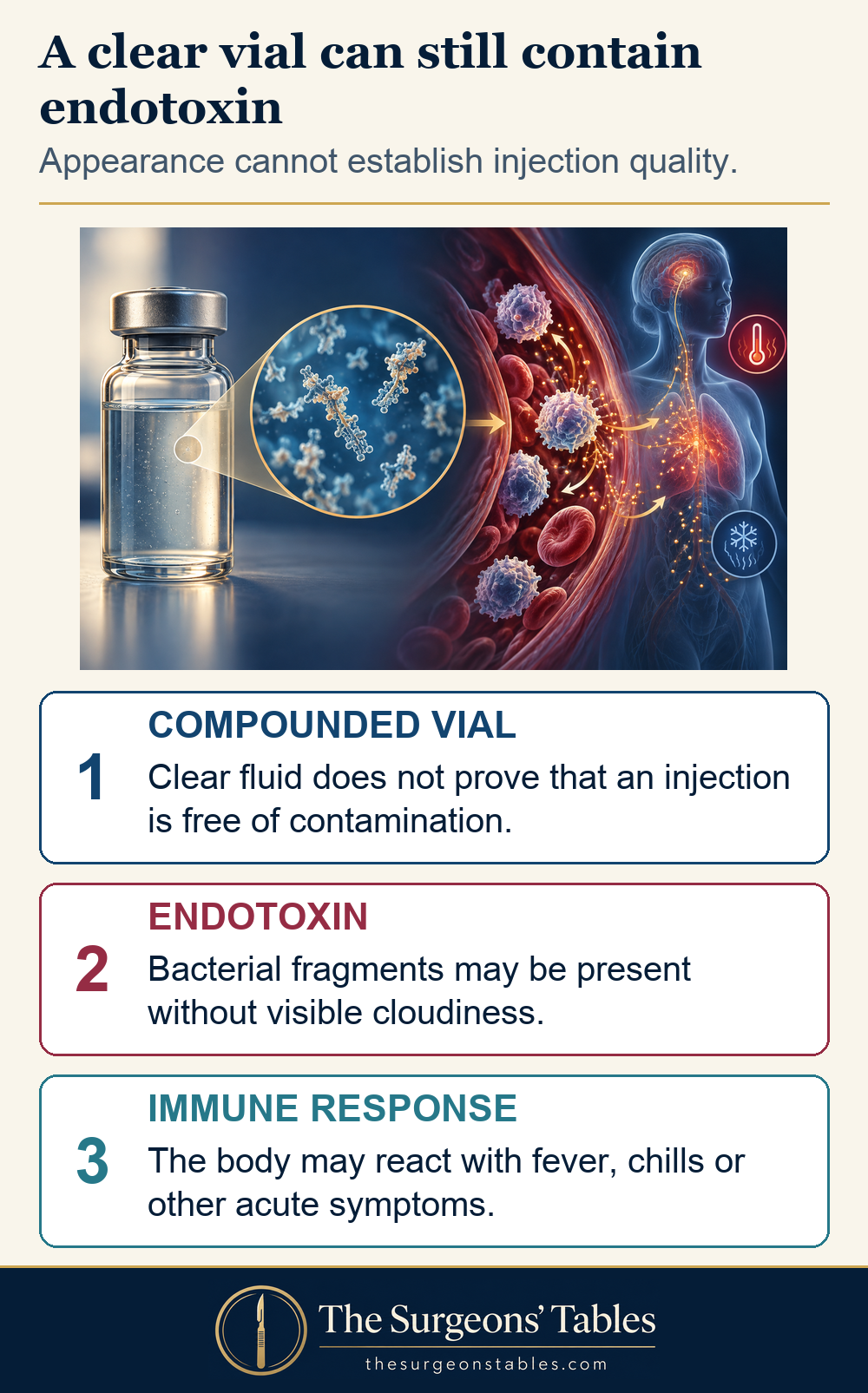
A label that says an ingredient is suitable for a dietary supplement does not establish that it is suitable for injection. The digestive tract and the bloodstream are different routes with different manufacturing requirements. A sterile injectable has to be controlled for microorganisms, particles, potency, and pyrogens such as bacterial endotoxin.
Endotoxin can remain even when live bacteria are not recovered. If enough reaches the bloodstream, it can trigger fever, chills, low blood pressure, and a severe inflammatory response that resembles sepsis. That is why post-infusion symptoms require medical assessment rather than reassurance based on the word “vitamin” or “antioxidant.” FDA had described a similar glutathione-compounding concern years before the 2026 event (4).
What the recall does not establish
The recall was not an efficacy trial. It cannot tell us whether glutathione improves energy, immunity, “detoxification,” skin tone, or recovery. Those claims need their own clinical evidence, with a defined dose, comparator, outcome, and follow-up.
For cosmetic skin lightening, a published evidence review found the IV literature extremely limited, with major concerns about study design and analysis. It did not establish a standard dose, durable benefit, or long-term safety (3). Evidence about oral or topical glutathione cannot simply be transferred to an IV infusion: route changes exposure and risk.
The term “wellness” also hides the endpoint. Feeling better, changing a laboratory antioxidant marker, and treating a diagnosed deficiency are not interchangeable outcomes. Before paying for an infusion, ask what exact outcome has been tested in people like you and whether an approved therapy already exists for the symptom.
If you received one of these products
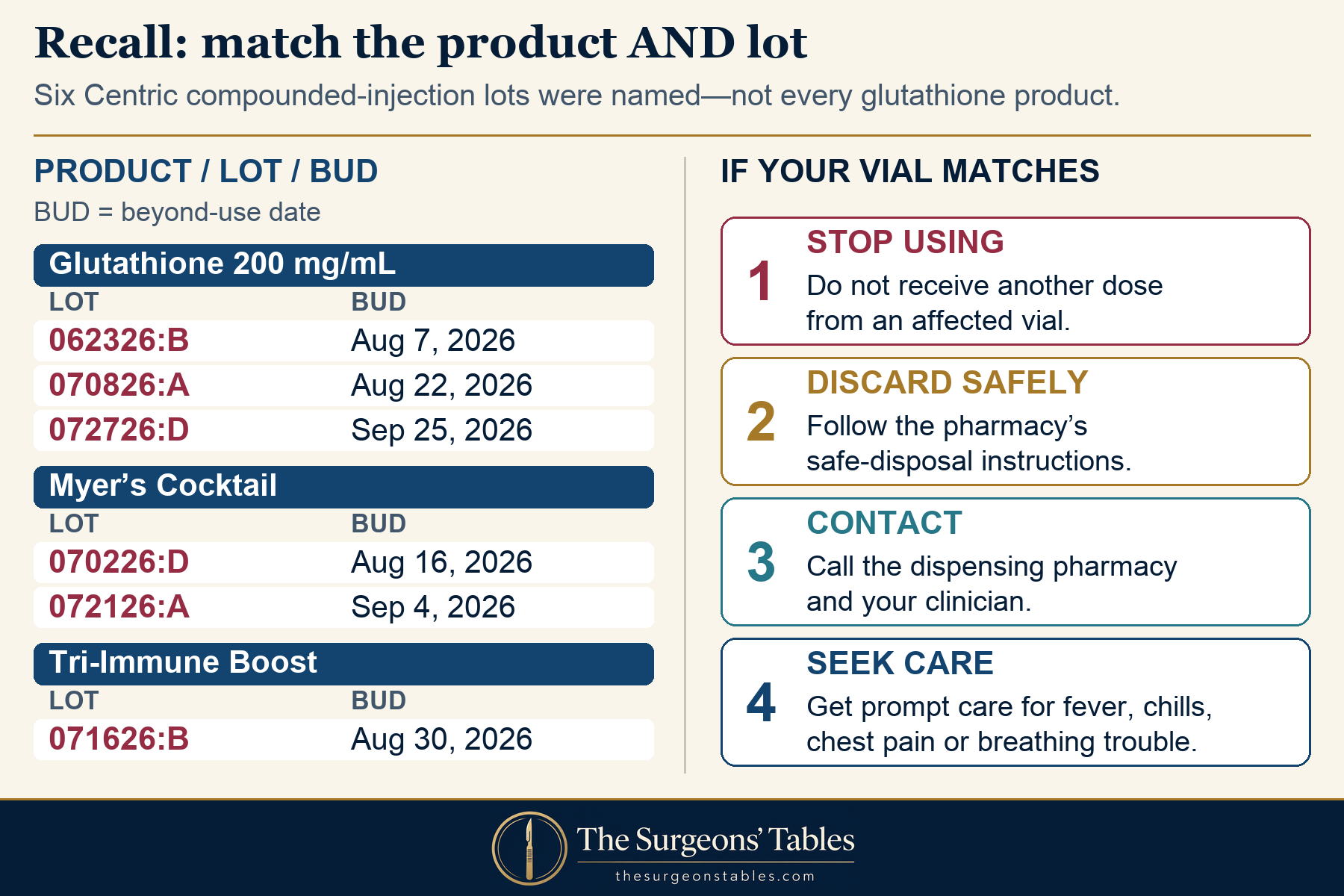
Check the product name, compounding pharmacy, lot number, and date of administration against the recall notice. The six affected Centric lots were:
| Product | Lot | Beyond-use date |
|---|---|---|
| Glutathione 200 mg/mL, 30 mL | 062326:B | August 7, 2026 |
| Glutathione 200 mg/mL, 30 mL | 070826:A | August 22, 2026 |
| Glutathione 200 mg/mL, 30 mL | 072726:D | September 25, 2026 |
| Myer's Cocktail, 30 mL | 070226:D | August 16, 2026 |
| Myer's Cocktail, 30 mL | 072126:A | September 4, 2026 |
| Tri-Immune Boost, 30 mL | 071626:B | August 30, 2026 |
Centric's notice says consumers should stop using and discard affected vials (2). The clinic or pharmacy should be able to confirm the lot. Do not assume that a similar-sounding infusion came from the same source.
Seek prompt medical care for fever, shaking chills, chest pain, faintness, confusion, shortness of breath, persistent vomiting, or rapidly worsening illness after an infusion. Tell the clinician what was infused and where it was prepared. Severe symptoms, low blood pressure, breathing difficulty, or altered mental status warrant emergency care.
If you feel well but learn that your lot was recalled, stop using and discard the affected vial as the recall directs, then contact the dispensing pharmacy or clinic about replacement and follow-up. Reporting an adverse event to FDA MedWatch can also help the investigation, but it does not replace clinical care.
Questions to ask before any compounded infusion
- What is the exact ingredient, dose, route, and intended outcome?
- Is there an FDA-approved product for this use? If not, why is a compounded injection being recommended?
- Which pharmacy prepared it, and was every ingredient intended for sterile injection?
- What evidence shows benefit for this specific use and route?
- What adverse symptoms should trigger a call or emergency evaluation?
Compounding can fill legitimate patient-specific needs, but it also moves important quality questions to the pharmacy and prescriber. A clean-looking IV bag and a familiar molecule do not answer those questions.
Approved, compounded, and marketed are different concepts
An FDA-approved drug has been reviewed for a defined indication, formulation, and manufacturing process. A compounded preparation is made for a patient need and is not FDA-approved in the same way. A commercially promoted “wellness” infusion can be compounded, but the existence of a prescription or clinic does not itself establish that the claimed benefit was tested. These categories explain why three questions must stay separate: Was the ingredient suitable for injection? Was the final preparation sterile and within specification? Is there good evidence that the infusion helps this patient for the proposed purpose?
The 2026 event shows why the chain matters. A pharmacy can prepare a clear solution from a familiar antioxidant and still begin with material that was never appropriate for sterile injection. Conversely, a product outside the named recall is not automatically effective. Passing a quality check would answer a manufacturing question, while clinical benefit still requires controlled evidence.
Patients can also ask whether a symptom has a conventional diagnosis and treatment before accepting a broad wellness label. Fatigue may reflect anemia, sleep apnea, thyroid disease, depression, medication effects, infection, or many other conditions. An infusion that has not defined what it treats can distract from that evaluation.
Do not let a recall notice become a sales tool
A clinic should not answer the recall by saying only that its product uses a different lot. Lot verification addresses immediate exposure, but a patient still deserves an evidence-based reason for the infusion. Likewise, fear of a recalled compounded product should not discourage a patient from receiving a medically indicated, appropriately manufactured treatment that happens to be given intravenously. Product identity, route, indication, and manufacturing source all belong in the same conversation.
The practical conclusion
The 2026 event was a real injectable-quality failure with clinically important reactions. Its scope was specific: named ingredient and product lots, a compounding pathway, and endotoxin concerns. The appropriate response is to verify products and lots, take post-infusion symptoms seriously, and demand evidence for the claimed benefit. It is not accurate to declare every glutathione product recalled, and it is equally inaccurate to use the limited recall scope as proof that routine IV glutathione for wellness is effective.
References
This article is for general education and does not replace individualized medical advice. Do not stop or switch a prescribed medicine on your own. Read our medical disclaimer.