
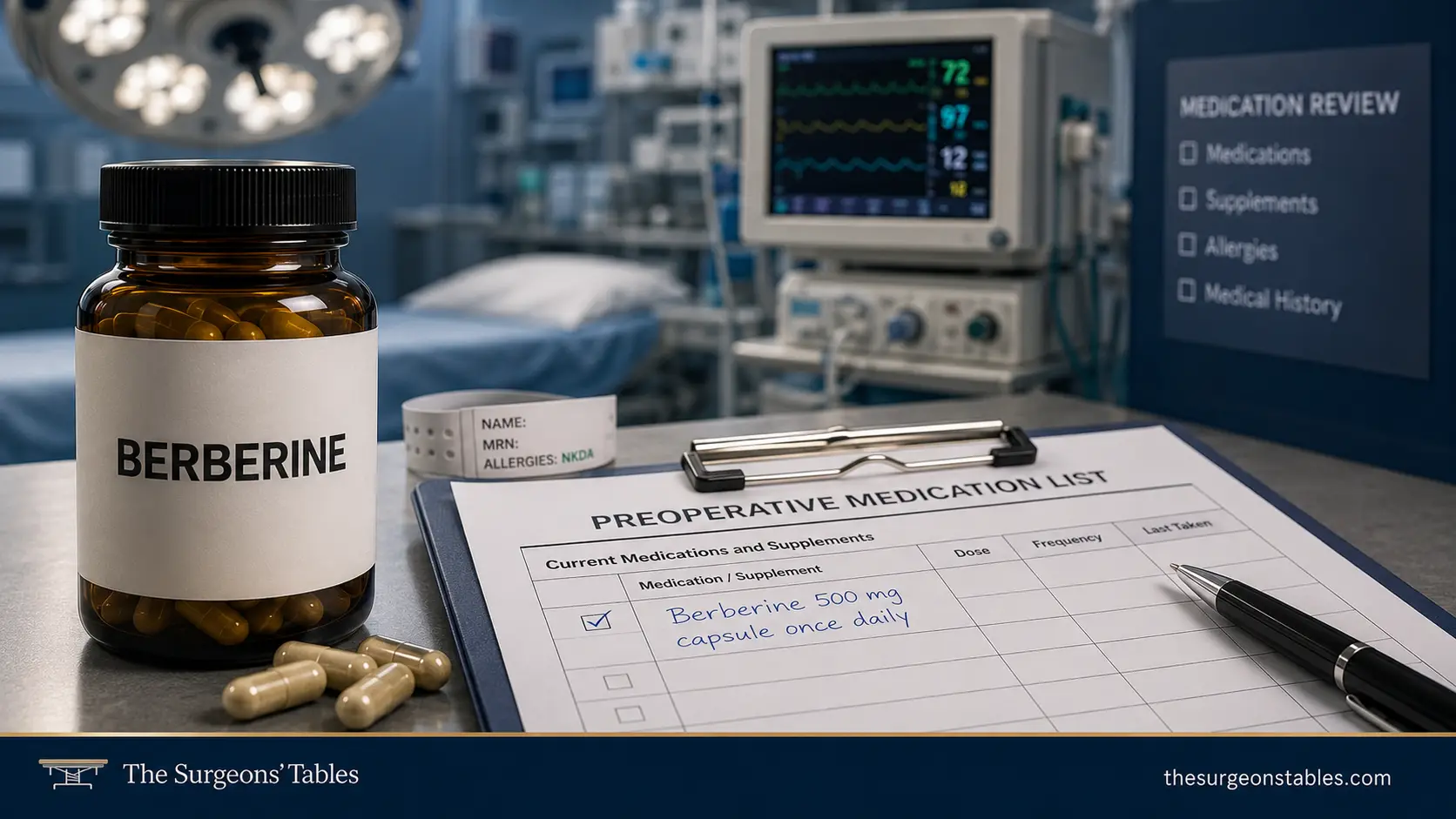
Berberine is promoted online as “Nature’s Ozempic.” The evidence tells a more complicated—and more useful—story about weight loss, liver safety, and drug interactions before anesthesia.
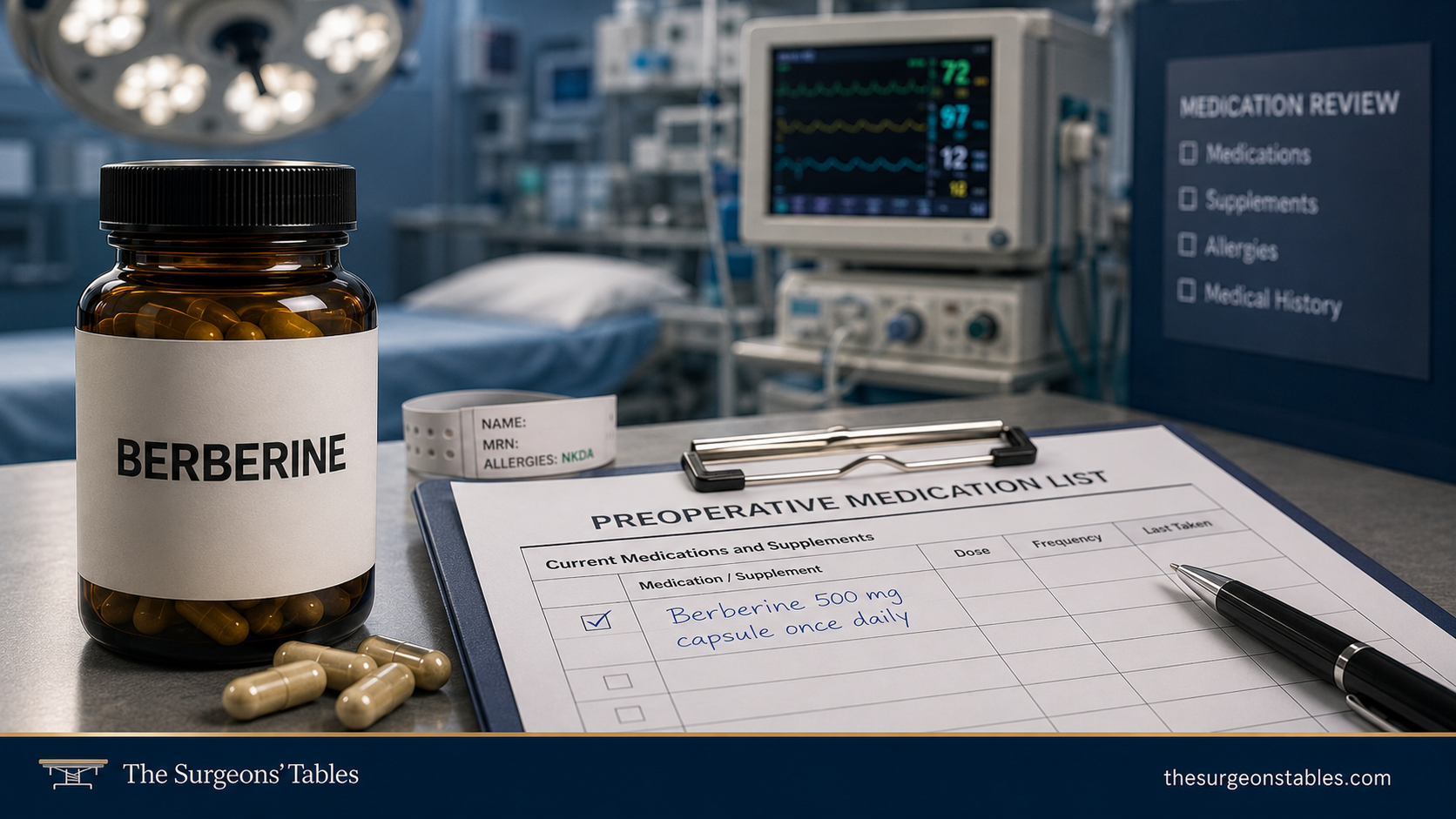
You are filling out your preoperative medication list. There is a box for prescriptions, so you write down your blood-pressure pill, diabetes medication, or antidepressant.
But what about the bottle labeled Berberine 1,500 mg sitting next to your vitamins?
That bottle belongs on the list too.
The reason is not that berberine has suddenly been proven to be a dangerous liver toxin. It hasn’t. The more interesting concern before surgery is that berberine is pharmacologically active enough to change how the body handles other drugs. (1) (2)
That distinction gets lost when berberine is marketed as “Nature’s Ozempic.”
Is berberine really “Nature’s Ozempic”?
No—not in any meaningful pharmacologic sense.
Berberine is a plant-derived compound found in several botanicals. Semaglutide is a prescription GLP-1 receptor agonist designed to act on a specific hormonal signaling system involved in appetite, glucose regulation, and other metabolic effects.
They are not botanical and pharmaceutical versions of the same drug.
Their weight-loss results are also very different.
A 2020 meta-analysis of 12 randomized berberine trials found an average reduction in body weight of about 2.1 kg, or 4.6 pounds, compared with controls. The studies were relatively small and heterogeneous. (3)
In the much larger STEP 1 randomized trial, adults receiving semaglutide 2.4 mg plus lifestyle intervention lost an average 14.9% of their starting body weight over 68 weeks, compared with 2.4% with placebo plus lifestyle intervention. (4)
Those numbers should not be treated as a head-to-head trial—because they aren’t. But they make one point clear:
Calling berberine “Nature’s Ozempic” makes two very different interventions sound far more similar than the evidence supports.
But can berberine hurt my liver?
This is where the viral discussion can point patients toward the wrong fear.
The NIH LiverTox database currently describes berberine as an unlikely cause of clinically apparent liver injury. It has not been convincingly linked to the pattern of acute liver injury seen with some drugs and supplements. (2)
A meta-analysis of randomized trials also found no significant increase in ALT or AST, two common blood tests used to look for liver-cell injury. (3)
That does not mean every bottle labeled berberine is automatically safe.
In the United States, dietary supplements are regulated differently from prescription drugs. FDA does not approve dietary supplements for safety and effectiveness before they reach the market, although manufacturers remain responsible for safety, labeling, and manufacturing requirements and FDA can take enforcement action. (5)
It also does not mean that abnormal liver tests in someone taking berberine should be dismissed. Elevated liver enzymes still deserve evaluation for medications, other supplements, alcohol, metabolic liver disease, viral hepatitis, and other possible causes.
The practical distinction is simple: “Berberine is not a well-established liver toxin” is not the same statement as “anything sold as berberine cannot cause a problem.”
Then why does an anesthesiologist care about it?
Because your liver does more than detect toxins. It also processes drugs.
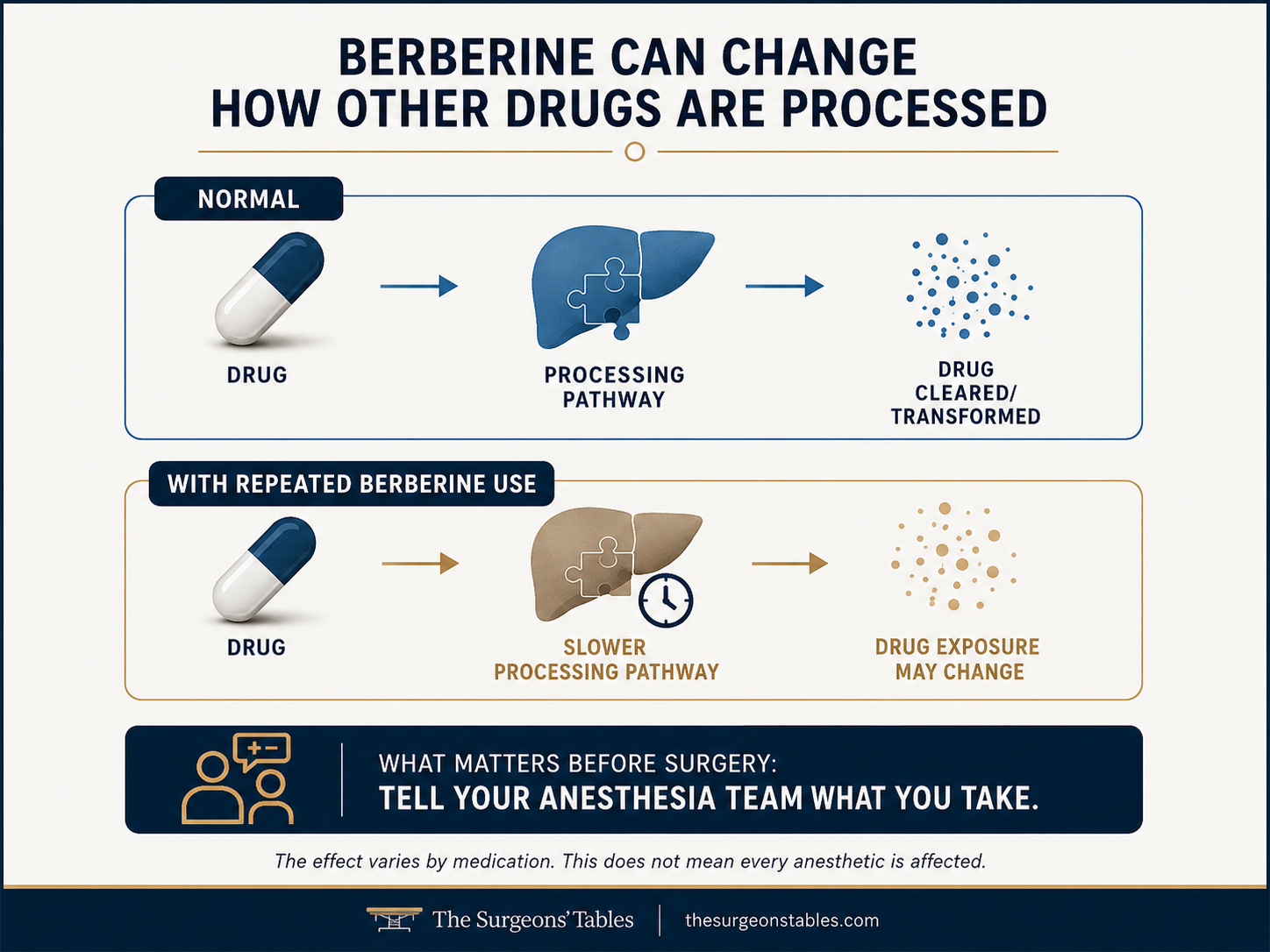
Think of some liver enzymes as drug-processing lanes. Different medications depend on different lanes to be broken down or transformed.
Berberine appears capable of slowing several of those lanes.
In a small randomized crossover study, 12 healthy men took berberine 300 mg three times daily for two weeks. Researchers then gave them medications used as probes to measure specific drug-processing pathways.
After berberine, activity of three important enzyme systems—CYP3A4, CYP2D6, and CYP2C9—decreased. (1)
You do not need to remember those names.
What matters is what happened to an actual drug.
Midazolam, a sedative processed largely through CYP3A4, had about a 40% increase in overall drug exposure after repeated berberine use. (1)
That is a real human drug-interaction signal.
But there is an important boundary around the finding: the study did not test surgical patients and did not show that berberine caused respiratory complications, prolonged anesthesia, or delayed recovery after an operation.
So an anesthesiologist should take the interaction seriously without pretending that a laboratory pharmacokinetic result is the same thing as a proven surgical complication.
What could those interactions mean for my medications?
The answer depends on what else you take.
| Situation | Why the surgical team may care |
|---|---|
| Sedatives or other drugs processed through CYP3A4 | Berberine can reduce CYP3A4 activity; oral midazolam exposure increased in a human study. |
| Drugs dependent on CYP2D6 | Berberine reduced CYP2D6 activity, so drugs that depend on this pathway may behave differently. |
| Diabetes medications | Berberine itself can affect glucose control, so the team needs to know about it when planning perioperative glucose management. |
| Transplant medications | Berberine has documented interaction potential with cyclosporine; narrow-therapeutic-index drugs deserve particular attention. |
| Multi-ingredient “metabolism” or weight-loss products | The team needs the entire ingredient list, not simply the word “berberine.” |
The cyclosporine example is particularly useful because it shows why “herbal” does not mean pharmacologically weak. Human pharmacokinetic research has found increased cyclosporine exposure under some berberine dosing conditions. (6)
The surgeon-level point is not that berberine makes every anesthetic dangerous.
It is that once a supplement can measurably alter human drug metabolism, it belongs in medication reconciliation before surgery.
Do I need to stop berberine exactly 14 days before surgery?
This needs more nuance than most online advice gives it.
There is not a high-quality clinical trial demonstrating that 14 days is the precise berberine washout period required to prevent anesthesia complications.
The two-week idea comes from broader perioperative management of herbal and dietary supplements—not from a berberine-specific anesthesia trial.
A modern SPAQI consensus statement reviewed perioperative management of 83 dietary supplements and emphasized identifying supplement use before surgery and temporarily discontinuing products when their benefit does not justify potential perioperative uncertainty. The preoperative visit is ideally early enough—typically at least two weeks before surgery—to address these decisions. (7)
Many institutional protocols therefore use roughly two weeks before elective surgery as a conservative stopping window for dietary supplements.
That is different from saying:
“Berberine takes exactly 14 days to leave your body.”
It doesn’t.
The safest instruction is to tell your surgical or anesthesia team as early as possible and follow the stopping interval they give you. If surgery is sooner than that, do not hide the supplement or assume the operation automatically must be canceled. Tell the team when you last took it.
What if I take berberine for blood sugar?
That information is especially worth mentioning.
Berberine has shown glucose-lowering effects in people with type 2 diabetes, although the quality and size of the evidence are not comparable with those for standard prescription diabetes therapies. NCCIH describes the evidence as suggesting a modest glucose-lowering effect. (8)
Before surgery, glucose management is already changing because eating patterns, fasting instructions, stress hormones, and prescription diabetes medications may all be different.
Adding an undisclosed glucose-active supplement makes that picture harder to interpret.
This does not mean berberine has been proven to cause severe hypoglycemia during anesthesia. That evidence is not established.
It means your anesthesia team needs to know it is part of the equation.
What should I actually tell my surgical team?
Bring more information than “I take some supplements.”
- Product name and brand
- Dose per capsule or serving
- How many doses you take each day
- When you took your last dose
- A photo of the Supplement Facts label, especially for combination products
- Your prescription diabetes medications, sedatives, pain medications, anticoagulants, transplant medications, and other regular drugs
- Any recent nausea, vomiting, diarrhea, jaundice, unusual fatigue, or abnormal liver-test results
If you are pregnant or breastfeeding, berberine deserves separate attention. Experimental evidence shows that berberine can displace bilirubin from albumin, creating concern about bilirubin toxicity in newborns. NCCIH advises against berberine use during pregnancy or breastfeeding and against giving it to infants. (9) (8)
Bottom Line
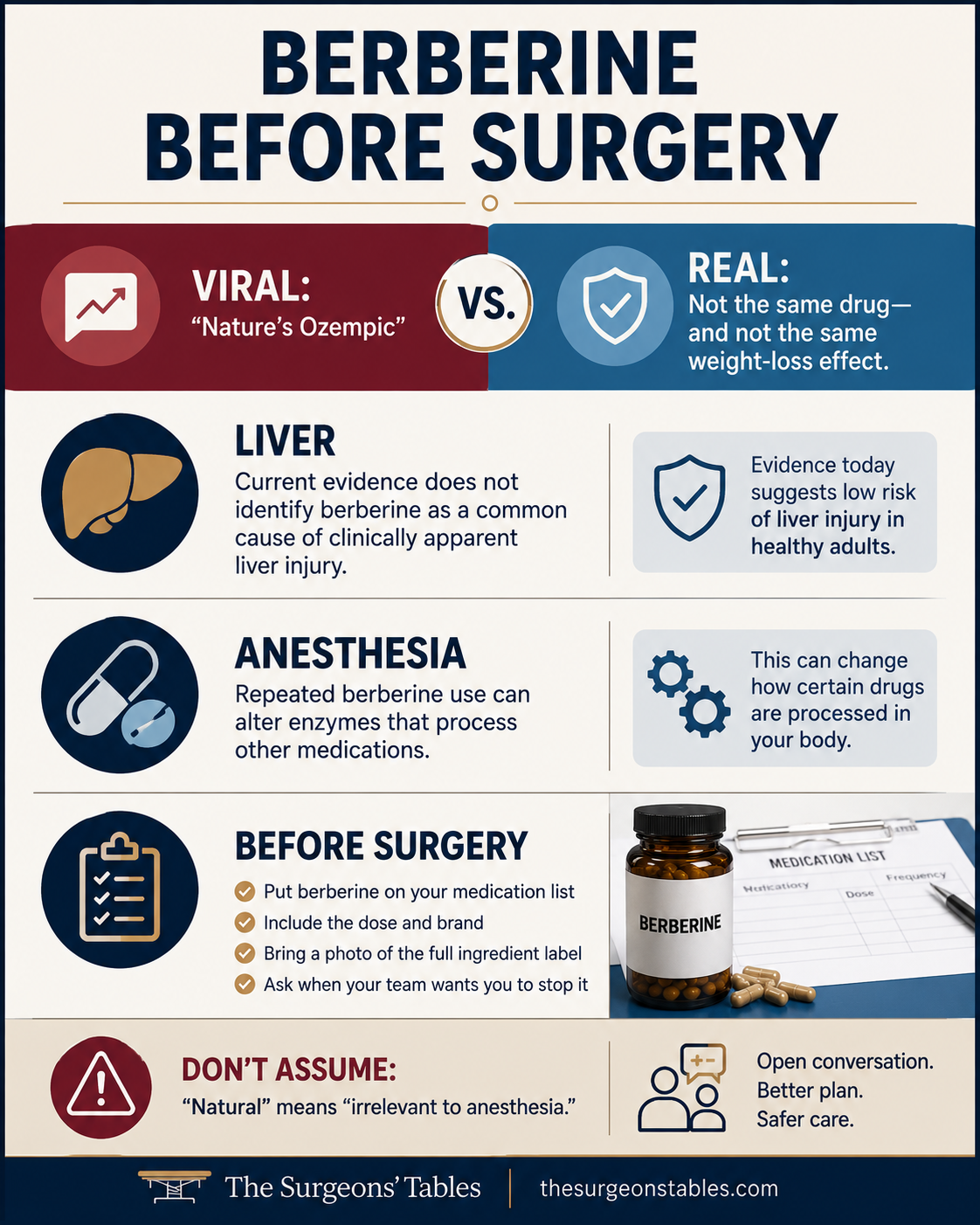
Berberine is neither a harmless vitamin nor a botanical version of Ozempic.
The reassuring part is that berberine itself has not emerged as a common cause of clinically apparent liver injury at conventionally studied doses. The part that deserves more attention before surgery is its ability to alter drug-processing pathways in humans.
We still do not have good clinical trials showing exactly how much this changes anesthesia outcomes—or establishing a berberine-specific perfect washout interval.
Put berberine on your medication list. Bring the bottle or a photo of its label. And ask your anesthesia or surgical team when they want you to stop it rather than treating “natural” as another word for “irrelevant.”
References
- (1) Guo Y, Chen Y, Tan ZR, Klaassen CD, Zhou HH. Repeated administration of berberine inhibits cytochromes P450 in humans. Eur J Clin Pharmacol. 2012;68:213–217. doi:10.1007/s00228-011-1108-2 . PMID: 21870106 .
- (2) LiverTox. Berberine. National Institute of Diabetes and Digestive and Kidney Diseases. Updated October 6, 2020. NCBI Bookshelf NBK564659 .
- (3) Asbaghi O, Ghanbari N, Shekari S, et al. The effect of berberine supplementation on obesity parameters, inflammation and liver function enzymes: A systematic review and meta-analysis of randomized controlled trials. Clin Nutr ESPEN. 2020;38:43–49. doi:10.1016/j.clnesp.2020.04.010 . PMID: 32690176 .
- (4) Wilding JPH, Batterham RL, Calanna S, et al. Once-Weekly Semaglutide in Adults with Overweight or Obesity. N Engl J Med. 2021;384:989–1002. doi:10.1056/NEJMoa2032183 . PMID: 33567185 .
- (5) U.S. Food and Drug Administration. Information for Consumers on Using Dietary Supplements. FDA .
- (6) Xin HW, et al. The effects of berberine on the pharmacokinetics of cyclosporin A in healthy volunteers. PubMed .
- (7) Cummings KC III, et al. Preoperative Management of Surgical Patients Using Dietary Supplements: Society for Perioperative Assessment and Quality Improvement (SPAQI) Consensus Statement. Mayo Clin Proc. 2021;96:1342–1355. doi:10.1016/j.mayocp.2020.08.016 . PMID: 33741131 .
- (8) National Center for Complementary and Integrative Health. Berberine. NCCIH .
- (9) Chan E. Displacement of bilirubin from albumin by berberine. Biol Neonate. 1993;63:201–208. doi:10.1159/000243932 . PMID: 8513024 .
- (10) Ang-Lee MK, Moss J, Yuan CS. Herbal medicines and perioperative care. JAMA. 2001;286:208–216. doi:10.1001/jama.286.2.208 . PMID: 11448284 .