
Microplastics in carotid plaque? A widely discussed study found plastic material in some plaques removed during carotid surgery. The most useful question for patients is whether that finding changes a real treatment decision.
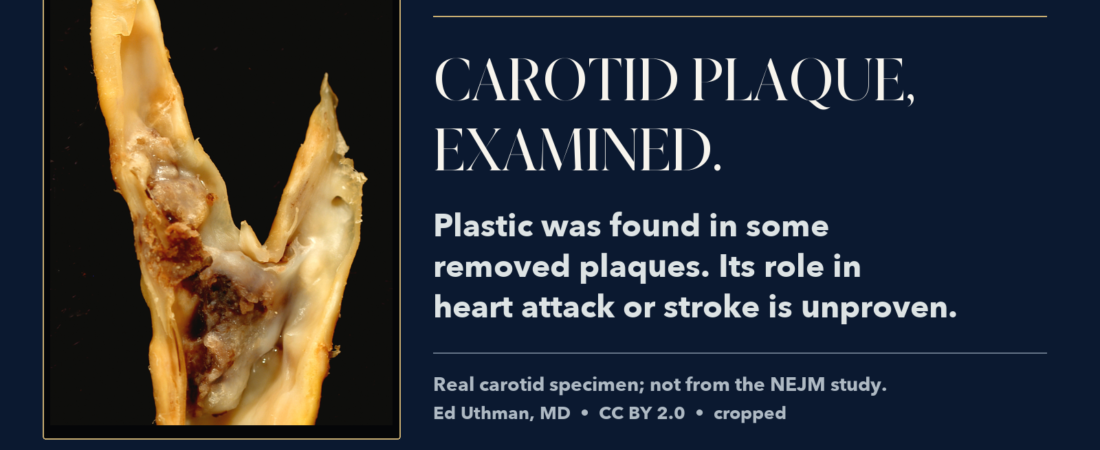
Featured specimen image: Ed Uthman, MD, CC BY 2.0; cropped and laid out for TST. This is a separate specimen from the study; its plastic content is unknown.
If you have carotid artery disease, a headline about plastic in artery plaque can sound as though a heart attack or stroke is waiting to happen. The evidence does not let us make that prediction. A 2024 study found an association between plastic material in plaque removed from the neck and a higher rate of later heart attack, stroke, or death. It did not show that the plastic caused those events, and it did not identify a test or treatment that improves outcomes by finding or removing plastic. (1)
For now, the practical answer is to keep the treatment conversation focused on what is known to matter: whether you have had stroke symptoms, how severe the narrowing is, your overall vascular risk, and whether a procedure would add enough benefit to justify its own risks. Plastic testing is not part of that decision. (2) (3)
Microplastics in carotid plaque: what did the study find?
Researchers in Italy studied people having carotid endarterectomy, an operation that removes plaque from an artery in the neck. All had asymptomatic, high-grade carotid stenosis; this was not a study of healthy adults or of everyone with a little plaque on an ultrasound. Of 304 enrolled patients, 257 completed an average of 33.7 months of follow-up. The team analyzed the removed plaque with a laboratory technique that identifies plastic polymers. They also examined selected samples using electron microscopy and stable-isotope analysis. (1)
Polyethylene was detected in the plaque of 150 of the 257 patients, or 58.4%. Among those 150, 31 also had detectable polyvinyl chloride (PVC). The main laboratory method measured polymer material but could not tell whether each detected particle was a microplastic or the smaller nanoplastic. Electron microscopy in a small selected subset showed tiny, irregular particles within or around plaque cells; those images alone do not identify every particle in every patient. (1)
Over follow-up, 30 of 150 patients (20.0%) with detected plastic and 8 of 107 (7.5%) without detected plastic had at least one event in the study’s combined outcome. That outcome joined nonfatal heart attack, nonfatal stroke, and death from any cause. The absolute difference between the observed proportions was 12.5 percentage points. After statistical adjustment for several measured cardiovascular risk factors, the reported hazard ratio was 4.53, with a 95% confidence interval from 2.00 to 10.27. (1)
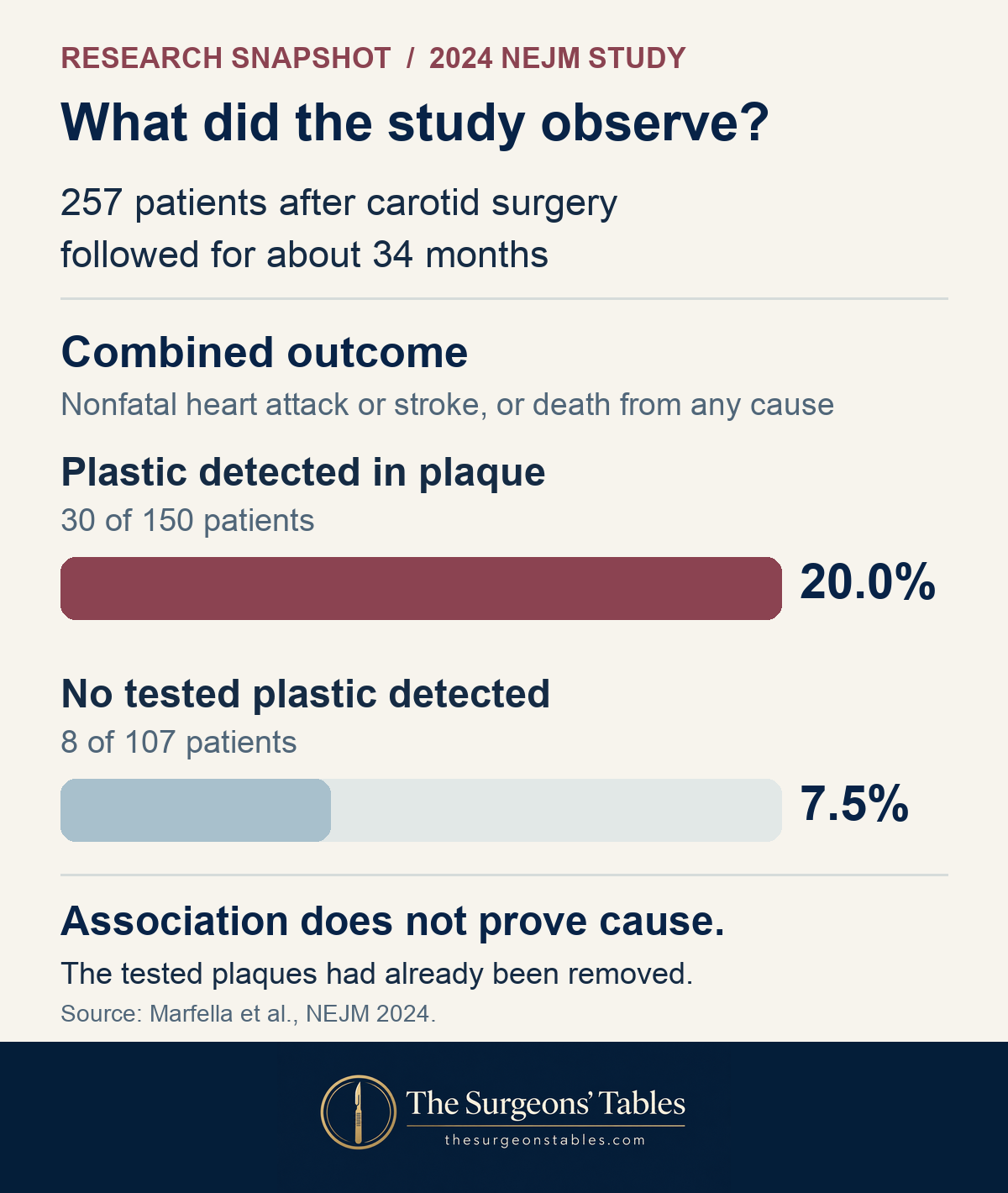
That hazard ratio describes a group-level association over time. It is not simply 20.0 divided by 7.5: the model accounts for timing and adjusts for measured differences between groups. It does not mean a patient with detected plastic has a 4.53-fold chance of stroke, nor does the combined outcome tell us that heart attacks and strokes each rose by the same amount. There were 38 events in total, and the confidence interval around the adjusted estimate was wide. The study did not establish a personal risk calculator for use in clinic.
If the plaque was removed, why did some patients later have a heart attack or stroke?
This is the question a vascular surgeon should ask before calling the particles a “trigger.” The researchers tested the plaque after taking it out of the carotid artery, then followed patients for later events. The removed piece of plaque could not subsequently rupture in that artery. A heart attack generally concerns an artery supplying the heart, not the carotid artery in the neck. (1)
The finding may therefore be a clue to something broader: exposure elsewhere in the body, a pattern of vascular disease, or other differences between patients. It might also play a biological role that this study could not prove. Those are interpretations, not established explanations for what happened to any individual patient.
The investigators did find plastic-like material near macrophages, immune cells that populate plaque. Plaques with detected plastic had a different pattern of inflammatory markers and less collagen, a structural component related to plaque stability. Those findings make the hypothesis biologically interesting. They do not show that plastic made a particular plaque rupture, and this study did not demonstrate the proposed chain from plastic to matrix metalloproteinases, a weakened cap, a clot, and a clinical event. (1)
Does the result tell me whether my plaque is dangerous?
No. The study required plaque that had already been surgically removed. A routine carotid ultrasound does not measure plastic content, and a blood test for microplastics has no established threshold that tells a clinician whether you need an operation or how to change medication. The FDA notes that methods for sampling and measuring these particles are not yet standardized enough for reliable comparisons across studies. (2)
“Not detected” also has a narrow meaning: the investigators did not detect the polymers they measured in that particular sample with their methods. It cannot certify that the rest of a person’s arteries are free of plastic or that stroke risk is low.
The association remained after the researchers adjusted for a list of measured risk factors. That makes it an interesting research signal, but it does not establish that a plastic measurement improves an individual patient’s risk prediction beyond the information clinicians already use. No study here tested whether using the result to change care prevents an event. (1)
If heart attack or stroke runs in your family but you have no carotid symptoms or known carotid disease, this study is not a reason to request a carotid ultrasound just to look for plastic. The U.S. Preventive Services Task Force recommends against routine screening for asymptomatic carotid stenosis in the general adult population. Family history and other risks are still worth discussing with your clinician as part of overall cardiovascular prevention. (4)
Most importantly, this research does not justify carotid surgery to “clean out plastic.” Carotid endarterectomy has a potential role in preventing stroke in selected patients, but it also has immediate procedural risks. Modern carotid treatment decisions weigh symptoms, the degree of narrowing, patient health and life expectancy, the quality of medical management, and the expected benefit and risk of an intervention. The later CREST-2 trials tested intensive medical management with or without a carotid procedure; they did not use plastic measurements to select patients. (3) Our separate carotid treatment guide explains those decisions in more detail.
What keeps this study from proving cause and effect?
The groups were not randomly assigned to plastic exposure. The researchers adjusted for many familiar cardiovascular risk factors, but they did not have a complete account of diet, drinking water, occupational and lifetime exposures, air pollution, socioeconomic conditions, or every aspect of vascular health. They also acknowledged that laboratory contamination could not be fully excluded. Of 304 enrolled patients, 47 had incomplete data or were lost during follow-up. The results apply to a selected group already undergoing surgery for severe, symptom-free carotid disease, not automatically to the general population. (1)
There is also no proof of where the detected material came from. The study did not trace polyethylene in a plaque back to a water bottle, food package, tea bag, or any other product. Finding the same polymer in a consumer item and in tissue is not a source investigation.
Since 2024, smaller studies have reported associations involving plastic material in coronary blood among people with heart disease. One followed 110 patients after myocardial infarction; another compared coronary blood from 61 people with acute heart attack, stable coronary disease, or normal coronary arteries. These studies add reasons to investigate, but their observational designs still cannot tell us whether particles caused disease, followed it, or traveled alongside other exposures such as smoking and air pollution. (5) (6)
What can I actually do now?
The study raises a question about plastic exposure; it does not create a new treatment plan. The practical steps below have different levels of evidence.
| Situation | Practical next step |
|---|---|
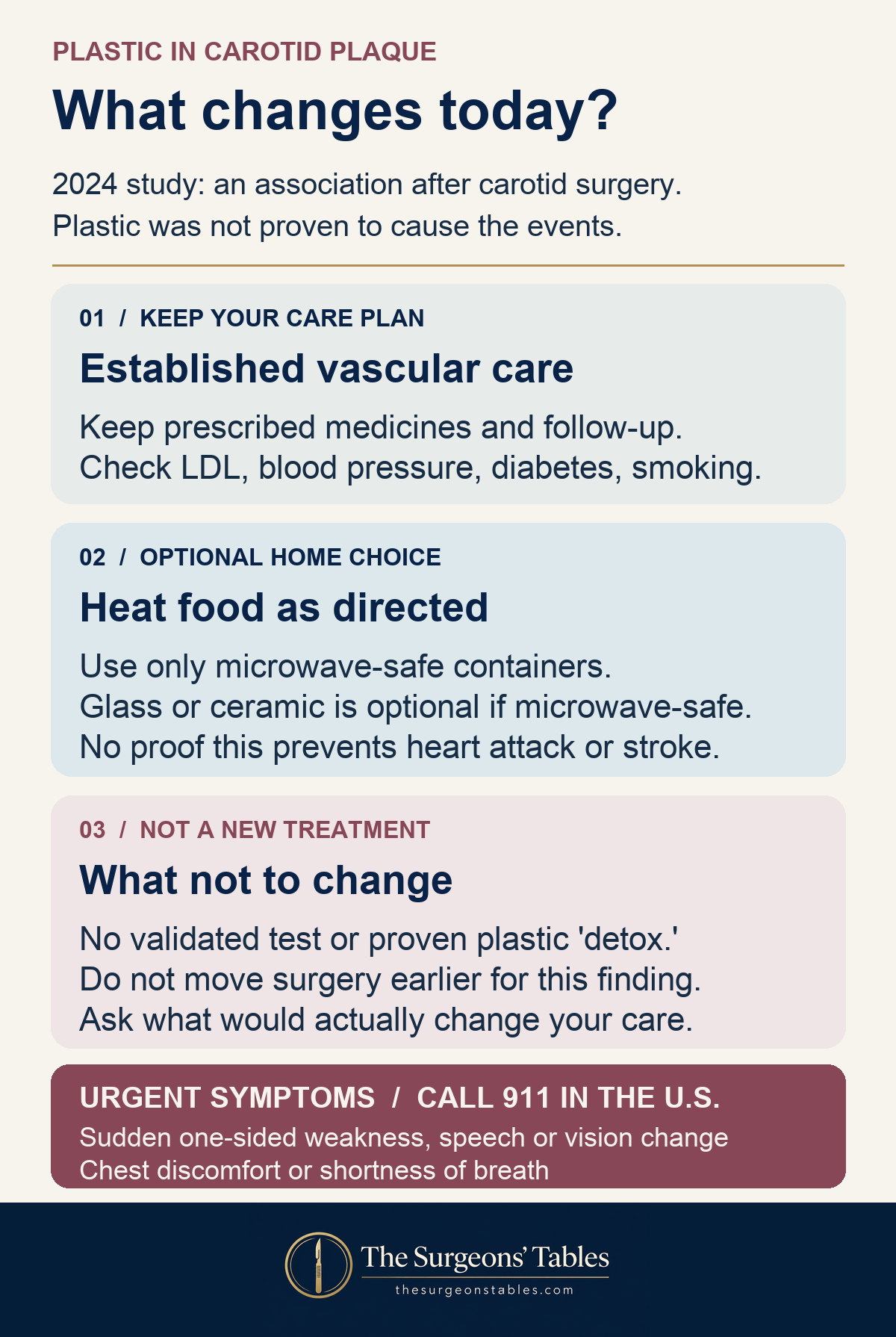
| You already have carotid or coronary disease. | Keep your planned follow-up and prescribed medicines. Review LDL cholesterol, blood pressure, diabetes if relevant, and smoking with your care team. Discuss any carotid procedure using your symptoms, narrowing, overall health, and procedural risk, rather than this plastic finding. (3) |
| You heat food in a plastic container. | Follow its microwave-use label. A cold-storage tub or takeout package without a microwave-safe label is not a substitute. Microwave-safe glass or ceramic is an option if convenient. These choices have not been shown to prevent heart attack or stroke. (7) (1) |
| You are thinking about a water filter or switching between bottled and tap water. | Do not make an expensive change solely to lower the risk reported in this plaque study. It did not identify where the particles came from or test a filter or beverage change. The FDA reports particles in both tap and bottled water and says their health effects remain uncertain. (1) (2) |
| You are considering a particle blood test, “detox,” or earlier surgery. | Ask whether the result would change a validated clinical decision. At present, there is no established blood threshold, plastic-clearing treatment, or reason to move carotid surgery forward based on this study. Do not stop a prescribed statin or antiplatelet medicine because of a headline. (1) (2) (3) |
The FDA says current evidence has not demonstrated that the levels detected in food or water pose a human health risk, while stressing that measurement and health-effect data remain limited. That is not proof that every exposure is safe. It also does not mean a glass dish, water filter, or other product prevents cardiovascular events. (2)
Three questions worth taking to your appointment
- Have I had any symptoms that change my carotid risk or the urgency of care? Mention even brief one-sided weakness, speech trouble, or sudden vision loss.
- What is my expected stroke risk with the treatment I am receiving now, and what would a procedure add for me? Ask how your scan, overall health, and the treating center’s outcomes affect that answer.
- Which established risk factor needs the most work next? Review LDL cholesterol, blood pressure, diabetes, smoking, medication adherence, and planned follow-up before paying for an unvalidated particle test.
When to act urgently: If you develop sudden facial droop, one-sided weakness, speech difficulty, or a new vision change, call 911 in the United States, even if the symptom improves. Chest discomfort or shortness of breath that may signal a heart attack also needs emergency assessment. (8) (9)
The 2024 result deserves serious research. For the person sitting in the vascular clinic today, it is a question to investigate, rather than a new reason to test a plaque, change a prescription, or rush into surgery.
References
- Marfella R, Prattichizzo F, Sardu C, et al. Microplastics and Nanoplastics in Atheromas and Cardiovascular Events. N Engl J Med. 2024;390:900–910. DOI: 10.1056/NEJMoa2309822. Full text reviewed: Methods—Study Design, Patients, End Points, Statistical Analysis; Results—Study Population, Electronic Microscopy, Plaque Phenotype, Cardiovascular Events; Figures 2–4; Discussion.
- U.S. Food and Drug Administration. Microplastics and Nanoplastics in Foods. Key Points; Scientific Information; Bottled Water sections. Accessed October 7, 2026.
- Brott TG, et al. Medical Management and Revascularization for Asymptomatic Carotid Stenosis. N Engl J Med. 2026;394:219–231. DOI: 10.1056/NEJMoa2508800. Full text reviewed: Abstract, Methods—Trial Design, Results, Discussion.
- U.S. Preventive Services Task Force. Asymptomatic Carotid Artery Stenosis: Screening. 2021. Recommendation Summary; Practice Considerations—Assessment of Risk. Accessed October 6, 2026.
- Zhang Y, et al. Microplastics and nanoplastics increase major adverse cardiac events in patients with myocardial infarction. J Hazard Mater. 2025;489:137624. Abstract reviewed only; title uses causal wording that the observational design does not establish.
- Paolisso P, et al. Micro- and nano-plastics in the coronary circulation and air pollution exposure in ischaemic heart disease presentation. Eur Heart J. 2026. DOI: 10.1093/eurheartj/ehag447. Abstract reviewed only, Methods/Results.
- USDA Food Safety and Inspection Service. Are utensils microwave safe?. Accessed October 7, 2026.
- American Stroke Association. Stroke Symptoms and Warning Signs. B.E. F.A.S.T. warning signs. Accessed October 7, 2026.
- American Heart Association. Warning Signs of a Heart Attack. “Catch the signs early” section. Accessed October 7, 2026.
This article is for general education and does not replace individualized medical advice. Read the full Medical Disclaimer.