
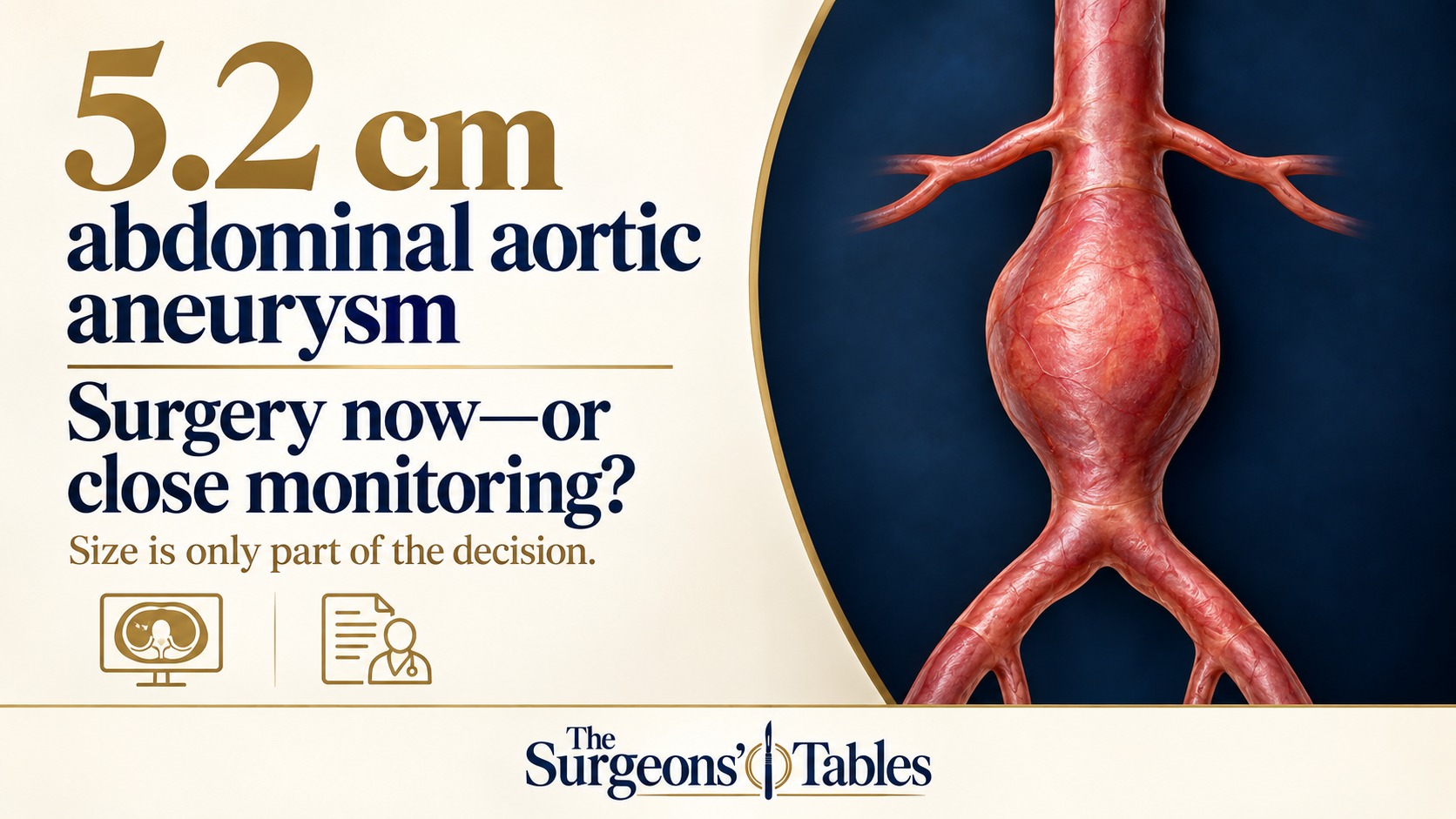
It is understandable to worry about rupture when a scan finds an abdominal aortic aneurysm—a widened section of the main artery carrying blood through your abdomen. If you feel well and the measurement is 5.2 cm, the next decision deserves more explanation than “come back later.”
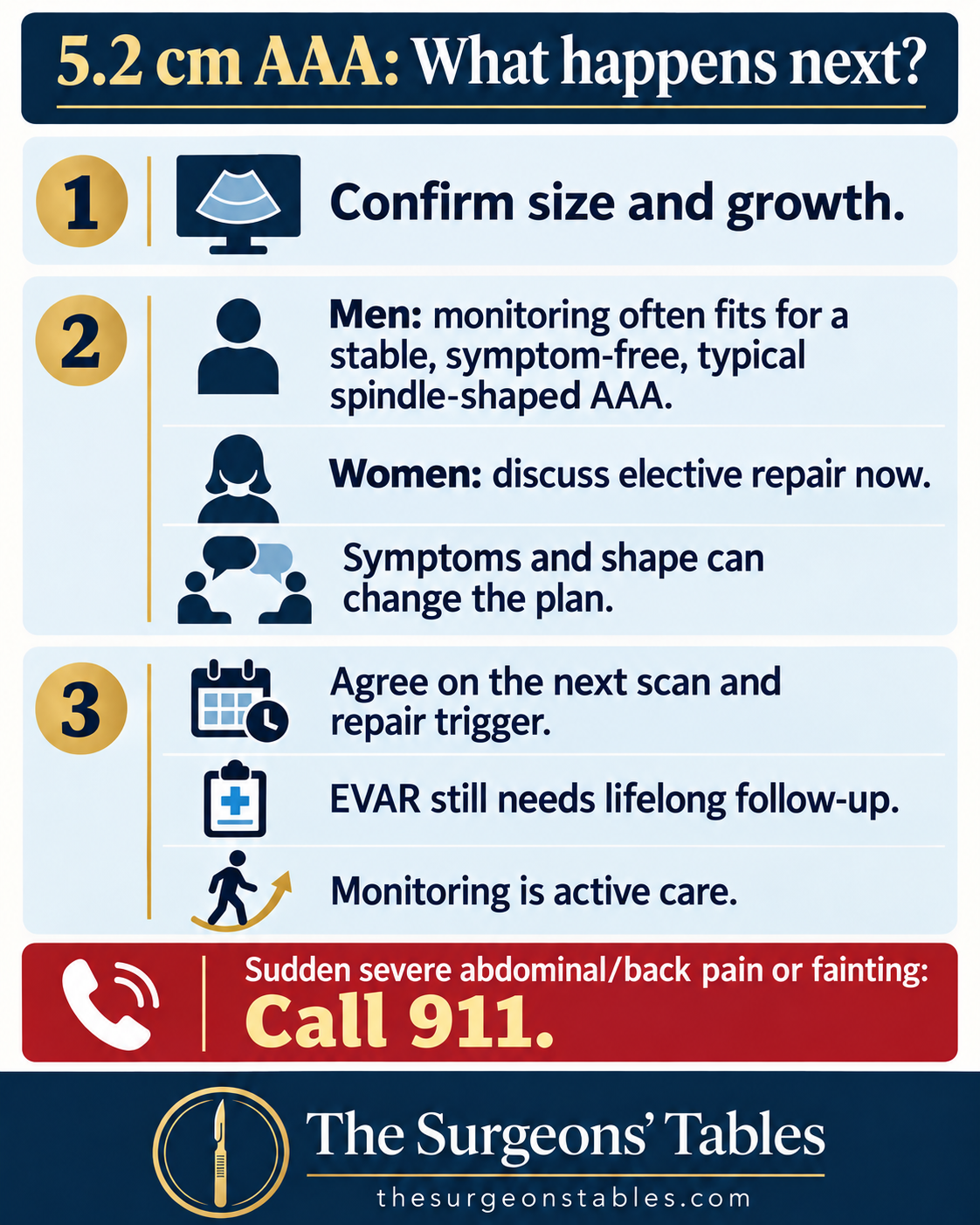
For a man with the usual spindle-shaped aneurysm below the kidney arteries, no symptoms and no confirmed rapid growth, close surveillance is generally appropriate at 5.2 cm. A woman at that diameter should discuss elective repair with a vascular surgeon now, because U.S. guidance uses a lower threshold for women. An otherwise stable aneurysm does not become an emergency solely because of its diameter. The plan also depends on your health, anatomy and the expected benefit of repair. (1), (2)
Clinical perspective — M.J. Kim, MD
I have cared for patients whose abdominal aortic aneurysms were in a gray area for repair based on size. They were anxious after unexpectedly learning that they had an aneurysm, and I did not base my answer on diameter alone.
In one patient I treated, the aneurysm measured less than 5 cm. It had a saccular appearance, and CT showed a lesion suspicious for an ulcer involving the aortic wall. Taken together, these findings led me to decide on emergency repair.
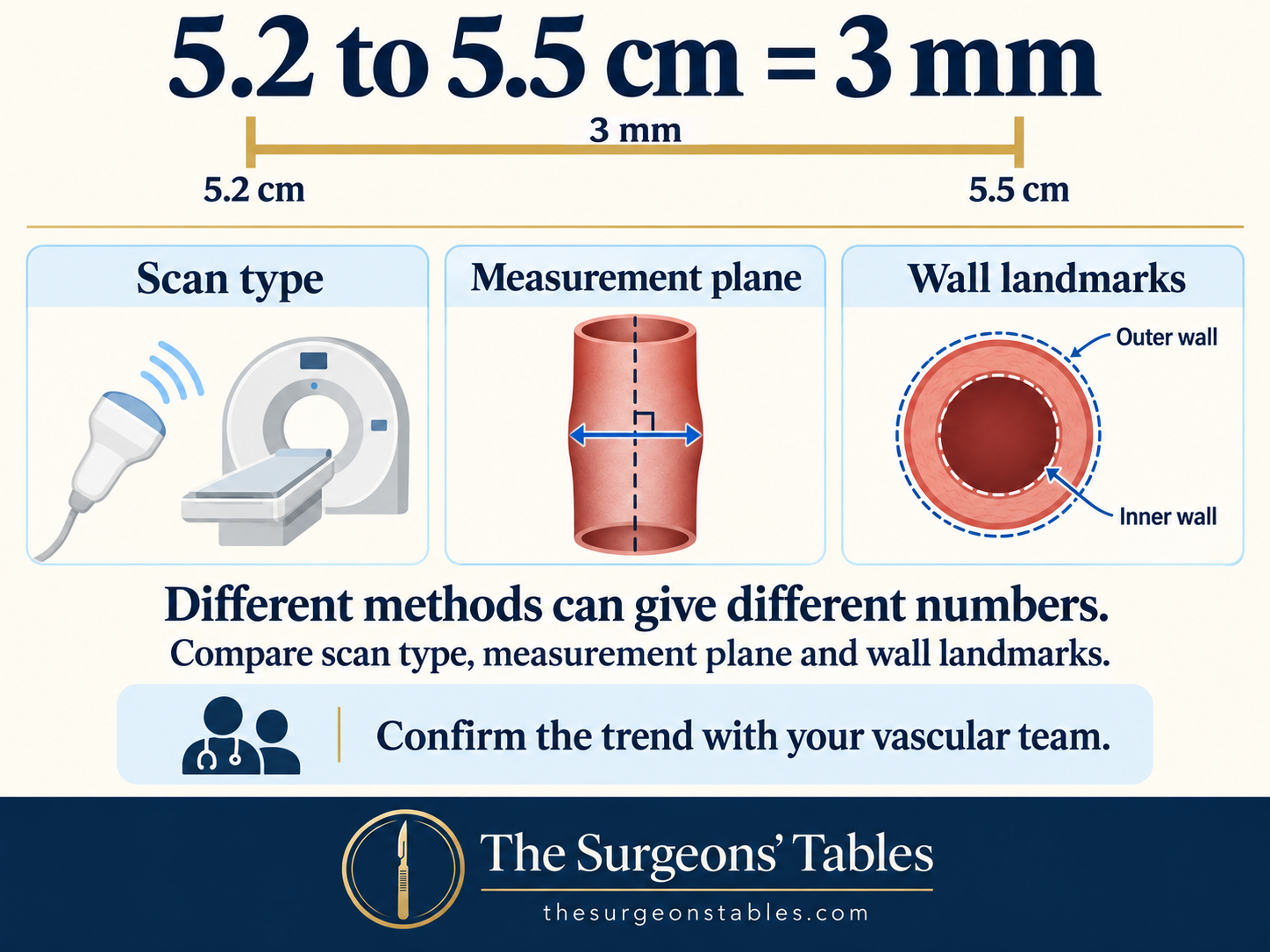
Three millimeters deserve a careful comparison
The distance from 5.2 to 5.5 cm is 3 mm. Ultrasound and CT can give different readings, and the measurement angle and choice of inner or outer wall landmarks can shift a reported diameter by several millimeters. Near a treatment threshold, the method matters. (3)
Ask your vascular surgeon to compare the actual images and measurement methods before deciding that a small change represents growth. There is no universal number to subtract from a CT result. A larger reading needs review, and confirmed growth remains important.
This is also why it helps to bring previous imaging reports and, when available, the images themselves. The useful question is whether the aneurysm has changed on comparable measurements.
The treatment threshold changes with the patient
Women have a higher observed rupture risk at a given diameter. Several guidelines therefore use a lower diameter threshold, although recommendations differ in strength and women were underrepresented in the trials of early repair. (4), (5)
Diameter guidance for a typical, symptom-free AAA
On a phone, swipe the table sideways to see the women’s recommendations.
| Guideline | Men | Women |
|---|---|---|
| ACC/AHA, U.S., 2022 (1) | Repair recommended at ≥5.5 cm | Repair recommended at ≥5.0 cm |
| SVS, U.S., 2018 (2) | Repair recommended at ≥5.5 cm with acceptable surgical risk | Repair suggested at 5.0–5.4 cm |
| ESVS, Europe, 2024 (4) | Repair should be considered at ≥5.5 cm | Repair may be considered at ≥5.0 cm |
| NICE, UK, 2020 (6) | Consider repair at ≥5.5 cm | Same diameter criterion; no separate female cutoff |
These are diameter criteria. Symptoms, growth and shape can change the timing, and measurement conventions also matter. The words “recommended,” “suggested” and “may be considered” preserve real differences between guidelines. For a U.S. woman at 5.2 cm, a monitoring plan should include an explicit repair discussion.
Several findings can bring that discussion forward. New pain attributable to the aneurysm warrants prompt evaluation. A clinician must determine the cause of abdominal, back or flank pain. Confirmed rapid growth—at least 0.5 cm in six months, or about 1 cm in a year—can prompt consideration of repair. ESVS advises remeasurement as the first step when rapid growth is reported. (1), (4)
A saccular aneurysm, a focal bulge on one side, also deserves a different assessment from the usual spindle-shaped, or fusiform, aneurysm. Earlier repair may be considered, but evidence is limited and there is no universally established smaller cutoff. These findings require individualized assessment; the emergency symptoms below require immediate action. (2), (1)
What makes surveillance an active treatment plan
Surveillance uses scheduled imaging and reassessment to identify when the balance between rupture risk and repair risk changes. Repair has its own immediate risks and long-term consequences, which helps explain why an operation can reasonably be deferred in an appropriate patient.
A Cochrane review of four randomized trials involving more than 3,300 people found no demonstrated overall survival advantage from routinely repairing small, symptom-free AAAs early. The early-EVAR studies had shorter follow-up and less certain evidence. The findings support surveillance in selected patients; they do not establish that every person with a small aneurysm should wait. (5)
A large English screening-program study found about 4 ruptures per 1,000 men per year while aneurysms measured 5.0–5.4 cm under structured surveillance. That estimate describes a particular, closely monitored population. It is not a personal risk estimate, does not apply to women, and cannot be assumed to describe every follow-up schedule. (7)
If surveillance remains appropriate, six-month ultrasound is a common schedule at this size. ACC/AHA recommends that interval for men at 5.0 cm or above and women at 4.5 cm or above, with individualization by the treating team. A woman at 5.2 cm also needs assessment for repair. Ultrasound is usually the first surveillance test; CT may be needed if ultrasound cannot adequately show the aneurysm or if repair is being planned. Routine contrast CT every six months is not required for everyone. (1), (2)
Smoking cessation support and clinician-directed blood-pressure and cholesterol care belong in the plan. They support cardiovascular health without guaranteeing that the aneurysm will stop growing. Continue prescriptions as directed and discuss changes with your care team. (8)
Choosing a repair comes after deciding its timing
EVAR, or endovascular aneurysm repair, delivers a fabric-covered stent graft through arteries, usually at the groin, to direct blood through the graft. Open repair places a surgical graft through an abdominal incision. EVAR generally offers faster recovery and lower early operative risk; open repair involves a larger operation and longer recovery. Anatomy, overall health and the tradeoffs over your remaining lifetime guide the choice. (9), (10)
Standard EVAR needs suitable sealing zones and access arteries. The healthy segment below the kidney arteries—the “neck”—must allow a secure seal; its length, width and angle matter. A 5.2 cm diameter alone does not establish eligibility. When standard EVAR anatomy is unsuitable, open repair may be an option if the person is fit for it.
After EVAR, an endoleak means blood still enters the aneurysm sac outside the graft. Some need treatment; others can be monitored. The type of leak and whether the sac is enlarging help determine the next step. FDA emphasizes lifelong imaging and clinical follow-up after EVAR. Open repair also needs periodic follow-up, and lifelong EVAR surveillance does not mean repeated contrast CT for everyone. (10), (11), (2)
Waiting can raise another concern: could the anatomy change enough to lose the EVAR option? One study found that most initially eligible patients remained eligible after two years, but participants started with smaller aneurysms and those repaired earlier were excluded. It cannot guarantee preserved eligibility for someone starting at 5.2 cm. Your surgeon should review the neck and access vessels alongside your heart, lung and kidney health, frailty and life expectancy. (12)
Before you leave the vascular-surgery appointment
Ask the team to write down the confirmed measurement and growth trend, the finding or size that would trigger repair for you, and the next scan date. The discussion should also cover your repair options and expected benefit, whom to contact about new symptoms, and what to do if you cannot attend follow-up. A dated plan makes surveillance active care.
New symptoms change the plan
Call 911 for sudden severe abdominal or back pain, fainting or marked light-headedness. Do not drive yourself. These can signal a serious aneurysm complication. (13), (8)
With a known AAA, new persistent or worsening unexplained abdominal or back pain needs urgent assessment. Contact your treating team promptly; if you cannot obtain urgent advice, seek emergency evaluation. Do not wait for the next scan. Pain alone cannot tell you whether the aneurysm has ruptured.
References
- (1) ACC/AHA aortic disease guideline, 2022. Sections 6.4.3.2, 6.5.5.3, 6.5.5.4 and 6.5.6.2. Official ACC summary.
- (2) Society for Vascular Surgery AAA recommendations, 2018. Aneurysm imaging; the decision to treat; post-repair surveillance.
- (3) Tomee et al. Reliable AAA measurement by ultrasound and CT, 2021. Abstract results; Table 2; discussion.
- (4) ESVS abdominal aorto-iliac aneurysm guideline, 2024. Recommendations 20–24 and 150.
- (5) Ulug et al. Cochrane review of early repair versus surveillance, 2020. Main results; authors’ conclusions; reliability of evidence.
- (6) NICE NG156: AAA diagnosis and management, 2020. Recommendations 1.5.1–1.5.5 and section 1.7.
- (7) Oliver-Williams et al. Surveillance outcomes in the English AAA screening program, 2019. Abstract methods and results; original Table 2.
- (8) NHLBI: Living With an Aortic Aneurysm. Monitor your condition; warning signs; prevention.
- (9) SVS patient information: AAA and its treatments. Treatments: open surgery and endovascular repair.
- (10) SVS patient information: Endovascular AAA repair. Standard repair; risks; imaging tests.
- (11) FDA recommendations for lifelong EVAR surveillance, 2022. Opening paragraph and panel conclusions.
- (12) Panthofer et al. EVAR eligibility during surveillance, 2021. Methods: subject selection and EVAR eligibility; results and Table 3.
- (13) NHLBI: Aortic Aneurysm Symptoms. Symptoms of a rupture.
This article is for general educational purposes and does not replace individualized medical advice. Read our full Medical Disclaimer.