
If you take Wegovy, Ozempic, Zepbound, or Mounjaro, you may receive different instructions because current professional recommendations do not all use the same approach.
You take your weekly injection on Sunday. Surgery is Thursday.
One center says to skip the medication for a week. Another says to continue it but follow a liquid diet. Which is right?
There is no single universal rule for every patient taking semaglutide or tirzepatide before surgery. Newer guidance increasingly uses individualized risk assessment, but professional groups and hospitals still differ on when to hold the medication, when to continue it, and when to change the preoperative diet.
The anesthesia team is trying to answer a practical question: Could food or liquid still be in your stomach when anesthesia begins?
That matters because anesthesia weakens the reflexes that protect the lungs. GLP-1–based drugs can slow stomach emptying, and current U.S. prescribing information for Wegovy and Zepbound includes warnings about rare reports of pulmonary aspiration during general anesthesia or deep sedation. (1), (2)
Who needs more caution?
| More concern for delayed stomach emptying | Why it matters |
|---|---|
| Your dose is still being increased | Dose escalation can increase concern about slower stomach emptying. |
| Significant nausea or vomiting | These symptoms may suggest slower emptying. |
| Marked fullness, bloating, or difficulty tolerating food | Food may be remaining in the stomach longer than expected. |
| Known gastroparesis or another motility disorder | The drug may add to an existing stomach-emptying problem. |
| Other factors affecting the procedure or anesthesia plan | Diabetes management, urgency, and anesthesia approach may change the plan. |
Having no symptoms does not prove that the stomach is empty. The decision cannot be reduced to a simple symptom checklist.
Patients taking Wegovy or Ozempic often ask me what they need to be most careful about. Another question comes up from time to time: “I fasted for my endoscopy, but they told me my stomach still wasn’t empty, so I couldn’t have the examination properly. Could it be because of this medicine?”
I explain that these medicines can slow stomach emptying, so food may remain in the stomach longer. The medicine may be contributing, although that story alone does not establish the cause. When an endoscopy or operation is planned, I explain that the preparation may need to be adjusted—including, in some circumstances, a longer period without solid food. The endoscopy or anesthesia team should give the specific instructions rather than having the patient simply extend the fast on their own.
Why are hospitals giving different instructions?
In 2023, the American Society of Anesthesiologists suggested holding weekly GLP-1 drugs for one week before elective procedures as a precaution during a period of limited evidence.
In 2024, U.S. multisociety clinical practice guidance shifted toward individual risk assessment. Depending on the patient, the treating team may choose continuation, a liquid diet, gastric ultrasound, a different anesthesia plan, postponement, or medication withholding. (3)
But it did not declare the 7-day hold obsolete. If the team decides the drug should be withheld, the guidance says the best interval is unknown and suggests the older one-week interval for weekly drugs until better evidence is available. (3)
Does stopping for 7 days solve the problem?
Not necessarily.
Semaglutide has an elimination half-life of about one week, while tirzepatide’s is about five days. (1), (2) A seven-day hold is not a complete drug washout, and blood levels do not tell us exactly how quickly a person’s stomach is emptying.
In a 2024 observational gastric-ultrasound study, weekly GLP-1 users were more likely to have food or a larger-than-expected amount of fluid still in the stomach despite standard fasting. In that study, longer interruption of the medication was not clearly associated with normalization of residual stomach contents. (4)
That does not prove a seven-day hold is useless. The optimal withholding time remains uncertain. A later systematic review found very-low-certainty evidence that withholding at least one dose may reduce residual stomach contents, but it could not establish the best interval. (5)
Does a 24-hour liquid diet solve the problem?
A 24-hour liquid or clear-liquid strategy appears in several current recommendations because avoiding solid food may reduce concern about solid material remaining in the stomach.
The groups use it differently. Some recommend it mainly when delayed emptying is a concern; others use it more broadly. (3)–(7)
What we cannot say is that a 24-hour liquid diet prevents pulmonary aspiration. That has not been proven in randomized trials. It is a risk-reduction strategy, not a guarantee.
“Liquid diet” also does not mean the same thing everywhere. Follow your hospital’s instructions about what you may drink and when you must stop.
Why current recommendations differ
| Guidance | General approach | What it means for patients |
|---|---|---|
| 2024 U.S. multisociety guidance | Individualize; many lower-risk patients may continue, with added precautions when concern is higher | A routine 7-day hold is not required for everyone, but withholding may still be chosen. (3) |
| 2025 SPAQI consensus | Generally continue without significant GI symptoms; avoid solid food for 24 hours | Some U.S. teams favor continuation plus a longer solid-food fast. (6) |
| 2025 Australia/New Zealand recommendations | Generally continue; use a 24-hour clear-fluid diet | Greater emphasis on dietary preparation than routine medication cessation. (7) |
| 2025 ESAIC guidance | More conservative medication withholding plus clear-fluid preparation | Some clinicians may recommend a longer hold under this framework. (8) |
The practical point: there is no universal professional consensus. Different hospitals may reasonably weigh incomplete evidence differently.
A fuller stomach is not the same as aspiration
This is the distinction that matters most.
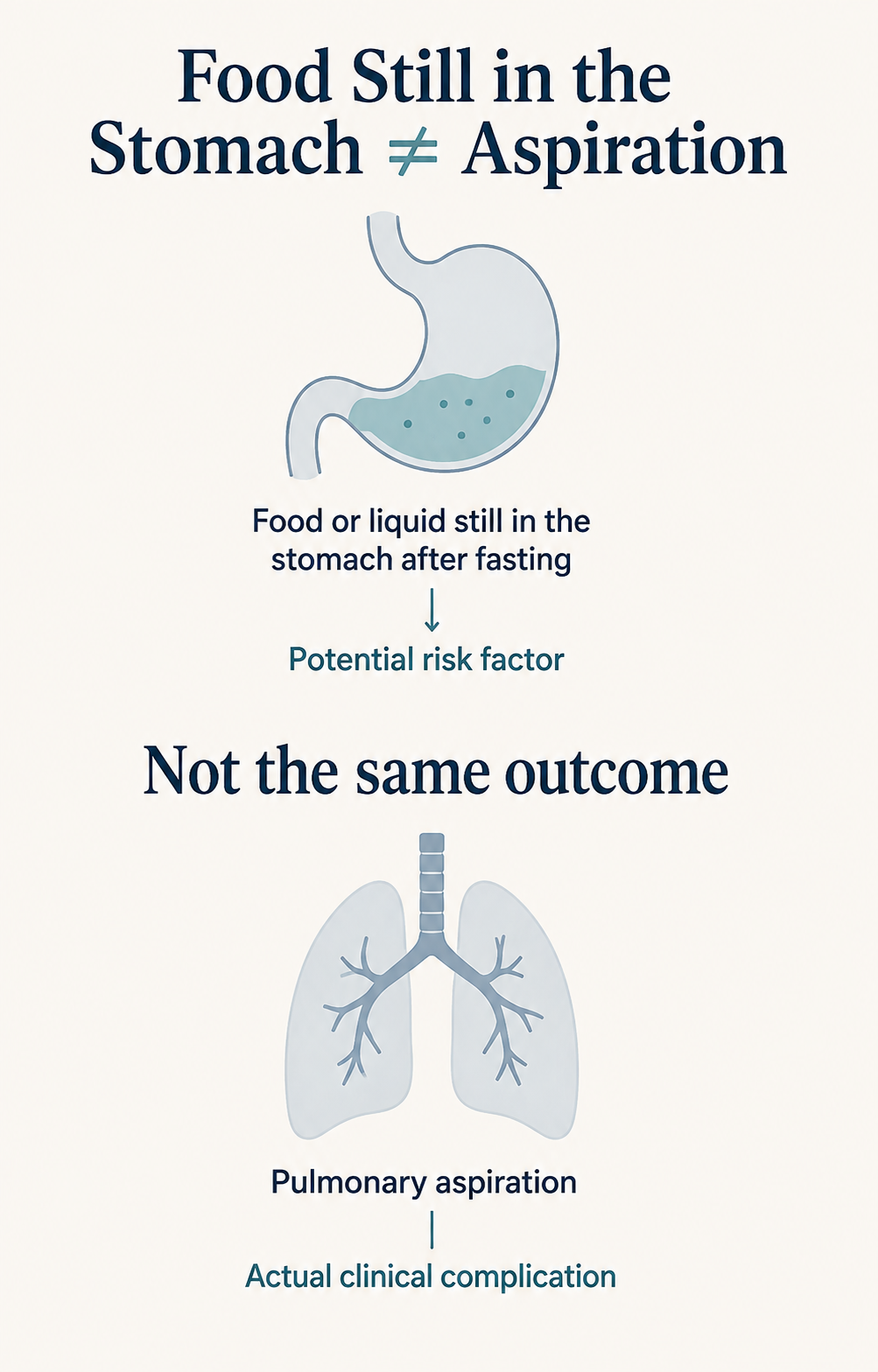
GLP-1 users appear more likely to have food or fluid still in the stomach despite standard fasting. In one ultrasound study, increased residual stomach contents were found in 56% of weekly GLP-1 users versus 19% of people not using the drugs. (4)
But food still in the stomach is not the same as food entering the lungs.
A 2025 systematic review found increased residual stomach contents among GLP-1 users but no statistically significant increase in pulmonary aspiration. The certainty of the aspiration evidence was low. (5)
That is reassuring, but it does not prove the risk is zero. The aspiration data are observational, not randomized.
“The question is no longer only, ‘When was your last shot?’ It is, ‘How likely is your stomach to still contain food today, and what is the safest way to manage that risk?’”
What should I tell my anesthesia team?
Before surgery, make sure the team knows:
- your exact medication
- your current dose
- the date of your last dose
- any recent dose increase
- any nausea, vomiting, marked fullness, bloating, or difficulty tolerating food
- whether you have diabetes or known delayed stomach emptying
- who prescribes the medication
Medication continuation or withholding should be decided by the treating team, not by the patient alone. If the drug is part of your diabetes treatment, stopping it may also require a plan for glucose control. (9), (3)
In selected cases, the anesthesia team may use gastric ultrasound to look for stomach contents before the procedure. It can support decision-making, but it does not perfectly predict aspiration. (3)
Bottom Line
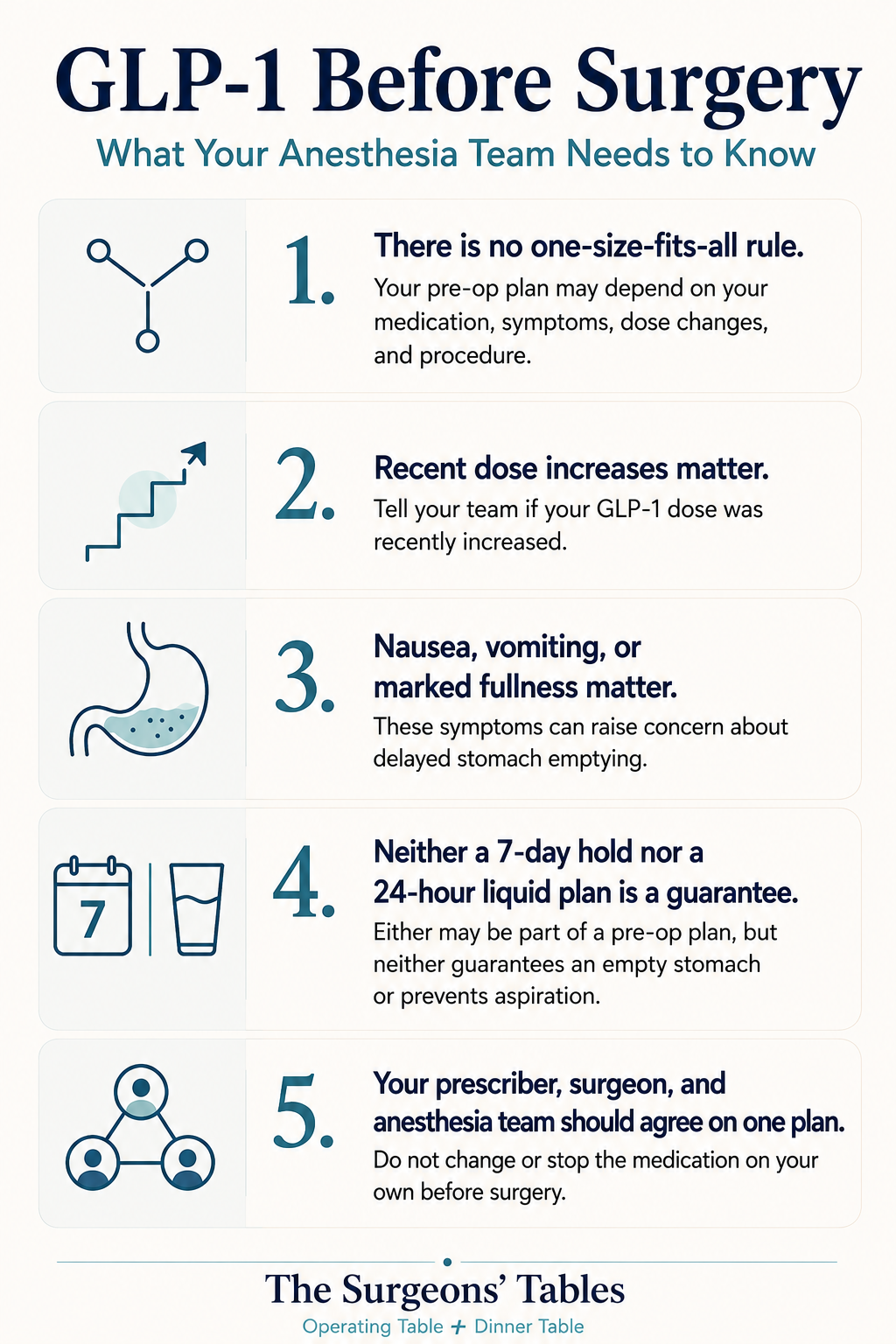
There is no one-size-fits-all rule for semaglutide or tirzepatide before surgery. A 7-day hold is not a guaranteed solution, and a 24-hour liquid strategy has not been proven to eliminate aspiration risk.
The best plan depends on your medication, dose changes, symptoms, other medical conditions, and procedure. Before surgery, make sure your prescriber, surgeon, and anesthesia team agree on one plan.
References
- (1) Wegovy (semaglutide) Prescribing Information. U.S. prescribing information.
- (2) Zepbound (tirzepatide) Prescribing Information. U.S. prescribing information.
- (3) Kindel TL, Wang AY, Wadhwa A, et al.
Multi-society clinical practice guidance for the safe use of glucagon-like peptide-1 receptor agonists in the perioperative period.
Surgical Endoscopy. 2025;39:180–183. Published online October 29, 2024.
doi:10.1007/s00464-024-11263-2 - (4) Sen S, Potnuru PP, Hernandez N, et al.
Glucagon-Like Peptide-1 Receptor Agonist Use and Residual Gastric Content Before Anesthesia.
JAMA Surgery. 2024;159(6):660–667.
doi:10.1001/jamasurg.2024.0111
PMID: 38446466 - (5) Elkin J, Rele S, Sumithran P, et al.
Association between glucagon-like peptide-1 receptor agonist use and peri-operative pulmonary aspiration: a systematic review and meta-analysis.
Anaesthesia. 2025;80(7):846–858.
doi:10.1111/anae.16601
PMID: 40230298 - (6) Oprea AD, Ostapenko LJ, Sweitzer B, et al.
Perioperative management of patients taking glucagon-like peptide 1 receptor agonists: Society for Perioperative Assessment and Quality Improvement multidisciplinary consensus statement.
British Journal of Anaesthesia. 2025;135(1):48–78.
doi:10.1016/j.bja.2025.04.001
PMID: 40379536 - (7) Hocking SL, Scott DA, Remedios ML, et al.
2025 ADS/ANZCA/GESA/NACOS clinical practice recommendations on the peri-procedural use of GLP-1/GIP receptor agonists.
Anaesthesia and Intensive Care. 2025;53(5):300–306.
doi:10.1177/0310057X251355288
PMID: 40814081 - (8) Lamperti M, Romero CS, Guarracino F, et al.
Preoperative assessment of adults undergoing elective noncardiac surgery: Updated guidelines from the European Society of Anaesthesiology and Intensive Care.
European Journal of Anaesthesiology. 2025;42:1–35.
doi:10.1097/EJA.0000000000002069 - (9) American Diabetes Association Professional Practice Committee for Diabetes.
16. Diabetes Care in the Hospital: Standards of Care in Diabetes—2026.
Diabetes Care. 2026;49(Suppl 1):S339–S355.
doi:10.2337/dc26-S016
PMID: 41358892