


Yes, semaglutide reduced knee osteoarthritis pain in a randomized trial of adults with obesity. The trial cannot tell us how much of that benefit came from weight loss, whether the drug also relieved pain through a separate action in people, or whether it helps patients avoid knee replacement. If your pain and mobility have improved, it makes sense to revisit the timing of surgery with your orthopedic surgeon. It does not mean that the joint has healed or that a scheduled operation should be canceled without reassessment.
How much pain relief did the trial find?
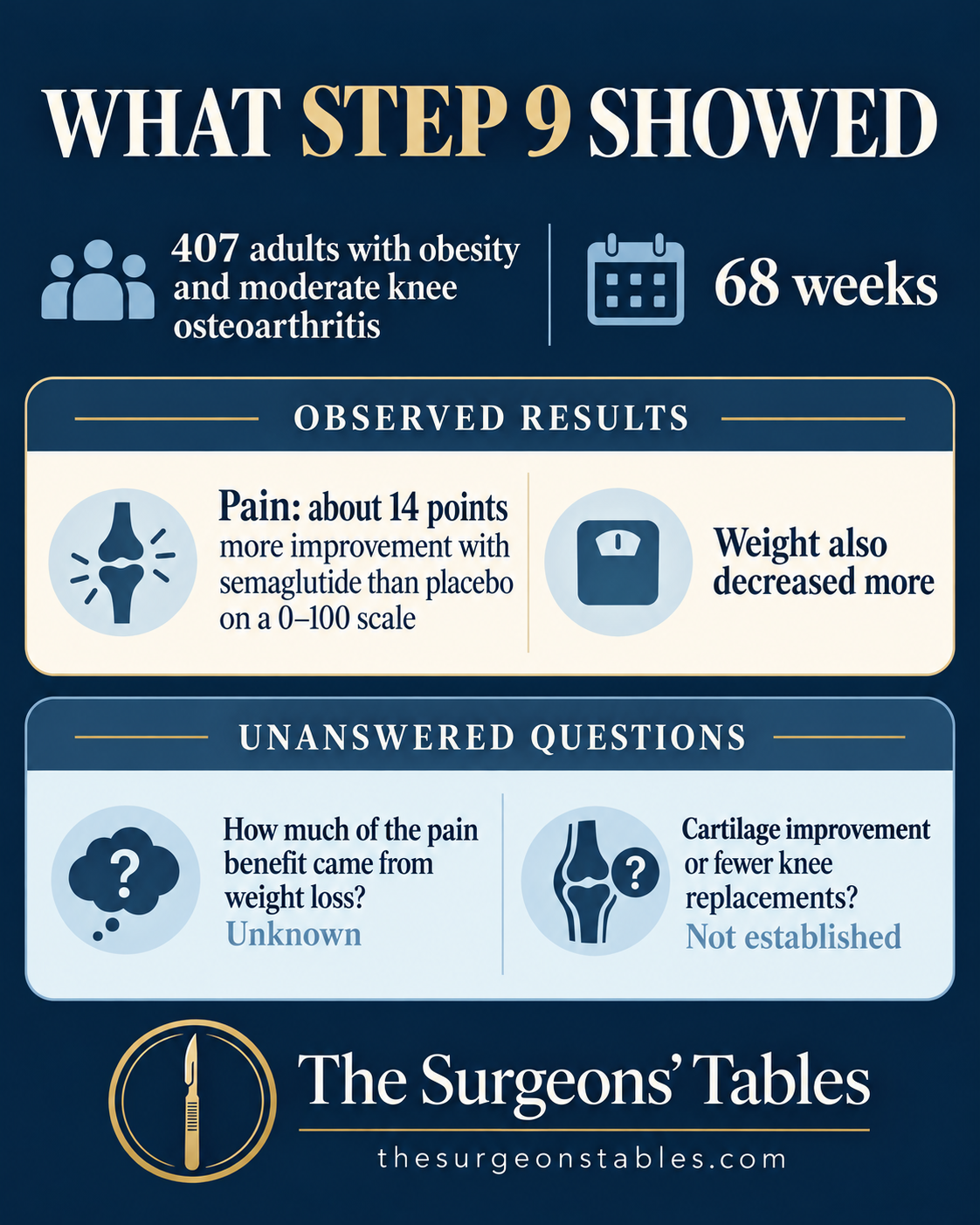
The STEP 9 trial enrolled 407 adults with obesity (body mass index of at least 30), moderate knee osteoarthritis, and at least moderate knee pain. Their average age was 56, average body mass index was 40.3, and about four in five were women. Participants received either weekly injected semaglutide 2.4 mg or placebo for 68 weeks. Both groups also received counseling about a reduced-calorie diet and physical activity. The trial was randomized and double-blind, and Novo Nordisk funded it. (1)
On a 0-to-100 knee-pain scale, where higher scores mean worse pain, the semaglutide group’s average score fell by 41.7 points. The placebo group’s fell by 27.5 points. The useful comparison is the difference between groups—about 14 points—rather than the 41.7-point change alone. Average body weight changed by −13.7% with semaglutide and −3.2% with placebo. A separate measure of physical function also improved more in the semaglutide group. These are group averages; they do not predict an individual’s response. (1)
The placebo group’s improvement matters. Both groups received diet and activity counseling, and pain can change for several reasons during a trial. STEP 9 cannot assign that group’s improvement to counseling, weight loss, expectations, or ordinary variation. It does show that adding semaglutide produced greater average pain relief than the comparison treatment over 68 weeks. (1)
Adverse events led 6.7% of participants taking semaglutide to stop the trial treatment permanently, compared with 3.0% taking placebo; gastrointestinal problems were the most common reason. A treatment decision has to include tolerability as well as the average benefit. (1)
Was the pain relief caused by weight loss or another drug effect?
Weight loss is a plausible contributor. But STEP 9 randomly assigned people to a medication, not to a fixed amount of weight loss. Weight and pain then changed after treatment began. The trial measured the overall treatment difference; it did not divide the roughly 14-point extra pain improvement into a weight-loss portion and a weight-independent portion. We cannot say that the relief was entirely due to weight loss, or that a separate joint effect was responsible for it. (1)
Other knee arthritis research shows why pain cannot be read directly from the scale. In the randomized IDEA trial, a diet-and-exercise program improved pain more than either approach alone. Diet alone reduced measured knee loading compared with exercise alone, yet did not produce greater pain relief. Weight, joint loading, exercise, and pain are related, but the relationship is not one-to-one. This does not establish semaglutide’s mechanism; it helps explain why weight change alone cannot settle the question. (2)
Could semaglutide act on the joint through another pathway? A 2026 study found weight-independent joint effects in diet-controlled experiments with obese mice and reported changes in cartilage-cell metabolism. It also included a small human pilot. That pilot did not establish that the drug relieves human knee pain independently of weight loss. The animal findings are a reason for further research, not proof of the mechanism behind STEP 9’s pain results or of human cartilage regrowth. (3)
Does less pain mean the arthritis itself has improved?
STEP 9 measured weight, pain, and physical function. It did not establish that semaglutide rebuilt cartilage, improved the arthritis seen on X-ray, or reduced the number of knee replacements. Nor does a 68-week result tell us how long a benefit will last after treatment stops. The trial studied a particular injected dose in people with obesity and moderate osteoarthritis. It cannot promise the same result for someone with advanced deformity or instability, or for every GLP-1 drug and dose. (1)
Less pain still matters. Knee replacement is a decision about how a person lives and moves with that knee, not an X-ray grade alone. Someone with striking imaging changes may function fairly well; someone else may struggle to walk after trying appropriate nonsurgical care. A change in symptoms can change the timing conversation even when the joint’s structure has not been shown to change.
Weight management remains part of standard knee arthritis care. The American Academy of Orthopaedic Surgeons recommends sustained weight loss to improve pain and function in people with knee osteoarthritis and overweight or obesity; it rates the strength of that recommendation as moderate. The American College of Rheumatology and Arthritis Foundation strongly recommend weight loss and exercise for appropriate patients. Those recommendations do not make semaglutide a proven cartilage-regrowing drug or a proven substitute for surgery. (4, 5)
If your symptoms improve, can you postpone knee replacement?
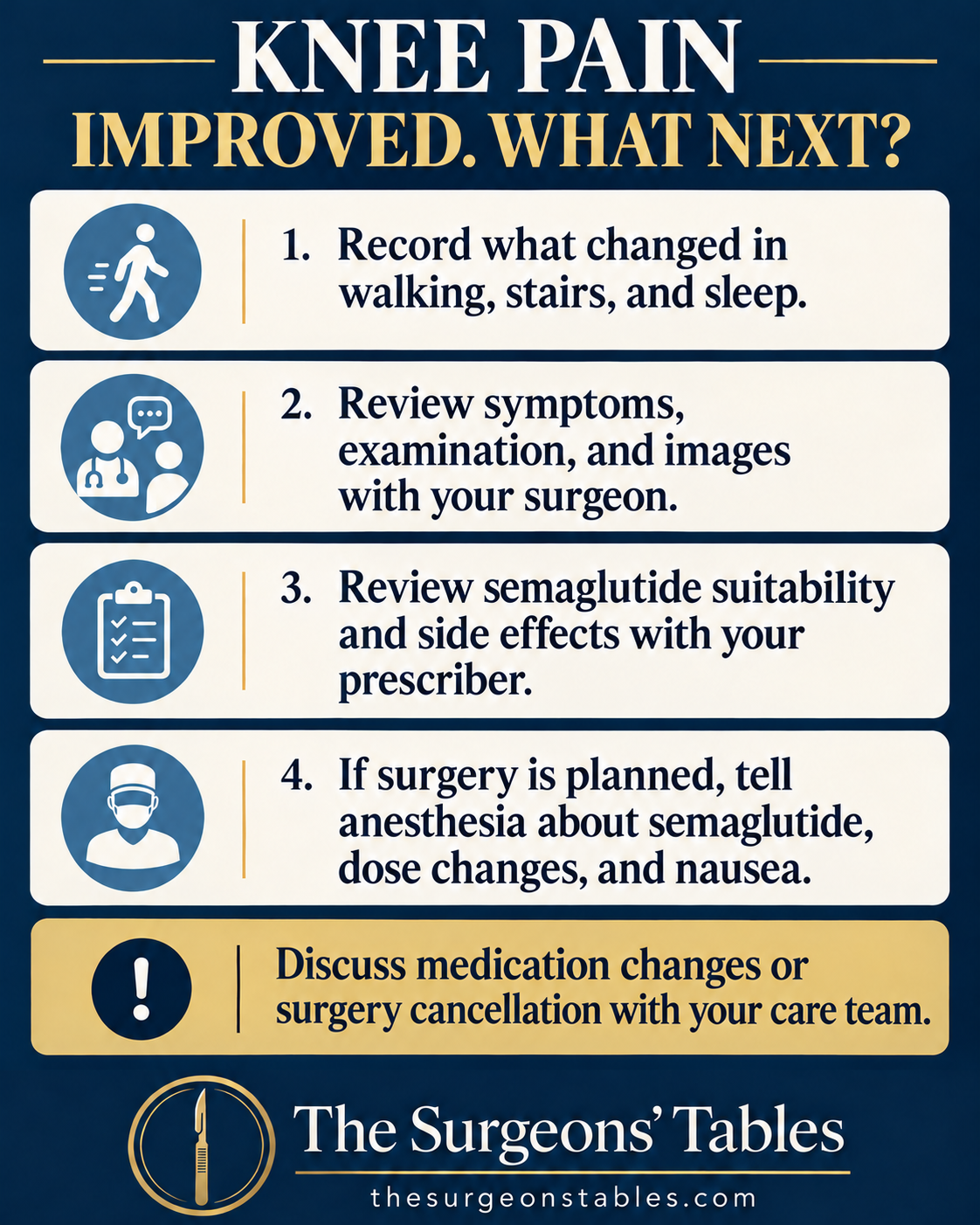
Possibly, after a fresh assessment. Tell your orthopedic surgeon what has changed: stairs, shopping, sleep, time on your feet, and what still stops you. Ask whether an examination or updated weight-bearing X-rays would change the plan. Reassessment may support waiting while you follow symptoms and function. It may instead show that pain relief has not resolved a major loss of function, instability, or deformity. Do not cancel a scheduled operation based only on a better week or a number on the scale.
There is a limit to “let’s wait longer,” too. For patients who have already tried appropriate nonsurgical treatment, still have moderate-to-severe symptoms and imaging findings, and have chosen joint replacement, a 2023 U.S. guideline conditionally recommends against delaying surgery simply to try more nonsurgical treatments or reach a rigid body-mass-index target. It encourages weight loss and discussion of individual surgical risks, and conditionally advises against delay for severe deformity or bone loss. Evidence supporting these timing recommendations is low or very low certainty. The guideline applies to people already considering replacement; it does not tell everyone with knee pain to have surgery. (6)
The question to bring to your next visit is: “Given what I can do now, what I still cannot do, and what my knee examination and images show, is replacement still the best choice at this time?” STEP 9 did not establish whether semaglutide changes knee replacement rates, so it cannot answer that question for you. (1)
What cautions matter if you take semaglutide?
The current U.S. prescribing information for Wegovy injection does not list knee osteoarthritis as an approved indication. STEP 9 therefore should not be treated as an instruction to start semaglutide solely to postpone surgery. Your prescriber should review whether the drug is appropriate for you, including other medical conditions and treatments. The label contraindicates Wegovy for people with a personal or family history of medullary thyroid carcinoma or multiple endocrine neoplasia type 2, and warns about problems that include severe gastrointestinal effects, pancreatitis, gallbladder disease, and dehydration-related kidney injury. This is a reason for an individual medication review, not a list for self-prescribing. (7)
If surgery remains the plan, tell your prescriber, surgeon, and anesthesia team that you take semaglutide, your current dose, any recent dose change, and any nausea or vomiting. Current U.S. perioperative guidance does not require every patient to stop a weekly GLP-1 drug for one week before surgery; the plan depends on individual risk and the procedure. Do not change the prescription on your own. Our separate article explains why preoperative GLP-1 instructions can differ. (7, 8)
Semaglutide’s effect on pain is a reason to reassess how your knee is working now. Whether that improvement will let a particular person delay or avoid replacement remains an open question. Bring the change in your daily function, your remaining limits, and your medication list to the surgical visit.
References
- Bliddal H, et al. Once-Weekly Semaglutide in Persons with Obesity and Knee Osteoarthritis. New England Journal of Medicine. 2024;391:1573–1583. doi:10.1056/NEJMoa2403664. Abstract: Methods, Results, Conclusions.
- Messier SP, et al. Effects of Intensive Diet and Exercise on Knee Joint Loads, Inflammation, and Clinical Outcomes: The IDEA Randomized Clinical Trial. JAMA. 2013;310:1263–1273. doi:10.1001/jama.2013.277669. Abstract: Interventions, Results.
- Qin H, et al. Semaglutide Ameliorates Osteoarthritis Progression Through a Weight Loss-Independent Metabolic Restoration Mechanism. Cell Metabolism. 2026;38:582–597.e6. doi:10.1016/j.cmet.2026.01.008. Abstract (animal experiments and exploratory human pilot); the accessible abstract does not quantify the human pilot’s mechanism.
- American Academy of Orthopaedic Surgeons. Management of Osteoarthritis of the Knee (Non-Arthroplasty), 3rd ed.. 2021. PDF p. 8, Summary of Recommendations: Weight Loss Intervention; pp. 38–39, rationale.
- Kolasinski SL, et al. 2019 ACR/Arthritis Foundation Guideline for the Management of Osteoarthritis of the Hand, Hip, and Knee. Arthritis & Rheumatology. 2020;72:220–233. doi:10.1002/art.41142. Abstract: Results; Figure 1 caption.
- Hannon CP, et al. 2023 ACR/AAHKS Guideline for the Optimal Timing of Elective Hip or Knee Arthroplasty. Arthritis Care & Research. 2023;75:2227–2238. doi:10.1002/acr.25175. PDF pp. 1–2: Results and Summary.
- Novo Nordisk. Wegovy (semaglutide) U.S. Prescribing Information. Revised June 2026. Sections 1, 4, 5.2–5.6, and 5.10; accessed October 9, 2026.
- American Society of Anesthesiologists. Drugs for Diabetes or Weight Loss: What To Know Before Surgery. Sections “Do I need to stop” and “What conditions raise my risk”; accessed October 9, 2026.