

An abdominal aortic aneurysm can grow silently, yet screening everyone creates more testing without proven benefit. One group has a clear recommendation for a one-time ultrasound; for women, never-smokers, and people with family history, the answer depends on which U.S. guideline is being used.
At a Glance
- USPSTF recommends a one-time abdominal ultrasound for men ages 65–75 who have ever smoked (1).
- Men 65–75 who never smoked should be offered screening selectively, based on other risks and preferences (1).
- USPSTF recommends against routine screening in women who never smoked and have no family history; evidence is insufficient for women 65–75 who smoked or have a family history (1).
- A positive screen usually leads to size-based follow-up, not automatic surgery (2).
What the scan is looking for
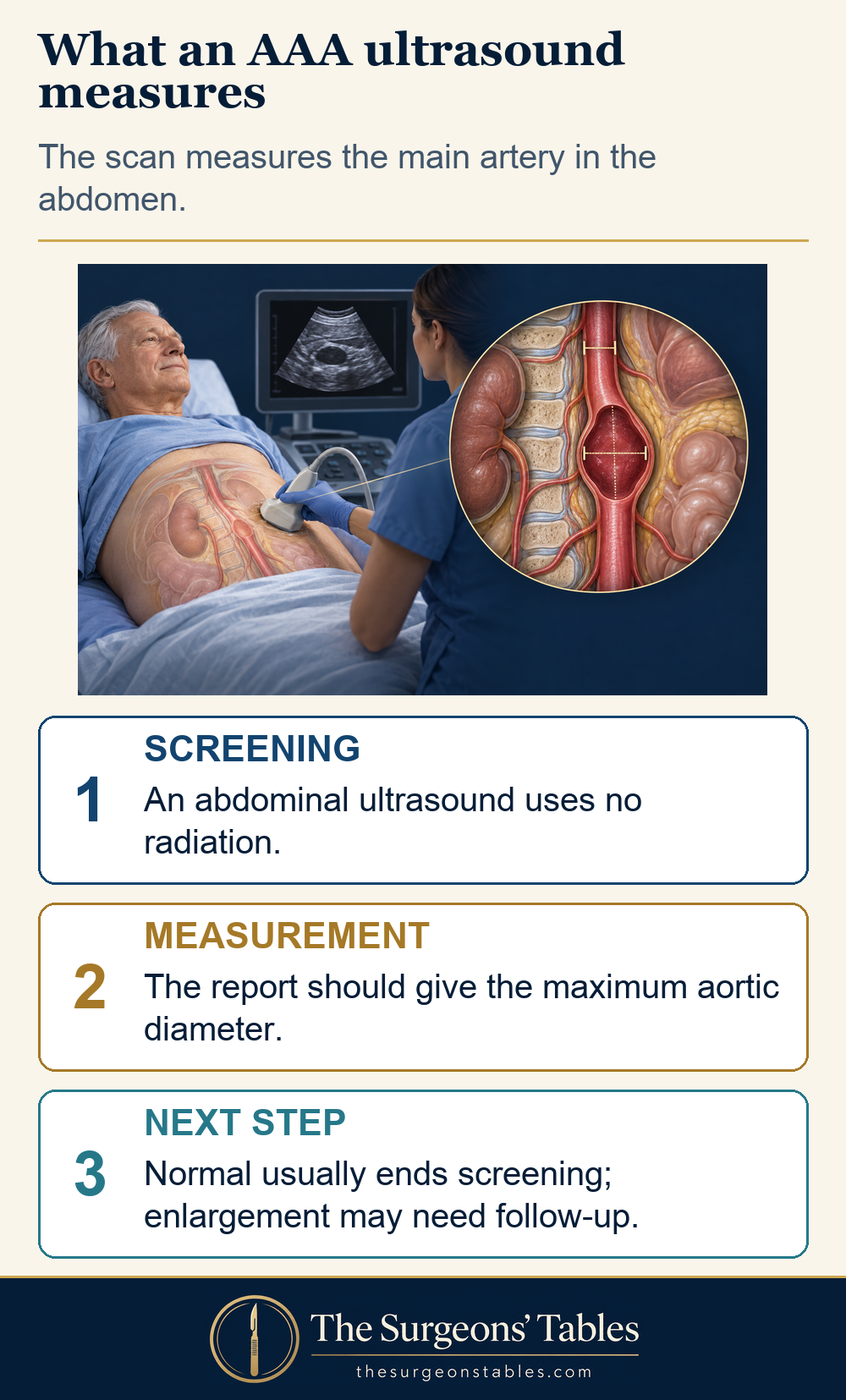
An abdominal aortic aneurysm, or AAA, is enlargement of the main artery through the abdomen. It often causes no symptoms until it becomes large or ruptures. A screening ultrasound is quick, noninvasive, and does not use radiation. Its purpose is to find enlargement early in a person who feels well.
That last point is important. Screening guidance applies to people without symptoms. Sudden severe abdominal or back pain, fainting, low blood pressure, or shock is an emergency, not a reason to schedule a routine screening appointment.
The clearest yes: men 65–75 who ever smoked
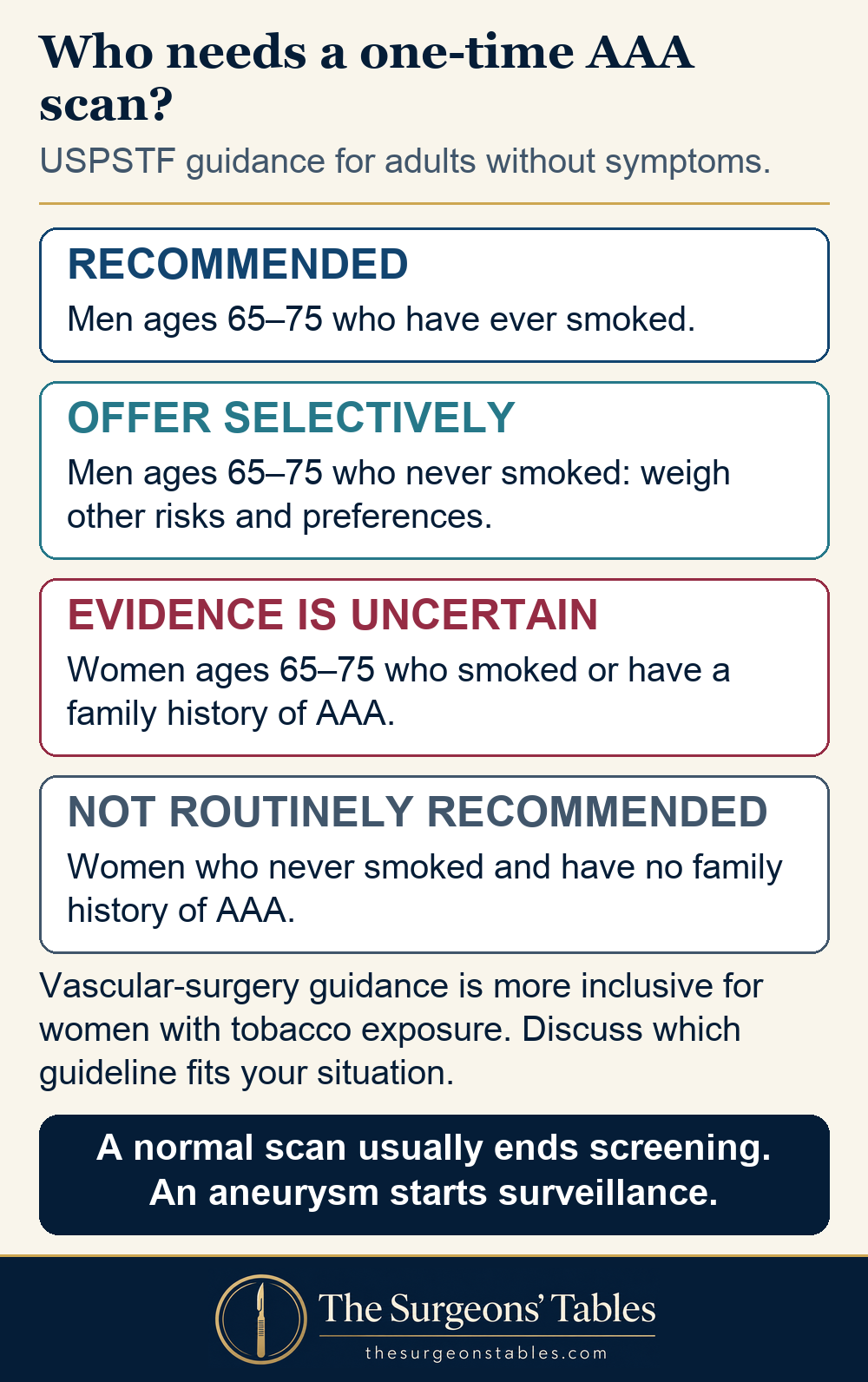
USPSTF gives a Grade B recommendation for one-time ultrasound screening in men ages 65 through 75 who have ever smoked (1). In the studies behind this guidance, “ever smoked” was commonly defined as at least 100 cigarettes over a lifetime. A person does not need to be a current smoker to qualify.
Why this group? Age, male sex, and smoking all raise AAA risk, and randomized trials found that inviting older men to screening reduced AAA-related deaths. Most trial participants were men, which is also why the evidence is less certain for women (3).
“One-time” means a normal scan usually completes the preventive screening task. It does not mean a person with enlargement gets only one scan; once an aneurysm is found, the process changes from screening to surveillance.
Men who never smoked
For men 65–75 who never smoked, USPSTF gives a Grade C recommendation: selectively offer screening rather than screen everyone (1). The decision can consider older age within the range, a first-degree relative with AAA, other cardiovascular risk, overall health, and whether the person would be willing and fit to undergo follow-up or repair if a large aneurysm were found.
Screening has less value when severe illness or limited life expectancy makes future repair unrealistic. It may have more value when family history raises baseline risk. This is a preference-sensitive conversation, not a rejection of screening.
Women: where guidelines diverge
USPSTF recommends against routine screening in women who have never smoked and do not have a family history of AAA (1). For women ages 65–75 who have ever smoked or have a family history, USPSTF says the evidence is insufficient. An “I statement” means the available evidence cannot reliably determine the balance of benefits and harms; it does not mean risk is zero.
The Society for Vascular Surgery is more inclusive. It strongly recommends one-time ultrasound for men or women ages 65–75 with a tobacco history, while its recommendation to screen first-degree relatives is a weaker suggestion based on low-quality evidence (2). This disagreement reflects limited direct trial evidence in women and different judgments about how to act under uncertainty. A woman with smoking exposure or a parent, sibling, or child with AAA should bring those details to a shared decision rather than being told the answer is universally yes or no. The USPSTF and SVS recommendations differ, so ask which guidance applies to your risk factors.
What happens after the ultrasound
When an aneurysm is found, patients often ask me, “Could it really burst? Do I need surgery right away?” I sometimes compare it with a balloon: as it gets larger, the possibility of rupture becomes a concern. I am explaining a risk, not predicting that it will inevitably happen. We discuss treatment because a rupture can be extremely dangerous.
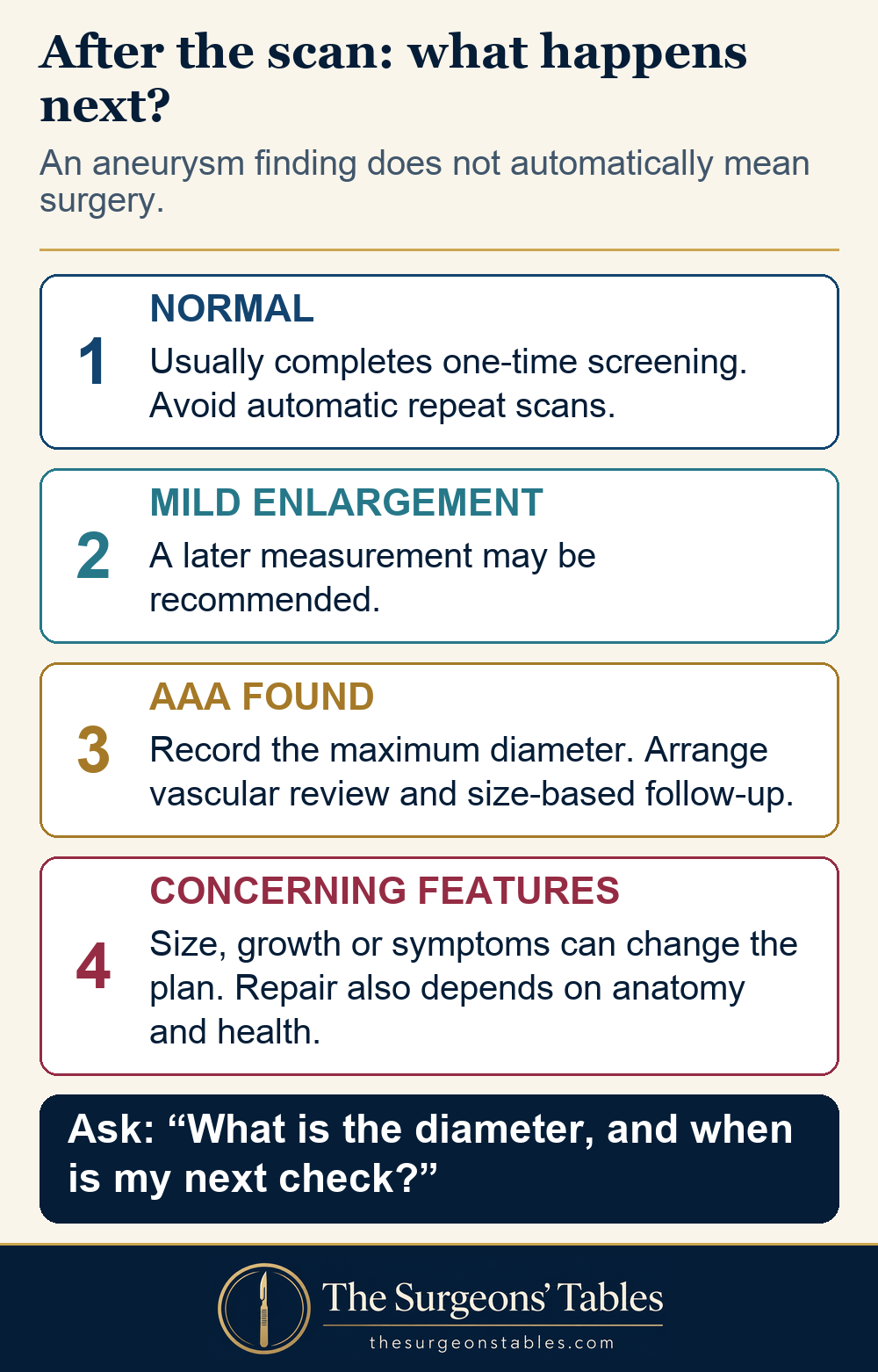
The report measures the aorta's diameter. A normal result generally ends screening. Mild enlargement may prompt a repeat scan years later; a small aneurysm is usually monitored more often as diameter increases. SVS guidance uses progressively shorter surveillance intervals as aneurysms grow and recommends vascular-surgery referral when an aneurysm is diagnosed (2).
I then explain that size is only part of the decision. I consider the patient’s age, the risks of repair, the aneurysm’s characteristics, sex, and smoking history. If it is not yet large enough to warrant repair and reliable follow-up is feasible, we may agree to monitor it with scheduled imaging. When the overall balance favors treatment, I explain why repair may be the better option for that person.
A positive screen does not equal an operation. Repair decisions consider diameter, growth rate, symptoms, anatomy, operative risk, life expectancy, and patient preferences. Surveillance is active care: its purpose is to intervene if the balance eventually shifts.
Screening also has possible harms. An uncertain or borderline measurement can create anxiety and more testing. Elective repair carries real procedural risk. The benefit comes from finding the right aneurysms in people likely to live long enough to benefit from surveillance and, if necessary, repair.
A five-question checklist
- Am I between 65 and 75?
- Have I smoked at least 100 cigarettes in my lifetime, even if I quit decades ago?
- Has a parent, sibling, or child had an abdominal aortic aneurysm?
- Have I already had an abdominal CT, MRI, or ultrasound that clearly measured my aorta?
- If an aneurysm were found, would surveillance and possible repair fit my health goals?
Bring prior imaging reports. A scan performed for another reason may already contain the needed measurement, avoiding duplication.
Family history changes the conversation
A first-degree relative means a parent, sibling, or child. If that relative had an AAA, note the age at diagnosis and whether rupture occurred. Family history can increase risk even when a person never smoked, which is why specialty guidance suggests screening selected relatives (2). It is also one reason a never-smoking man in the USPSTF selective group may reasonably choose the scan.
For women, family history or tobacco exposure moves the decision into an evidence gap. A clinician may reasonably discuss ultrasound because the test itself is low burden, while also acknowledging that trials have not shown the same population-level benefit established in older men. The quality of the decision depends on stating that uncertainty, not disguising it as a firm national rule.
Screening is only one part of prevention
An ultrasound does not prevent every aneurysm, and repeating scans after a normal result without a reason can add cost and incidental findings. Smoking cessation remains central because smoking affects aneurysm formation, growth, and overall cardiovascular risk. Blood pressure, lipids, physical activity, and other vascular risks deserve attention whether the aorta is normal or enlarged.
If an aneurysm is found, ask for its exact maximum diameter and the recommended date of the next study. Keep that number in the medical record. A plan stated only as “small—recheck later” is easy to lose during a change of clinic or insurance.
Avoid duplicate screening
Many adults have already had abdominal imaging for kidney stones, abdominal pain, cancer surveillance, or another reason. Before ordering a screening ultrasound, check whether a prior study clearly visualized and measured the infrarenal aorta. If it did, the clinician can decide whether that examination already answered the screening question. If the aorta was not adequately seen or the report is silent, a dedicated ultrasound may still be appropriate. The goal is a reliable measurement, not a particular billing label.
If the result is technically limited
Body habitus and bowel gas can sometimes prevent a complete ultrasound view. A limited study is not the same as a normal aorta. The ordering clinician should decide whether a repeat ultrasound or another imaging method is justified, based on the reason for screening and any prior images.
The practical conclusion
The strongest U.S. recommendation is simple: one ultrasound for men 65–75 who ever smoked. The decisions for never-smoking men and for women require more individual judgment, especially when family history is present. The scan is a gateway to risk-based follow-up, not a verdict that surgery is needed.
References
This article provides general educational information and does not replace evaluation, diagnosis, or treatment by a qualified healthcare professional. Read our medical disclaimer.