

Maybe you have heard the story or lived it yourself: bread causes bloating or discomfort at home, but croissants, pasta, or a crusty loaf seem easier to eat on a trip to France or Italy. It is tempting to conclude that European wheat is different, American wheat is unusually high in gluten, or a chemical used in U.S. farming must be responsible.
That experience may be real. But it does not identify the cause.
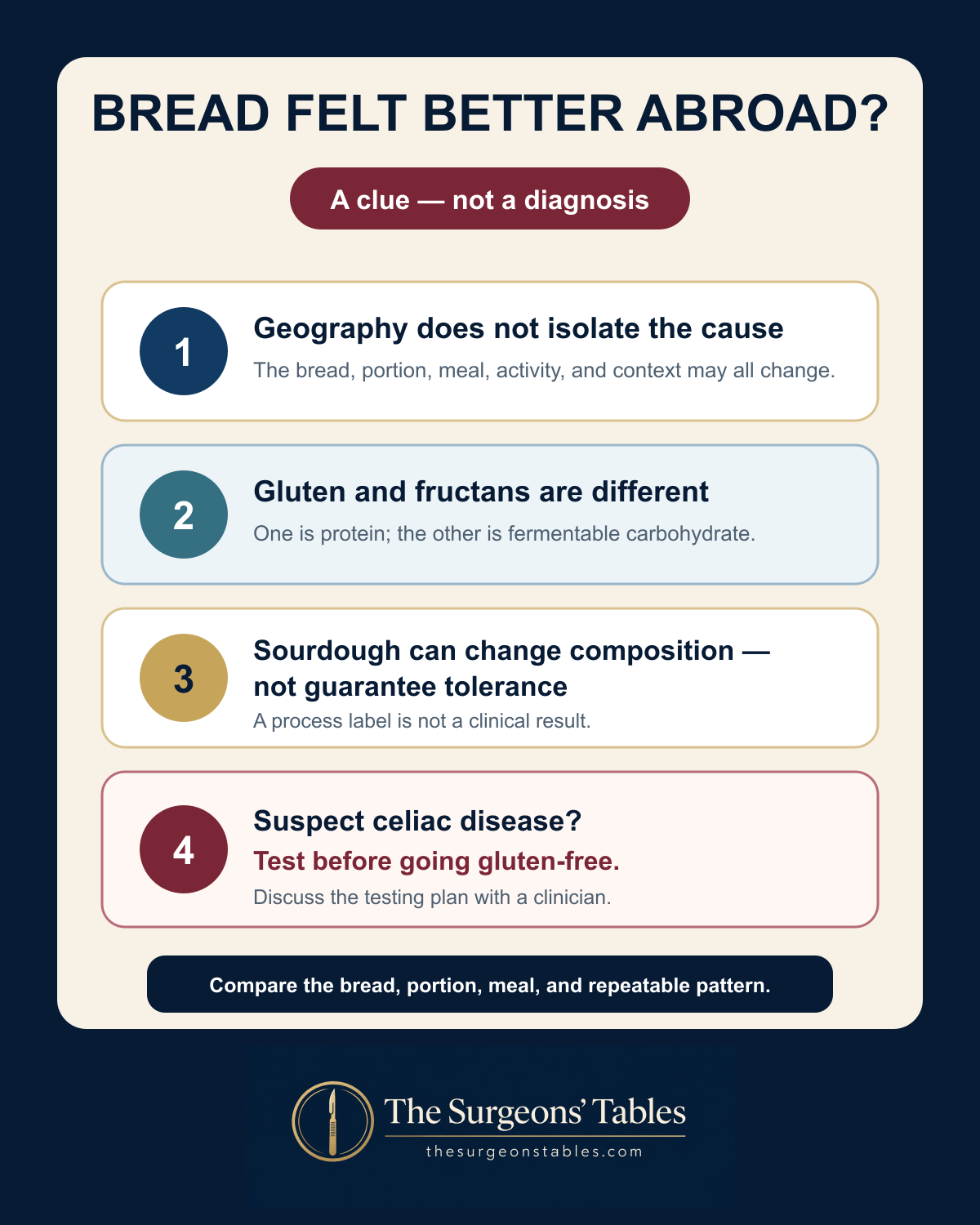
A trip changes the bread, the amount eaten, the rest of the meal, activity, sleep, stress, and expectations at the same time. The evidence reviewed here did not include a trial that fed the same travelers matched U.S. and European breads. Several mechanisms can produce similar symptoms, and geography alone cannot tell them apart.
At a Glance
- Ordinary wheat bread contains gluten whether it is made in the United States or Europe. For someone with celiac disease, European origin does not make it safe. (1), (2)
- In one randomized crossover trial of 59 people with self-reported non-celiac gluten sensitivity, fructans caused higher symptom scores than gluten at the group level. Gluten did not differ from placebo, but individual responses varied. (3)
- A separate small trial also failed to reproduce a specific gluten effect after participants reduced FODMAPs. These studies do not prove that fructans explain every case. (4)
- Sourdough fermentation can change a bread’s fructan and other components, but one small trial found no better gastrointestinal tolerance for the particular sourdough wheat bread it tested. (5)
- Claims about “modern American wheat” and glyphosate often mix a limited piece of evidence with a much broader conclusion. Neither claim has been shown to explain why one person feels better while traveling. (6), (7)
First, separate celiac disease from food-related symptoms
Celiac disease is an immune-mediated disease triggered by gluten in wheat, barley, and rye. The American College of Gastroenterology describes it as a permanent response that requires a strict gluten-free diet and lifelong follow-up. (1) NIDDK likewise states that people with celiac disease need a gluten-free diet for life and lists wheat varieties such as durum, emmer, semolina, and spelt as natural sources of gluten. (2)
That makes the country of origin irrelevant to the basic safety question. A regular baguette in Paris and a regular loaf in Chicago are both wheat products unless specifically made and handled as gluten-free. Feeling no immediate symptoms does not establish safety for a person with celiac disease.
Symptoms alone also cannot diagnose celiac disease. NIDDK says doctors most often use blood tests and small-intestinal biopsies and advises against starting a gluten-free diet before diagnostic testing because removing gluten can affect the results. (8) Anyone who may have celiac disease should discuss testing with a clinician before making a major dietary change rather than using a vacation meal as a diagnostic experiment.
Gluten and fructans are different parts of wheat
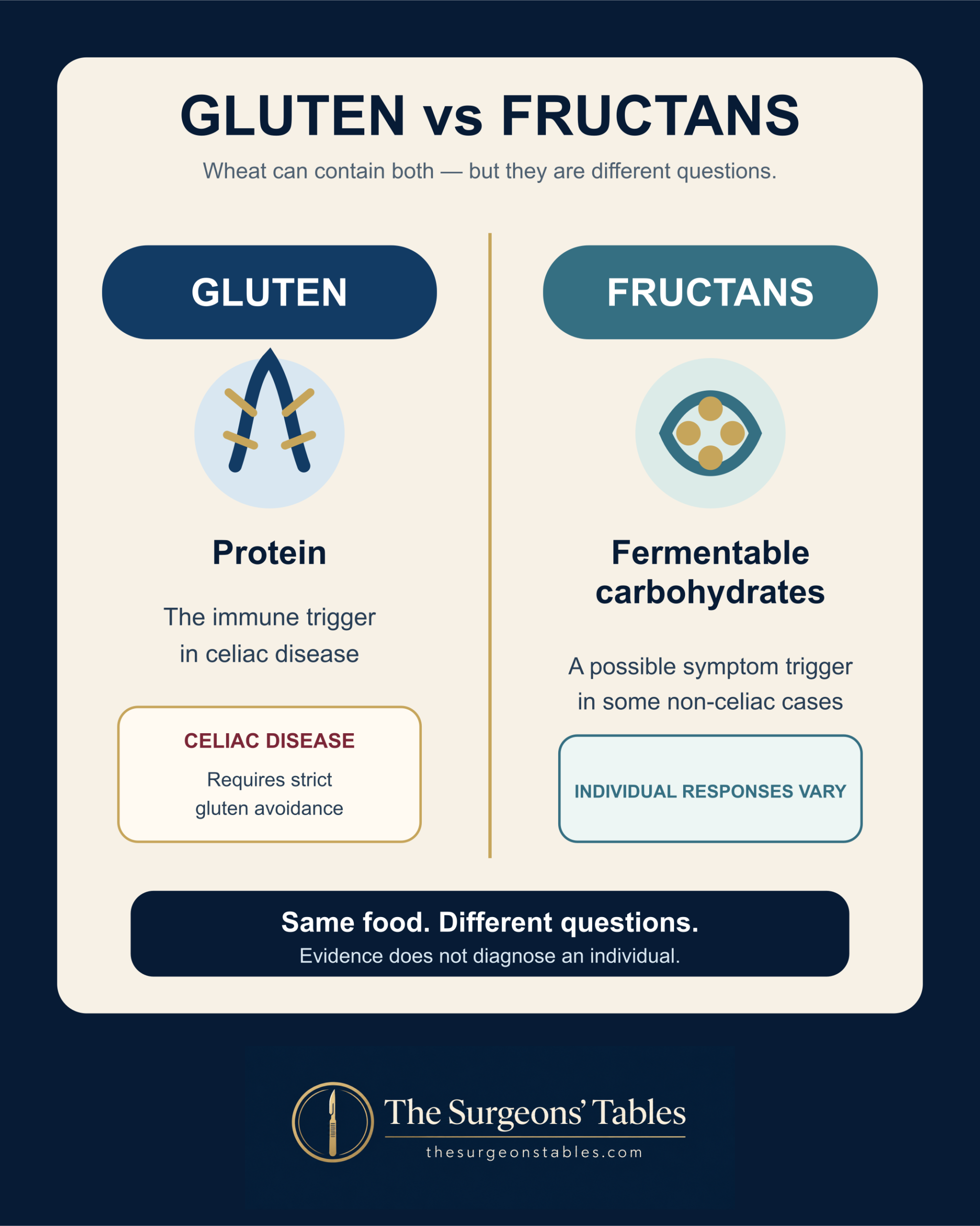
Gluten is a group of proteins. Fructans are fermentable carbohydrates and are one type of FODMAP. Wheat-containing foods commonly deliver both, so feeling better after avoiding wheat does not by itself reveal which component mattered.
| Question | Gluten | Fructans |
|---|---|---|
| What are they? | Proteins | Fermentable carbohydrates |
| Are they present in wheat foods? | Yes | Often |
| Are they the immune trigger in celiac disease? | Yes | No |
| What did one controlled challenge find in self-reported sensitivity? | No group-level difference from placebo | Higher group symptom scores than gluten; individual responses varied (3) |
The practical consequences differ. Celiac disease requires strict gluten avoidance. Possible sensitivity to fermentable carbohydrates is a separate question that one meal or trip cannot diagnose.
What did the controlled trials actually show?
The most frequently cited trial randomized 59 people on self-initiated gluten-free diets, all with celiac disease excluded, to concealed seven-day challenges with gluten, fructans, and placebo. The mean overall symptom score was higher during the fructan challenge than during the gluten challenge, and gluten did not differ from placebo at the group level. Yet the individual results were mixed: 13 participants had their highest score after gluten, 24 after fructans, and 22 after placebo. (3)
This result supports fructans as one plausible explanation in a selected group. It does not establish that fructans cause most bread symptoms in the general population, and it does not show why a particular traveler felt better abroad. The challenges were delivered in muesli bars, not matched loaves from different countries.
A separate double-blind crossover trial studied 37 people with self-reported non-celiac gluten sensitivity and irritable bowel syndrome after reducing dietary FODMAPs. Symptoms worsened similarly with gluten and a whey-protein control, and investigators did not reproduce a specific or dose-dependent gluten effect. The study was small, challenges were short, and an order effect occurred. (4) It challenges a simple “gluten explains everything” story without resolving individual cases.
A 2024 microbiome paper is sometimes presented as newer confirmation, but it analyzed the same 59-person challenge cohort as the earlier fructan trial. It did not identify a substantial change in the overall fecal microbiome or measured metabolites that explained the symptom difference. It is useful follow-up work, not an independent replication. (9)
Does sourdough explain the European vacation story?
Fermentation can change bread chemistry, but the label “sourdough” is not a guarantee of a particular fermentation time, microbial culture, fructan level, or clinical effect.
In a randomized, double-blind seven-day pilot involving 26 people with irritable bowel syndrome and subjective wheat sensitivity, a tested long-fermented sourdough wheat bread contained fewer FODMAPs and alpha-amylase/trypsin inhibitors than the comparison yeast-fermented bread. Gastrointestinal symptoms and markers of low-grade inflammation, however, did not significantly differ between the two groups. (5)
Fermentation can alter measurable components, but lower measured FODMAP content did not produce better tolerance in that small trial. It is too broad to say either “European sourdough solves gluten sensitivity” or “processing never matters.”
Both markets contain many wheat varieties, recipes, fermentation methods, serving sizes, and imported ingredients. The product actually eaten matters more than the flag attached to it.
Is American wheat unusually high in gluten because of modern breeding?
A historical review by USDA researcher Donald Kasarda examined U.S. wheat data from the 20th and early 21st centuries. It did not support the proposed explanation that conventional breeding had broadly increased wheat protein content, used as proportional to gluten content, enough to account for the rise in celiac disease. (6)
That finding does not mean all wheat is identical. Protein is an imperfect proxy for gluten, products differ, and the paper did not compare U.S. and European bread clinically. It does show that historical data do not establish the sweeping claim that modern American breeding simply created much more gluten.
What about the glyphosate claim?
The online claim often says Europe banned glyphosate and that this explains digestive symptoms. The regulatory premise is incomplete. The European Commission says glyphosate is approved in the EU until December 15, 2033, with restrictions including a prohibition on using it as a desiccant to control harvest timing or optimize threshing. (7)
That corrects the regulatory myth but does not answer the clinical question. The verified sources do not establish a U.S. wheat-use percentage, a residue comparison, or a causal link to one traveler’s symptoms.
Why might the experience still change during travel?
A travel anecdote compares two bundles of circumstances rather than one variable. The loaf, portion, accompanying foods, meal timing, activity, sleep, stress, alcohol, and expectations may all change.
These are possible confounders, not proven explanations. They prevent the anecdote from isolating “European wheat” as the cause. Compare specifics instead: bread type and amount, available fermentation or ingredient information, accompanying foods, and whether other foods cause similar symptoms.
A better way to investigate recurring symptoms
- Do not rule out celiac disease based on a good vacation. If it is a realistic concern, discuss testing before starting a gluten-free diet. (8)
- Describe the symptom pattern rather than naming the culprit. Record the food, portion, timing, accompanying foods, and symptoms. A record can support a clinical conversation; it cannot diagnose the mechanism by itself.
- Compare products, not continents. A carefully controlled comparison of specific breads is more informative than assuming every European and American loaf belongs to a single category.
- Keep gluten and fructans separate in the discussion. The controlled trials show why these components should not be treated as interchangeable. (3), (4)
- Treat sourdough as a process, not a medical claim. Its composition varies, and ordinary wheat sourdough is not gluten-free or appropriate for celiac disease. (2), (5)
The practical answer
Bread may genuinely feel easier to digest during a European trip. Current evidence does not show that crossing the Atlantic makes wheat safe, that American wheat is uniformly higher in gluten, or that one farming chemical explains the difference.
The strongest controlled evidence reviewed here points to a more careful conclusion: in selected people who believed they were sensitive to gluten, fructans produced more symptoms than gluten at the group level, but responses varied and the studies did not compare countries or travelers. Fermentation can change bread composition without guaranteeing better tolerance. Celiac disease remains a separate, medically important diagnosis for which ordinary European wheat bread is not an exception.
The useful next question is not “Which continent has the good wheat?” It is “Which condition or food component best explains this person’s repeatable pattern, and has celiac disease been evaluated before the diet changes?”
References
- (1) Rubio-Tapia A, et al. ACG Guidelines Update: Diagnosis and Management of Celiac Disease. Am J Gastroenterol. 2023;118(1):59-76.
- (2) NIDDK. Eating, Diet, & Nutrition for Celiac Disease.
- (3) Skodje GI, et al. Fructan, Rather Than Gluten, Induces Symptoms in Patients With Self-Reported Non-Celiac Gluten Sensitivity. Gastroenterology. 2018;154(3):529-539.e2. Find: Abstract, Methods, Results, and Conclusions. Limit: abstract-level review; selected cohort; no country comparison.
- (4) Biesiekierski JR, et al. No effects of gluten after dietary reduction of FODMAPs. Gastroenterology. 2013;145(2):320-328.e1-3. Find: Abstract Methods, Results, Conclusions. Limit: small cohort, short rechallenge, order effect.
- (5) Laatikainen R, et al. Comparison of Sourdough and Yeast-Fermented Wheat Bread. Nutrients. 2017;9(11):1215.
- (6) Kasarda DD. Can an Increase in Celiac Disease Be Attributed to Wheat Breeding?. J Agric Food Chem. 2013;61(6):1155-1159.
- (7) European Commission. Glyphosate second renewal.
- (8) NIDDK. Diagnosis of Celiac Disease.
- (9) Herfindal AM, et al. Effects of fructan and gluten on gut microbiota. 2024.