
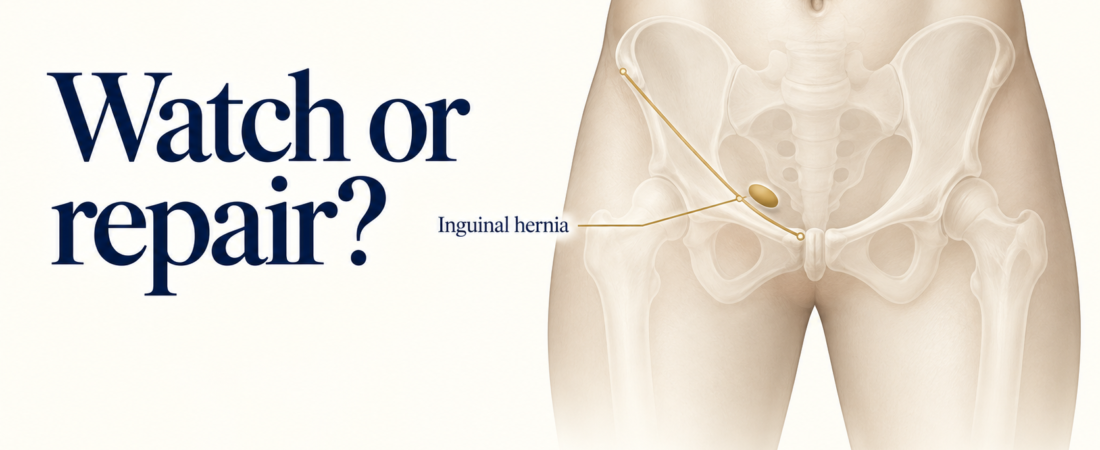
An inguinal hernia diagnosis raises two immediate questions: do you need surgery now, and will you need mesh? Here is how symptoms, hernia type, and the evidence help frame the decision—and when waiting is no longer appropriate.
Having a hernia for years does not, by itself, determine whether surgery is needed. The decision depends on the type of hernia, symptoms, and the person’s overall health. Some men with an inguinal hernia that causes little or no discomfort can consider watchful waiting with follow-up. Symptoms that interfere with daily life are a reason to discuss planned repair.
A hernia that suddenly becomes stuck needs urgent medical assessment, especially with severe pain, vomiting, or abdominal swelling. Trapped bowel can become obstructed or lose its blood supply, and emergency surgery may be necessary.
At a Glance
- Men with hernias causing no or mild symptoms can often delay surgery safely — at least for a while.
- Watching isn’t risk-free or permanent: in one 12-year trial, most men who started with watchful waiting eventually had surgery anyway.
- Women with a groin hernia face a higher likelihood of femoral involvement and emergency presentation, so this “wait and see” evidence doesn’t automatically apply to them.
- If surgery is needed, mesh is recommended for most — but not every — repair.
- Certain symptoms mean go to the ER now, not “monitor it a bit longer.”

Can I Just Watch My Hernia Instead of Having Surgery?
For some men, yes — at least initially. According to patient education from the American College of Surgeons, men with an asymptomatic or only mildly symptomatic inguinal hernia can reasonably discuss watchful waiting with their doctor rather than scheduling surgery right away. (1)
But “watchful waiting” isn’t a decision you make once and forget. A 12-year follow-up of a randomized Dutch trial, involving men aged 50 and older with asymptomatic or mildly symptomatic inguinal hernias, found that an estimated 64.2% eventually crossed over to surgery. That’s a striking number, but it needs context: crossover to surgery is not the same as strangulation. The trial distinguishes later surgery from incarceration; those outcomes should not be treated as interchangeable. (2)
The more clinically important number from that same trial is the incarceration rate: 10 out of 255 men in the watchful-waiting group, or 3.9%, developed a hernia that became trapped over the study period. That’s a real risk, but it’s a cumulative figure over more than a decade, not an annual one. It’s also worth knowing that only 41% of participants were reachable by phone for long-term follow-up, which limits how confidently researchers can speak to patient-reported outcomes like ongoing pain or quality of life in that group. (2)
What this means: watching is a legitimate short- and medium-term strategy for the right patient, but it usually isn’t a lifelong plan, and it carries a small but nonzero risk of an emergency down the road.
Does It Matter If You’re a Man or a Woman?
Yes — significantly. The observation evidence above comes specifically from men aged 50 and older with mild or no symptoms. It should not be generalized to women. Groin hernias in women carry a higher likelihood of involving the femoral canal and are more likely to present as an emergency. There is no single, universally established lifetime strangulation percentage in the material reviewed for this article, so be cautious of any source that states one with false precision. The practical takeaway is that women diagnosed with a groin hernia typically warrant more prompt surgical evaluation, even when current symptoms feel mild.
What About Femoral Hernias Specifically?
This is a distinction a lot of general hernia explainers skip. A femoral hernia — which sits lower, near the femoral canal rather than the inguinal canal — carries a different emergency risk profile than a typical inguinal hernia. According to ACS patient guidance, femoral hernias generally warrant evaluation for repair rather than a “let’s watch it” approach, precisely because their emergency behavior differs. (1)
When Should I Go to the Emergency Room Instead of Waiting for a Callback?
Regardless of what a patient’s baseline hernia plan has been, certain symptoms change the situation immediately:
- Sudden increase in pain at the hernia site
- A bulge that becomes hard, tender, and won’t push back in
- Sudden pain accompanied by nausea or vomiting
Do not attempt to forcefully push a trapped hernia back into place yourself. Seek urgent medical evaluation instead.
If Surgery Is Recommended, What Type of Repair Is Best?
The 2023 HerniaSurge guideline update reports that laparo-endoscopic (minimally invasive) approaches are associated with less chronic pain and faster recovery compared with the open Lichtenstein technique — but only in settings where the surgeon and center have appropriate expertise and resources for that approach. This is an important nuance: it does not mean every patient should insist on laparoscopic surgery, nor that all open repairs are interchangeable, and it does not establish that robotic surgery is superior. The outcome depends heavily on who is doing the surgery and how experienced they are with that specific technique, not just which technique is chosen on paper. (3)
Do I Actually Need Mesh?
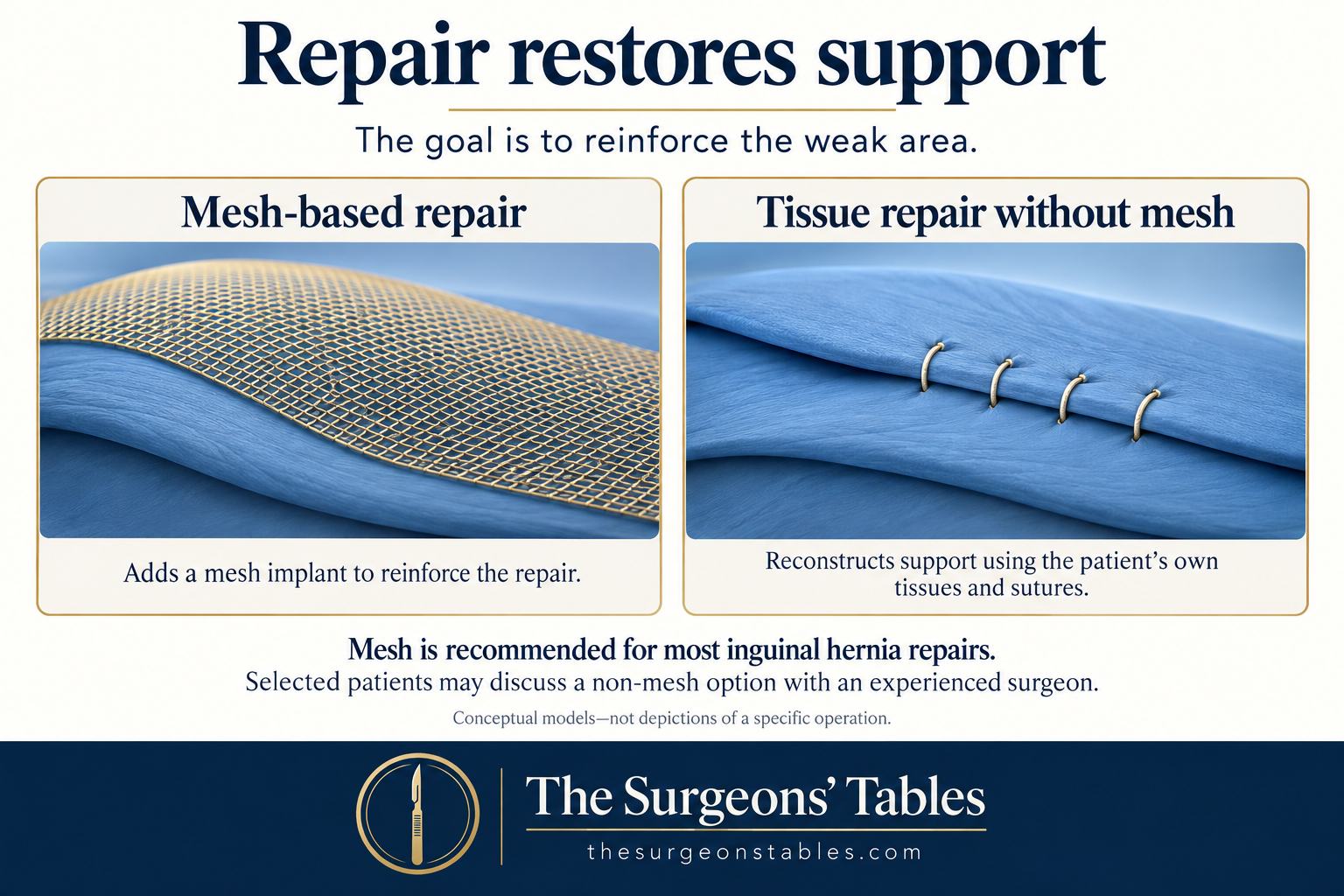
For most inguinal hernia repairs, yes — mesh is the recommended standard, according to the HerniaSurge guideline. But “most” is not “all.” Selected patients may discuss a non-mesh repair through shared decision-making with their surgeon, specifically using the Shouldice technique, when a surgeon experienced in that method is available. (3)
Both approaches have potential benefits and harms; choosing a non-mesh repair does not eliminate recurrence or chronic-pain risks. It means the right choice depends on the individual hernia, the patient’s priorities and concerns (some patients specifically want to avoid mesh), and — critically — the surgeon’s specific experience with the alternative technique being considered.
Quick Comparison: Observation vs. Repair
| Factor | Watchful Waiting | Surgical Repair |
|---|---|---|
| Best candidate | Asymptomatic/mildly symptomatic men | Symptomatic hernias, femoral hernias, women with groin hernia |
| Long-term outcome | Most eventually cross over to surgery (est. 64.2% at 12 years in one trial) | Fixes the defect directly |
| Emergency risk | Small but real: 3.9% incarceration over 12 years in one study group | Treats the hernia; recurrence and other complications remain possible |
| Trade-off | Avoids surgery now; requires monitoring for symptom change | Possible recurrence, infection, or persistent pain depending on technique and individual factors |
Quick Comparison: Mesh vs. Non-Mesh
| Factor | Mesh Repair | Non-Mesh (Shouldice) |
|---|---|---|
| Recommended for | Most inguinal hernia repairs | Select patients, via shared decision-making |
| Requirement | Surgeon experienced in the chosen repair | Surgeon experienced specifically in Shouldice technique |
| Key point | Not automatically “risk-free” | Not automatically “inferior” |
Factors That Can Change Your Hernia Treatment Plan
1. The 64% crossover number and the 3.9% incarceration number answer different questions. Crossover counts later operations. The 3.9% figure counts incarceration in this particular study group; it is not a personal risk estimate or a count of all possible emergencies.
2. Sex changes the entire framework, not just the statistics. The reassuring “watch and wait” evidence specifically comes from studies in men. Femoral anatomy and emergency presentation patterns differ enough in women that this evidence shouldn’t be assumed to transfer directly.
3. A preference about mesh needs a discussion about the specific repair. The real question isn’t which technique is universally better; it’s whether a given patient’s hernia and priorities fit a scenario where a surgeon with specific non-mesh (Shouldice) experience is available.
What Should You Actually Do Next?
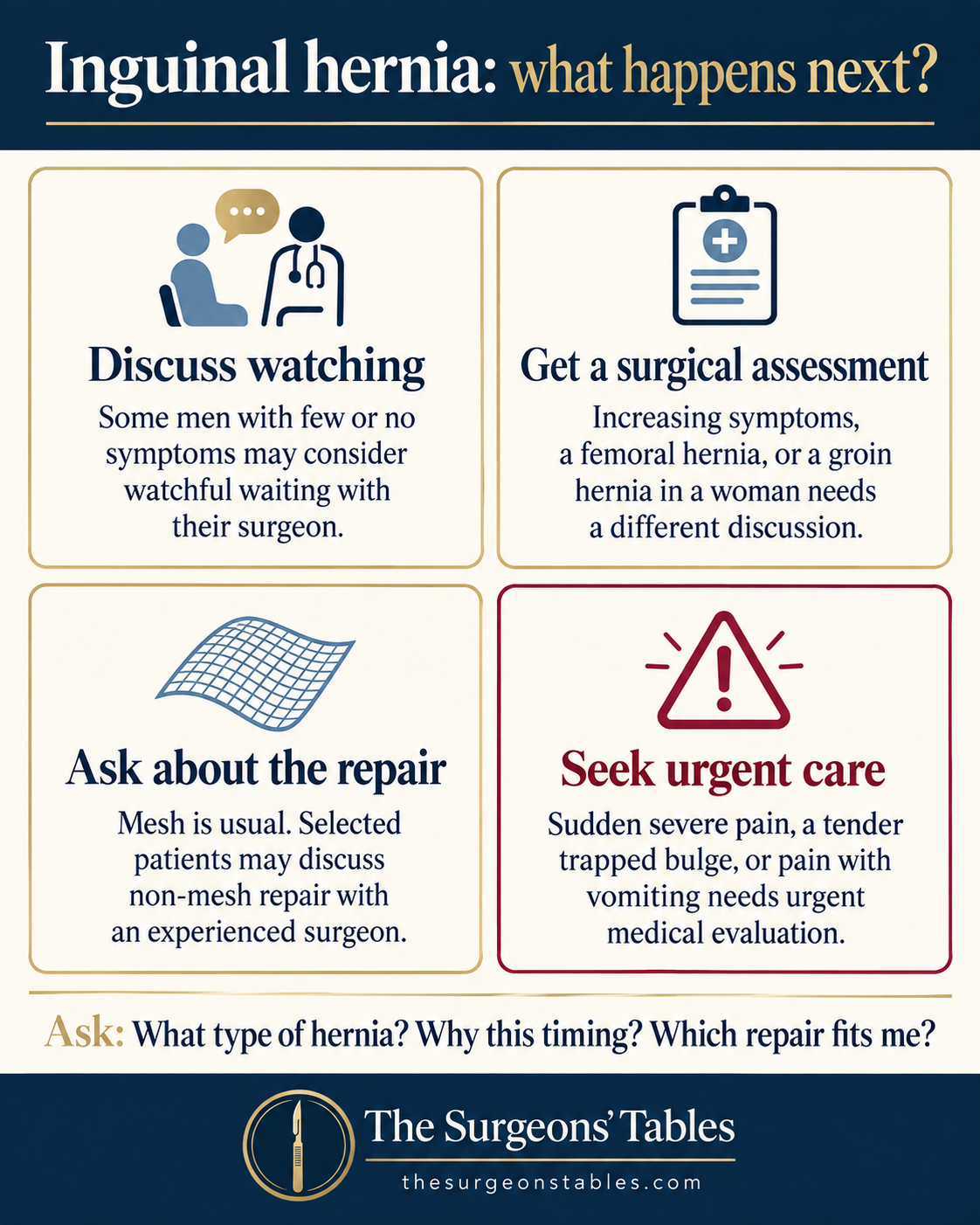
If you or a family member has been told “you have an inguinal hernia,” the next step is a direct conversation with a surgeon covering:
- Is this inguinal or femoral, and does sex change the recommended timeline?
- Given my symptoms, is watching still reasonable, or has that window passed?
- If I need surgery, is a laparo-endoscopic approach realistic at this center, with this surgeon’s experience level?
- If I’m interested in avoiding mesh, do you have specific experience with Shouldice repair?
And if new pain, a hardening or trapped bulge, or vomiting develops at any point — that conversation becomes an emergency room visit, not a scheduled follow-up.
This article is for general education and does not replace individualized medical advice. Decisions about observation, surgical timing, and technique should be made with a qualified surgeon based on your specific anatomy and history.