
“Nothing after midnight” and “take your morning medications” can sound like opposite instructions. They are not necessarily contradictory – because food, clear liquids, medications, and individual aspiration risk are not treated as the same thing before anesthesia.
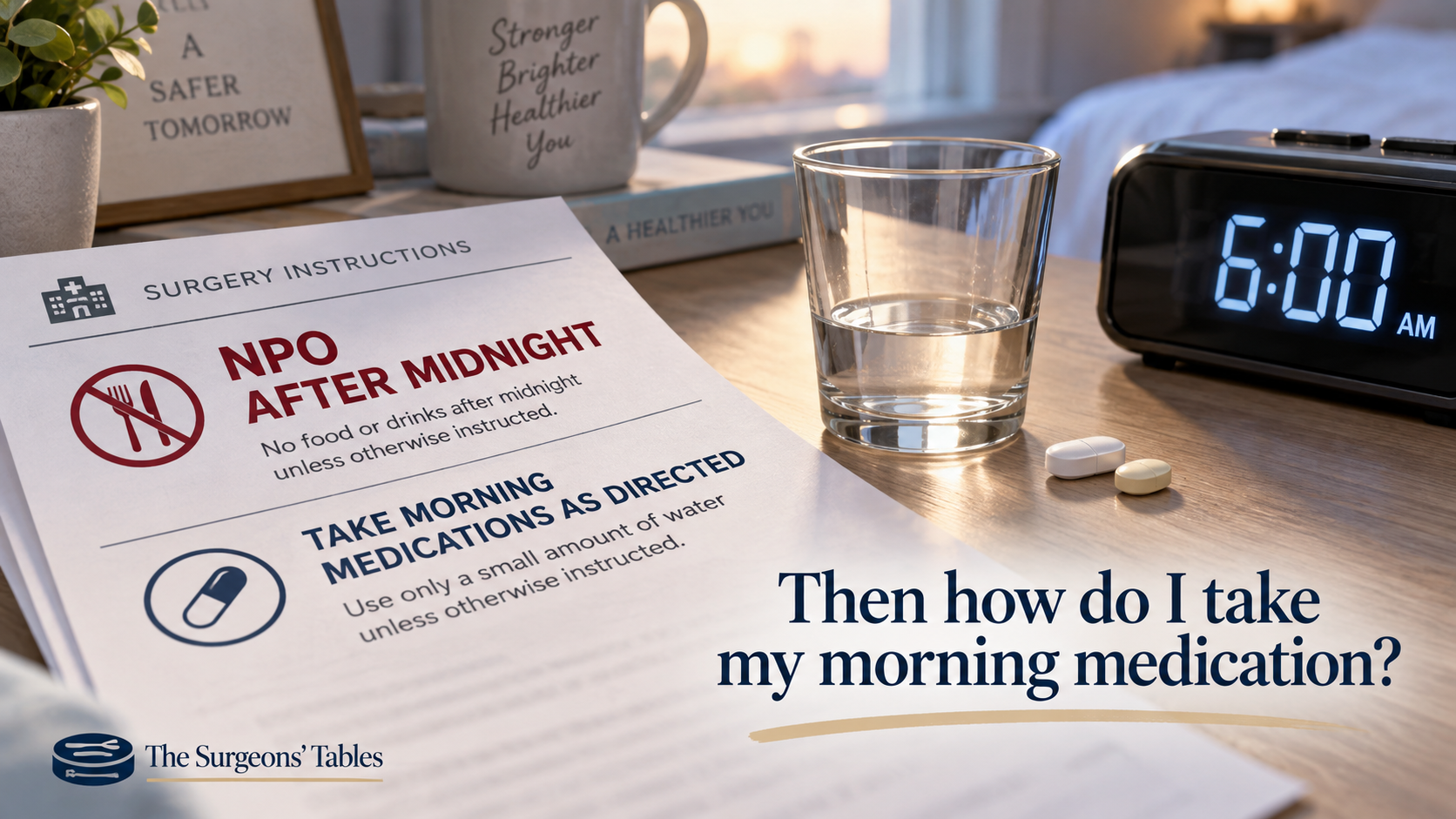
It is 6 a.m. on the morning of surgery. Your instructions say, “Nothing to eat or drink after midnight.” But a second line tells you to take certain morning medications.
So what are you supposed to do – swallow the pills dry?
Usually, this apparent contradiction exists because preoperative fasting is more nuanced than the phrase “nothing after midnight” suggests. Modern anesthesia practice distinguishes solid food from clear liquids, and it also recognizes that some medications should still be taken on the morning of surgery. But there is an important limit to that statement: you should not use a general fasting guideline to override the specific instructions from your own surgical or anesthesia team.
Your operation, medical conditions, medications, and risk of delayed stomach emptying all matter.
Why do hospitals still say “nothing after midnight”?
The reason for fasting is real. During general anesthesia or deep sedation, the normal reflexes that help keep stomach contents out of the airway are reduced. If stomach contents come back up and enter the lungs – called pulmonary aspiration – the consequences can be serious.
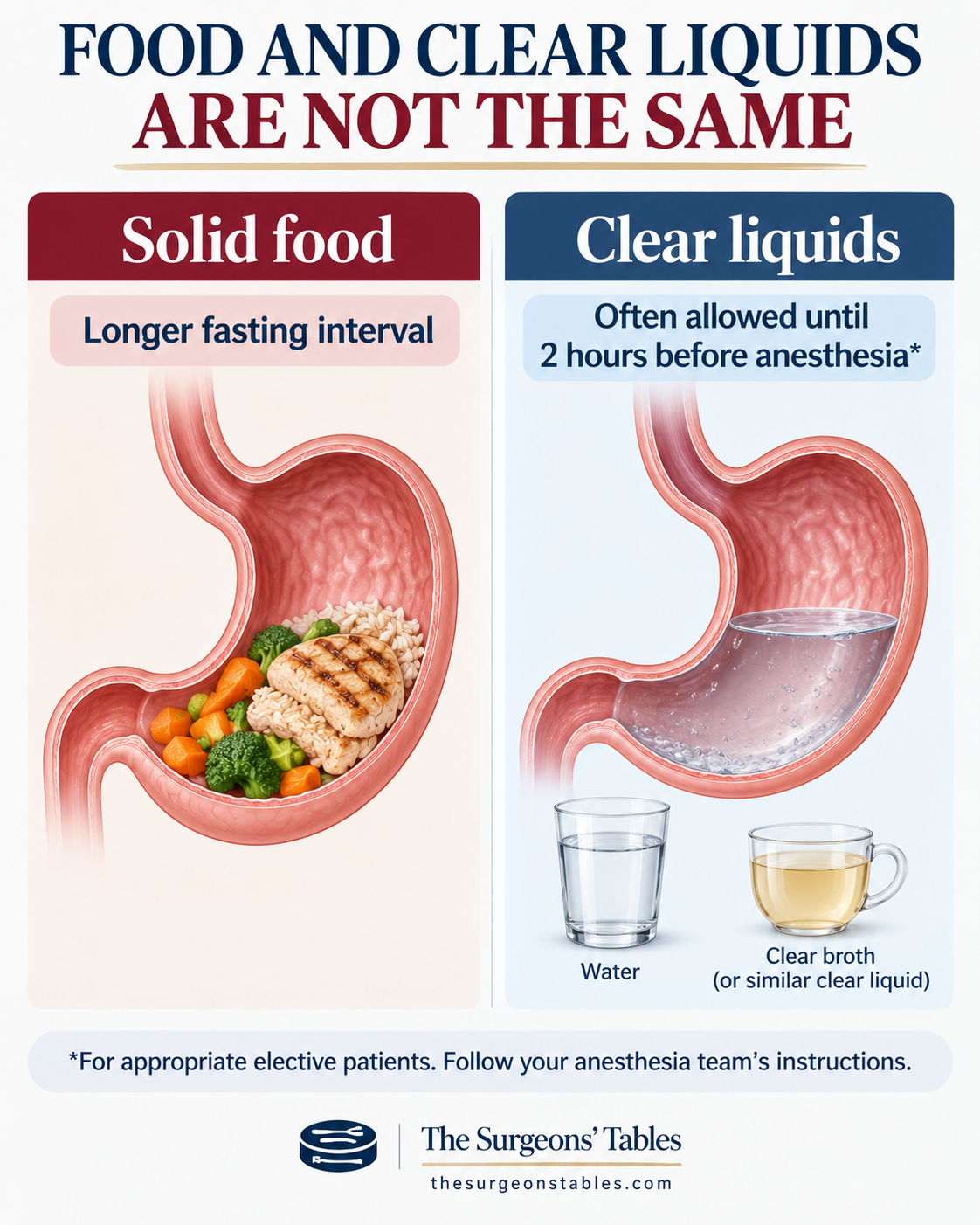
But preventing aspiration does not mean that every patient needs to stop all oral intake at midnight. ASA guidance for otherwise healthy patients undergoing elective procedures allows clear liquids until 2 hours before anesthesia, while solid food requires a longer fasting period. (1) (2)
Why, then, does “NPO after midnight” survive? Sometimes it is simply an easy instruction to communicate. It can also provide scheduling flexibility if an operation is moved earlier. And some institutions deliberately use more conservative rules because their patients or procedures do not fit the assumptions behind standard fasting guidelines.
That difference explains something patients often find frustrating: two hospitals can give different instructions without one of them necessarily practicing unsafe medicine.
So can I take my morning medications with water?
When patients ask how they can take medicine while fasting, I explain that medicines have a duration of action, and the timing of certain essential medicines matters. If the surgical or anesthesia team has told them to take a medicine that morning, I tell them to take it at the instructed time with just a small sip of water.
To make that small amount easier to picture, I sometimes remind them that we still swallow saliva even when we are not eating. It is a way to explain “just a sip,” not permission to drink freely. Patients sometimes ask, “Could I take the medicine with a sip of something else, like juice, instead of water?” For taking those medicines, my instruction is water only. I explain that food and drinks remaining in the stomach can pose an aspiration risk during anesthesia, and that they should follow their team’s specific fasting instructions.
The harder question is not how to swallow a pill. It is which pills should be taken at all.
Some medications are commonly continued through the morning of surgery. Others may need to be held, rescheduled, or individually adjusted because of effects on blood pressure, blood sugar, bleeding, kidney function, stomach emptying, or interactions with anesthesia. The answer also changes with the operation and the reason you take the medication.
That is why neither of these approaches is safe:
- “I’m fasting, so I’ll skip every medication.”
- “I always take these in the morning, so I’ll take all of them.”
The useful question before surgery is: “Which of my usual medications do you want me to take that morning, and how should I take them?”
| Situation | What it means |
|---|---|
| Solid food | Requires a longer fasting interval because solids remain in the stomach longer than clear liquids. |
| Clear liquids | For many otherwise healthy elective patients, standard guidance permits clear liquids until 2 hours before anesthesia. Your facility may give different instructions. |
| Morning medication | Whether to take it depends on the specific medication and patient. Follow the medication plan provided by the surgical, anesthesia, or prescribing team. |
| Accidental intake | Do not decide yourself that the surgery must be canceled – and do not hide it. Tell the anesthesia team what, how much, and when. |
I accidentally drank two sips of water. Is my surgery canceled?
Not automatically.
A small amount of water is not physiologically equivalent to eating breakfast. But there is also no universal number of “safe sips” that lets a patient make the decision independently.
The anesthesia team will want to know three things: what you consumed, how much, and when. They will then consider the scheduled procedure, type of anesthesia, your medical history, and whether there is reason to suspect delayed stomach emptying.
Depending on those factors, the team may proceed as scheduled, wait longer, modify the anesthetic plan, or occasionally postpone the procedure.
The practical rule is simple: report the mistake accurately instead of trying to decide whether it “counts.”
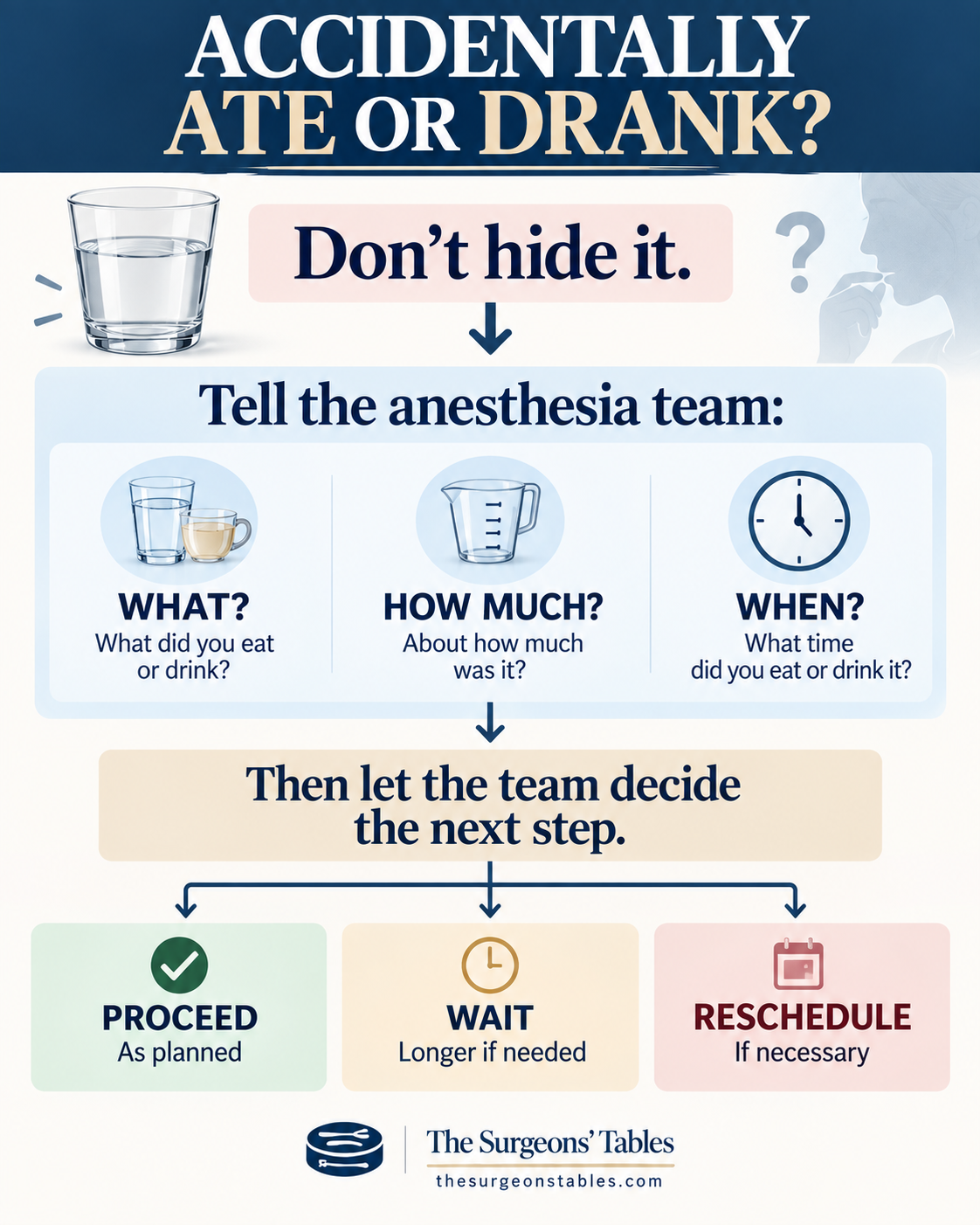
A sip of water, a full breakfast, and a stomach that empties unusually slowly are not the same problem – even if all three occurred before anesthesia.
Why does the 2-hour rule not apply to everyone?
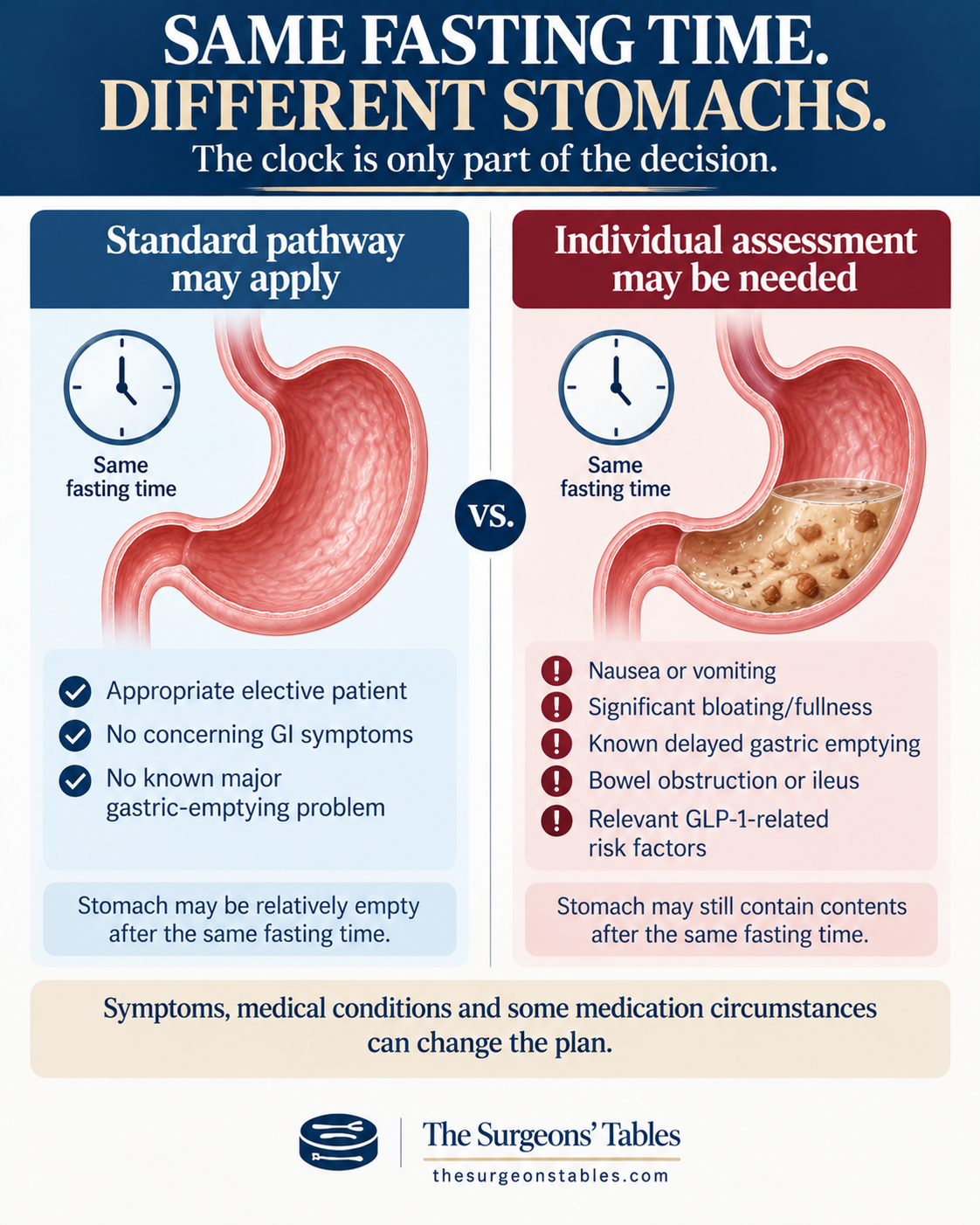
The standard fasting intervals are designed around patients in whom stomach emptying is reasonably predictable. The clock matters, but an experienced anesthesia team also asks a second question: is there any reason this particular patient’s stomach may still contain more than expected?
Examples include bowel obstruction or ileus, known gastroparesis, active nausea or vomiting, marked abdominal fullness or bloating, and certain other conditions associated with delayed gastric emptying. Urgent and emergency operations are a separate situation because there may not be enough time to wait for conventional fasting intervals.
This is also why simply extending fasting for everyone is not a perfect solution. A longer fasting time cannot guarantee an empty stomach in a patient whose gastric emptying is abnormal.
What if I take Ozempic, Wegovy, Mounjaro, or another GLP-1 medication?
This is one area where recommendations have changed substantially.
GLP-1 receptor agonists and related medications can delay gastric emptying and may be associated with retained stomach contents despite conventional fasting. Earlier guidance therefore took a more conservative approach to withholding these medications before procedures.
Current multi-society guidance is more individualized. It does not say that every patient taking a GLP-1 medication must automatically stop it before surgery. Instead, the surgical, anesthesia, and prescribing teams are asked to balance the reason for treatment against the patient’s risk of delayed gastric emptying. (3)
Factors that can increase concern include being in the dose-escalation phase, higher doses with gastrointestinal side effects, nausea, vomiting, abdominal pain, constipation or marked fullness, and another medical condition that slows gastric emptying. In selected higher-risk situations, the team may use a liquid-only diet for at least 24 hours, consider point-of-care gastric ultrasound when available, change the anesthetic approach, delay the procedure, or decide that temporarily withholding the medication is appropriate. (3)
Do not stop a prescribed GLP-1 medication on your own simply because surgery is approaching. The safest plan is the one coordinated among the teams caring for you.
Then what is preoperative carbohydrate loading?
Enhanced Recovery After Surgery, or ERAS, programs were developed partly to move elective surgery away from unnecessary prolonged fasting. Some protocols include a specifically formulated carbohydrate-containing clear drink before surgery rather than asking an appropriate patient to fast from midnight until an afternoon operation. ERAS colorectal guidance has supported clear liquids until 2 hours before anesthesia and structured preoperative carbohydrate treatment in selected patients. (4)
The metabolic idea is reasonable: surgery creates a major stress response, and avoiding an unnecessarily prolonged preoperative fast may reduce some of the metabolic effects of starvation. Trials and meta-analyses have found improvements in some measures of postoperative insulin sensitivity and, in certain surgical populations, modest reductions in hospital stay. (5) (6)
But this is an area where the marketing version is cleaner than the evidence. Benefits vary by operation and by what the carbohydrate drink is compared with. A network meta-analysis found a small reduction in hospital stay compared with fasting, but no clear length-of-stay advantage over water or placebo. (6) More recent analyses continue to suggest possible recovery benefits in selected major surgical populations, while showing that the magnitude and clinical importance are not uniform. (7)
In other words, preoperative carbohydrate loading is a protocol, not permission to drink a sports drink before surgery. It should be used when the surgical pathway specifically calls for it.
| What the team considers | Lower concern | May require a different plan |
|---|---|---|
| Procedure | Routine elective procedure with standard fasting pathway | Emergency surgery or procedure-specific preparation |
| GI symptoms | No nausea, vomiting, marked fullness, or significant bloating | Active symptoms suggesting delayed gastric emptying |
| Stomach emptying | No known disorder affecting gastric emptying | Gastroparesis, obstruction, ileus, or another relevant condition |
| GLP-1 therapy | Stable treatment without concerning GI symptoms or other high-risk features | Dose escalation, significant GI symptoms, higher-risk circumstances, or another cause of delayed gastric emptying |
What should I actually do before surgery?
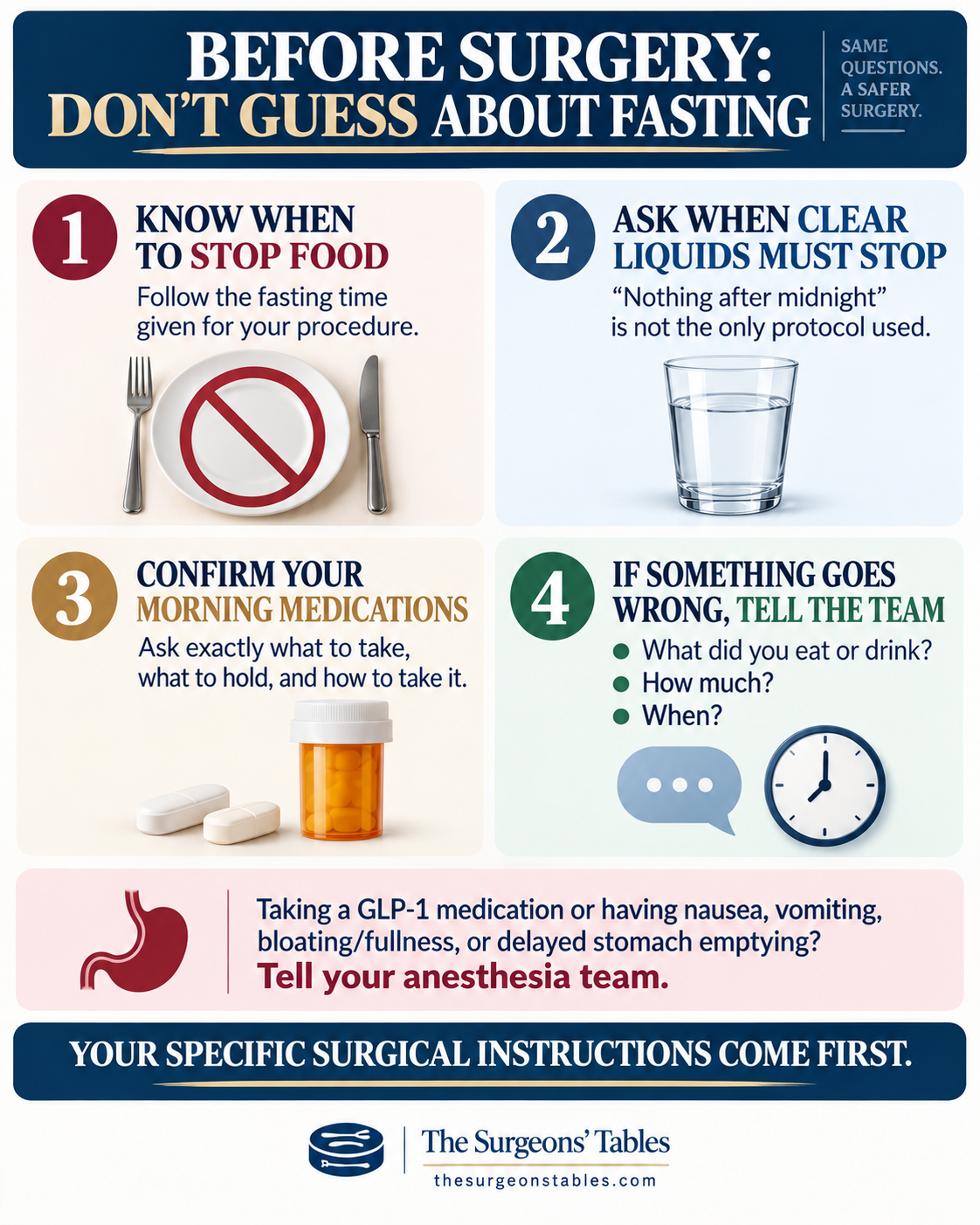
The most useful preparation is not memorizing a universal midnight rule. It is making sure you understand the instructions written for your procedure.
- Confirm when solid food must stop.
- Ask whether clear liquids are permitted, and exactly when they must stop.
- Ask which morning medications to take and which to hold. Do not make medication changes based only on a general article or fasting handout.
- Tell the team if you use a GLP-1 medication or have nausea, vomiting, unusual fullness, significant bloating, known gastroparesis, bowel obstruction, or another condition that may affect stomach emptying.
- If you accidentally eat or drink, tell them what, how much, and when. Do not hide it and do not cancel the procedure yourself unless the team instructs you to do so.
Bottom Line
“NPO after midnight” does not mean that solid food, clear water, and a small amount of water used for an instructed morning medication all carry identical implications.
For many otherwise healthy elective surgery patients, modern fasting practice allows clear liquids closer to anesthesia than solid food. But standard fasting rules are not a substitute for individualized instructions. Your procedure, medications, gastrointestinal symptoms, and risk of delayed stomach emptying may change the plan.
If the instructions seem contradictory, ask before the day of surgery. And if you accidentally eat or drink something, report it accurately. The anesthesia team – not the patient alone and not the clock alone – decides what is safest next.
References
- (1) Joshi GP, Abdelmalak BB, Weigel WA, et al. 2023 American Society of Anesthesiologists Practice Guidelines for Preoperative Fasting: Carbohydrate-containing Clear Liquids with or without Protein, Chewing Gum, and Pediatric Fasting Duration – A Modular Update of the 2017 American Society of Anesthesiologists Practice Guidelines for Preoperative Fasting. Anesthesiology. 2023;138(2):132-151. PubMed
- (2) American Society of Anesthesiologists. Practice Guidelines for Preoperative Fasting and the Use of Pharmacologic Agents to Reduce the Risk of Pulmonary Aspiration: Application to Healthy Patients Undergoing Elective Procedures. Anesthesiology. 2017;126(3):376-393. ASA guideline
- (3) Kindel TL, Wang AY, Wadhwa A, et al. Multi-society clinical practice guidance for the safe use of glucagon-like peptide-1 receptor agonists in the perioperative period. Surg Endosc. 2025;39(1):180-183. Published online October 29, 2024. doi:10.1007/s00464-024-11263-2. PubMed
- (4) Gustafsson UO, Scott MJ, Hubner M, et al. Guidelines for Perioperative Care in Elective Colorectal Surgery: Enhanced Recovery After Surgery (ERAS) Society Recommendations: 2018. World J Surg. 2019;43(3):659-695. PubMed
- (5) Smith MD, McCall J, Plank L, Herbison GP, Soop M, Nygren J. Preoperative carbohydrate treatment for enhancing recovery after elective surgery. Cochrane Database Syst Rev. 2014;(8):CD009161. doi:10.1002/14651858.CD009161.pub2. PubMed
- (6) Amer MA, Smith MD, Herbison GP, Plank LD, McCall JL. Network meta-analysis of the effect of preoperative carbohydrate loading on recovery after elective surgery. Br J Surg. 2017;104(3):187-197. doi:10.1002/bjs.10408. PubMed
- (7) Preoperative carbohydrate loading in elective colorectal surgery: postoperative complications and outcomes, a systematic review and meta-analysis. 2026. PubMed