
Social media says facial puffiness, belly fat, fatigue, and poor sleep may mean your cortisol is too high. Here is what your face can actually tell you – and what it cannot.

Scroll through social media long enough and you may see the same transformation again and again: a puffy morning face on one side, a sharper jawline on the other, followed by some version of the claim: “It wasn’t fat. It was cortisol.”
So is this another social-media health myth, or is there real medicine behind it?
There is a fragment of truth. Cortisol can influence metabolism and body-fat distribution, and prolonged pathological cortisol excess can change the face and body. But “cortisol face” itself is not a recognized medical diagnosis.
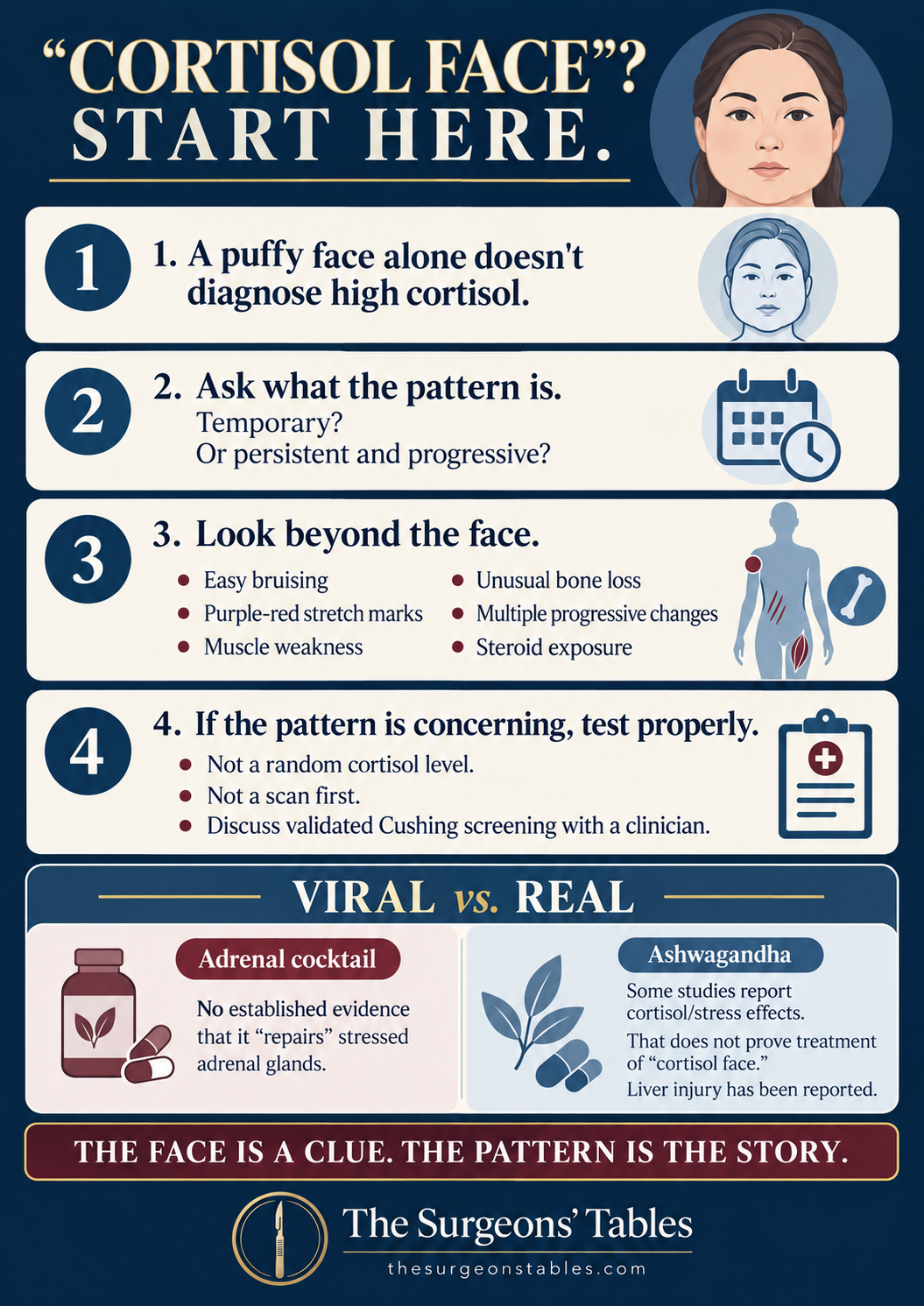
A rounder face, morning puffiness, belly fat, acne, fatigue, or poor sleep cannot tell you by themselves that your body is producing too much cortisol. The more useful question is not, “Does my face look like cortisol?” It is: “Do I have a pattern of symptoms that would make a physician seriously consider Cushing syndrome?”
If cortisol is high in the morning, isn’t that bad?
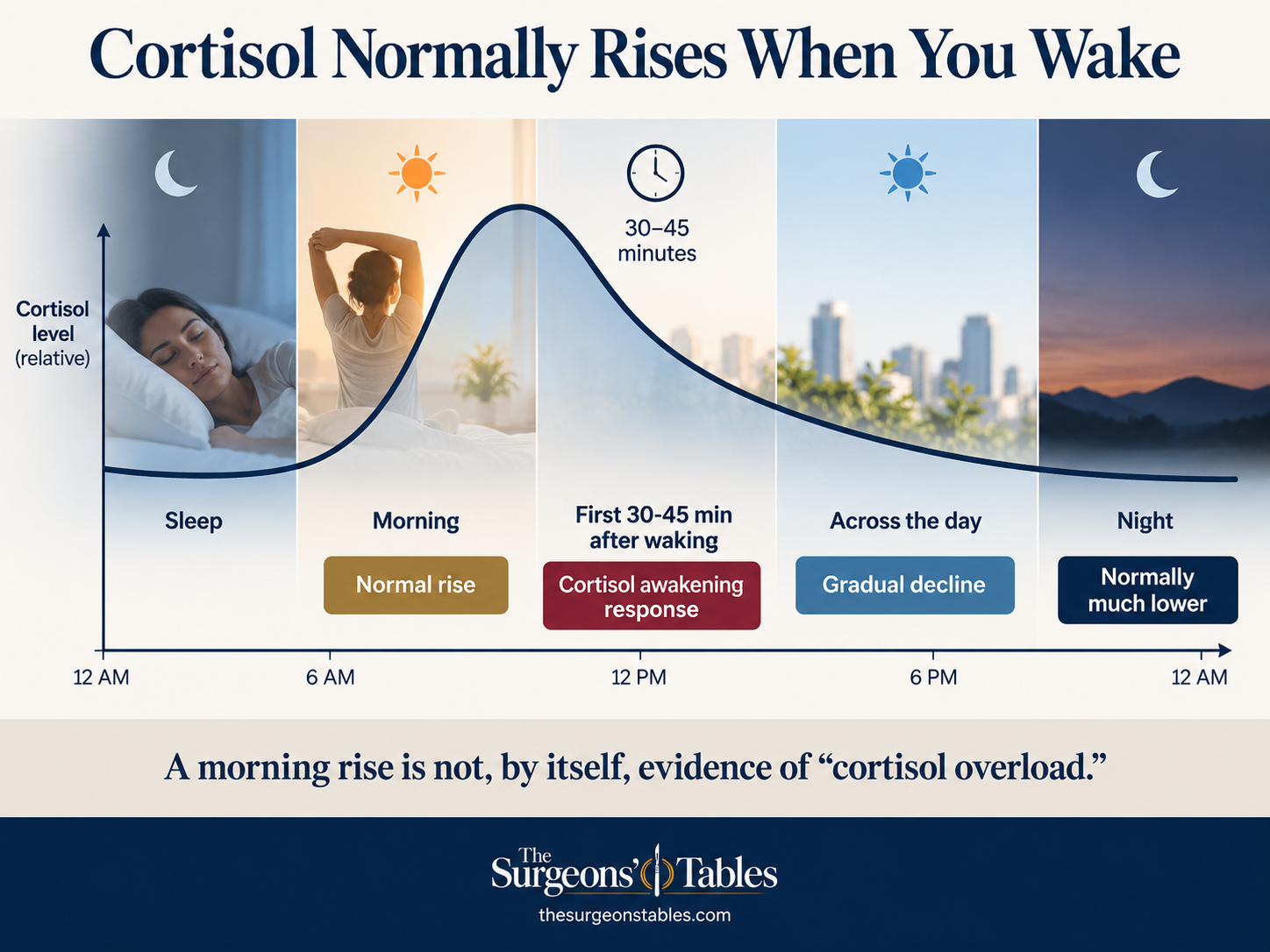
Not necessarily. Cortisol follows a strong daily rhythm. In healthy people, cortisol secretion rises around waking and typically increases further during the first 30 to 45 minutes after awakening. This is called the cortisol awakening response. (1)
That rise is normal physiology. Cortisol helps mobilize energy and supports systems the body needs as it transitions from sleep into daytime activity. Levels generally decline across the day toward their nighttime low.
So the phrase “high morning cortisol” is not, by itself, a diagnosis. Timing matters enormously when cortisol is measured.
VIRAL: “Your cortisol rises in the morning because you are chronically stressed.”
REAL: A morning cortisol rise occurs in healthy human physiology. Abnormal cortisol disorders are not diagnosed simply because cortisol is higher after waking.
Then why does my face look puffier some mornings?
This is the question many “cortisol face” posts never answer.
Faces change. Fluid distribution changes while you are lying down overnight. Salt intake, alcohol, sleep quality, allergies, medications, menstrual-cycle-related changes, and other factors can also affect how swollen or defined someone’s face looks from one morning to another.
That does not mean persistent facial swelling should always be ignored. Thyroid disease, kidney or liver disease, cardiac conditions, allergies, inflammation, and medications can all contribute to facial swelling in the appropriate clinical setting.
And sudden swelling of the lips, tongue, or throat – particularly with trouble breathing or swallowing – is not a “cortisol” issue and requires urgent medical attention.
The clinically useful distinction is often temporary appearance versus persistent or progressive change.
What does true Cushing syndrome actually look like?
Cushing syndrome means the body has been exposed to excessive glucocorticoid activity for too long. Importantly, one common cause is exposure to corticosteroid medications. When the body itself is producing too much cortisol, the source may involve excess ACTH signaling or autonomous cortisol production by an adrenal lesion. (2)
Cushing disease is more specific: it refers to Cushing syndrome caused by an ACTH-producing pituitary tumor.
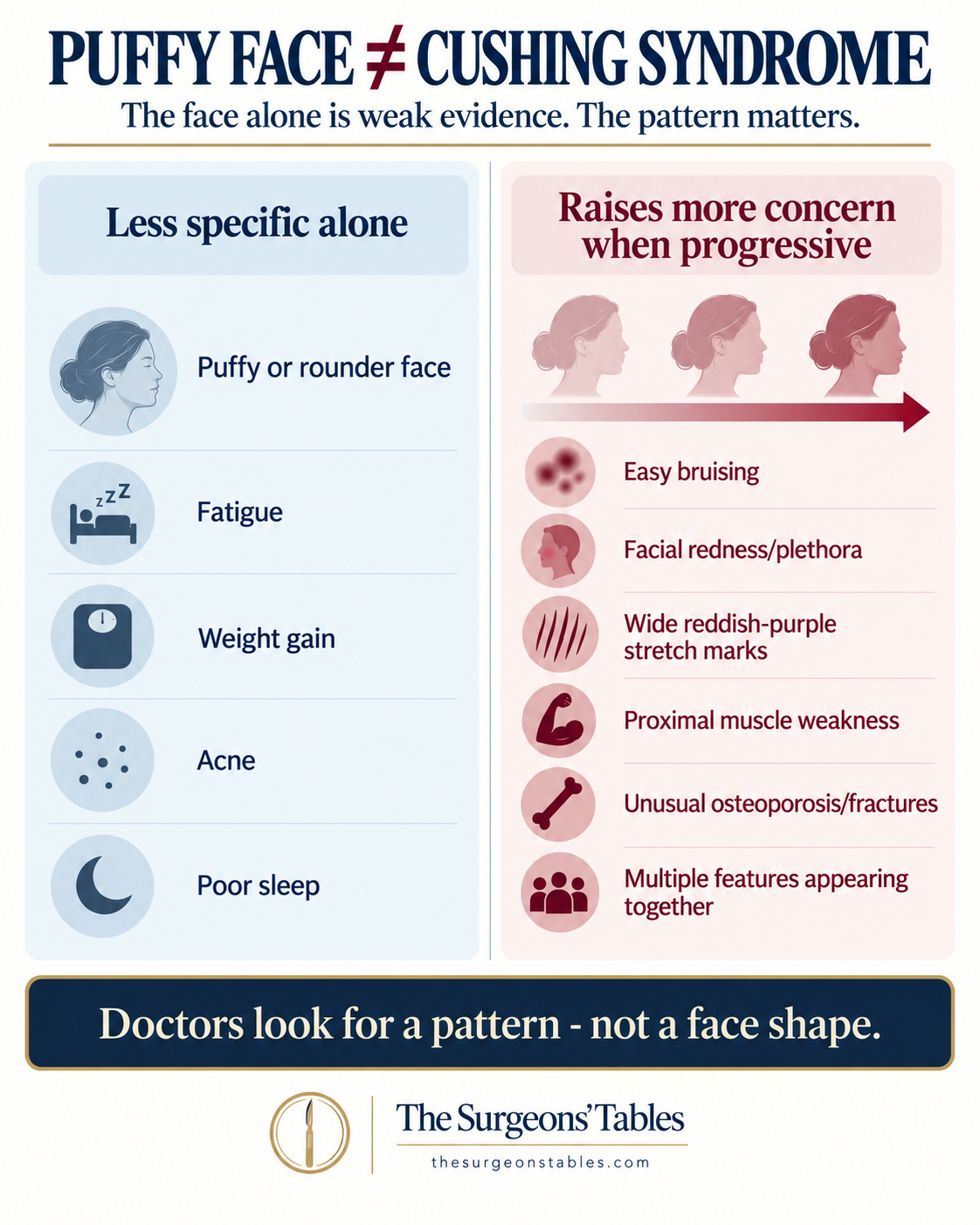
Most importantly, Cushing syndrome is not diagnosed by looking at someone’s cheeks. Doctors become more suspicious when several characteristic features appear together and progress over time. (2)
| More common and less specific | Features that raise more concern for Cushing syndrome | Why the distinction matters |
|---|---|---|
| Rounder or puffier face | Progressive facial fullness with other systemic findings | Face shape alone has poor diagnostic specificity. |
| Fatigue or poor sleep | Progressive proximal muscle weakness | Difficulty rising from a chair or climbing stairs may be more informative than nonspecific tiredness. |
| Weight gain | Multiple progressive changes in body composition and metabolism | Weight gain is common and has many causes. |
| Stretch marks | Wide reddish-purple striae | Characteristic wide violaceous striae are more discriminatory than ordinary stretch marks. |
| Occasional bruising | Unusual easy bruising and skin fragility | The pattern and severity matter more than a single bruise. |
| High blood pressure | Hypertension occurring with several other suggestive features | Hypertension alone is extremely common. |
The face is a clue. The pattern is the story.
Could Cushing syndrome still be subtle?
Yes. Saying that true Cushing syndrome is always visually obvious would be another oversimplification.
Many findings associated with Cushing syndrome – obesity, fatigue, hypertension, acne, mood changes, and diabetes – are common in people who do not have Cushing syndrome. Earlier or milder disease can therefore be difficult to recognize. (2)
This is precisely why clinicians look for multiple progressive features with higher discriminatory value rather than deciding whether a patient’s face simply “looks like cortisol.”
Should I ask my doctor to “just check my cortisol”?
This is a reasonable question. But if Cushing syndrome is being considered, one random morning cortisol measurement is not the recommended screening strategy. (2)
The first step is usually to determine whether the clinical pattern justifies testing and to review exposure to glucocorticoid medications.
When biochemical screening is appropriate, established options include late-night salivary cortisol, 24-hour urinary free cortisol, and an overnight low-dose dexamethasone suppression test. Repeated measurements may be needed depending on the test and clinical situation. (2) (3)
These tests examine different parts of cortisol regulation. If an initial result is abnormal, further biochemical evaluation is generally required.
And the scan should not come first.
Pituitary and adrenal abnormalities can be discovered incidentally. Finding a small lesion on imaging does not prove that it is producing cortisol. The hormonal disorder should first be established biochemically; localization comes afterward when appropriate.
I don’t take prednisone. Why would my doctor ask about steroids?
Because “steroid exposure” means more than steroid pills.
Clinicians may need to consider glucocorticoids delivered by different routes, including oral medications, injections, inhalers, nasal preparations, topical products, and other formulations. The clinical significance depends on factors such as the specific drug, potency, route, dose, duration, and absorption. (2)
That does not mean every steroid inhaler or skin cream causes Cushing syndrome. It means the medication history is important enough that professional guidance recommends reviewing glucocorticoid exposure before testing for endogenous cortisol excess.
If you take a prescribed corticosteroid, do not abruptly stop or change it on your own. Long-term glucocorticoid therapy can suppress the body’s normal cortisol production, and medication changes may require medical supervision.
What about the viral “adrenal cocktail”?
A commonly promoted recipe combines orange juice, coconut water, and salt, with claims that it “supports,” “replenishes,” or “heals” stressed adrenal glands.
The ingredients contain carbohydrates and electrolytes. What has not been established is the endocrine treatment claim built around them.
There is no validated endocrine disorder in which ordinary psychological stress gradually exhausts otherwise healthy adrenal glands and is then corrected by a particular combination of juice, coconut water, and salt.
The broader label often used to justify these products – “adrenal fatigue” – is not an accepted medical diagnosis. Systematic review and contemporary endocrine literature have found insufficient evidence for the proposed disorder. (4) (5)
VIRAL: “Your adrenal glands are depleted and need electrolytes to recover.”
REAL: True adrenal insufficiency is a serious endocrine disease. “Adrenal fatigue” caused by ordinary chronic stress is not an established diagnosis, and an electrolyte drink is not its treatment.
What about ashwagandha? Doesn’t it actually lower cortisol?
This is where a simplistic debunking story would also be misleading.
Ashwagandha is not identical to an adrenal cocktail, and there is human research on it. Randomized trials summarized in systematic reviews have reported improvements in perceived stress or anxiety measures and reductions in serum cortisol in some study populations. (6)
But a reduction in a measured cortisol value does not establish that someone had pathological cortisol excess. It does not prove that “cortisol face” is a real diagnosis, that cortisol caused the person’s facial appearance, or that lowering a biomarker will change that appearance.
This is the difference between changing a laboratory marker and treating a disease.
There is also a genuine safety signal. Published case series and the NIH LiverTox database document clinically apparent liver injury associated with ashwagandha products in some users, including cases involving jaundice and prolonged cholestatic symptoms. (7) (8)
The complication appears uncommon, but “natural” does not mean biologically inactive or automatically risk-free.
When should a puffy or changing face actually be evaluated?
The face alone rarely answers the question. Think about the pattern.
- Facial or body changes that are persistent and progressively worsening
- Unexplained easy bruising or unusually fragile skin
- Wide reddish-purple stretch marks
- Progressive muscle weakness, particularly around the hips and shoulders
- Unexpected osteoporosis or fractures
- Difficult-to-control blood pressure or new metabolic abnormalities occurring with other suggestive findings
- Significant current or prior exposure to corticosteroid medications
- Persistent facial swelling that may require evaluation for causes unrelated to cortisol
Sudden swelling of the lips, tongue, face, or throat with difficulty breathing or swallowing requires urgent medical evaluation.
Bottom Line
Social media did not invent cortisol. It took a real hormone, borrowed visible features from a real endocrine disease, and compressed the story into something simple enough to diagnose from a selfie.
Human endocrinology does not work that way.
Morning cortisol elevation can be normal. Facial puffiness has many possible causes. Cushing syndrome is real, but physicians look for progressive patterns of systemic disease, not one cosmetic feature.
If testing is warranted, the answer is not a random cortisol level or a scan ordered because a face looks round.
A more useful question to bring to your doctor is:
“These changes are new and persistent. Is there a pattern here that suggests an endocrine problem – and if so, what is the right way to test for it?”
References
- (1) Stalder T, Oster H, Abelson JL, et al. Cortisol Awakening Response: Regulation and Functional Significance. Endocrine Reviews. 2025;46(1):43-59. doi:10.1210/endrev/bnae024
- (2) Nieman LK, Biller BMK, Findling JW, et al. The Diagnosis of Cushing’s Syndrome: An Endocrine Society Clinical Practice Guideline. Journal of Clinical Endocrinology & Metabolism. 2008;93(5):1526-1540. PMID: 18334580. doi:10.1210/jc.2008-0125
- (3) Galm BP, Qiao N, Klibanski A, Biller BMK, Tritos NA. Diagnostic Tests for Cushing Syndrome. Journal of Clinical Endocrinology & Metabolism. 2020;105(6):dgaa105. doi:10.1210/clinem/dgaa105
- (4) Cadegiani FA, Kater CE. Adrenal fatigue does not exist: a systematic review. BMC Endocrine Disorders. 2016;16:48. PMID: 27557747. doi:10.1186/s12902-016-0128-4
- (5) McDermott MT. Pseudo-endocrine Disorders: Recognition, Management, and Action. Journal of the Endocrine Society. 2025;9(1):bvae226. doi:10.1210/jendso/bvae226
- (6) Arumugam V, Vijayakumar V, Balakrishnan A, et al. Effects of Ashwagandha (Withania somnifera) on stress and anxiety: A systematic review and meta-analysis. Explore. 2024;20(6):103062. PMID: 39348746. doi:10.1016/j.explore.2024.103062
- (7) Bjornsson HK, Bjornsson ES, Avula B, et al. Ashwagandha-induced liver injury: A case series from Iceland and the US Drug-Induced Liver Injury Network. Liver International. 2020;40(4):825-829. PMID: 31991029. doi:10.1111/liv.14393
- (8) National Institute of Diabetes and Digestive and Kidney Diseases. Ashwagandha. In: LiverTox: Clinical and Research Information on Drug-Induced Liver Injury. Updated December 3, 2024. NIH LiverTox