
For most people with atrial fibrillation, a short interruption of anticoagulation before surgery does not mean they need “bridge” injections. The harder question is deciding who is an exception – and when it is safe to restart.

Patients taking a blood thinner often bring me two opposite worries. Some ask, “I was told never to miss this medicine. If I stop it for surgery, could I have another stroke?” Others ask, “What if I bleed too much because I’m taking it? Can’t I just skip it for the operation?”
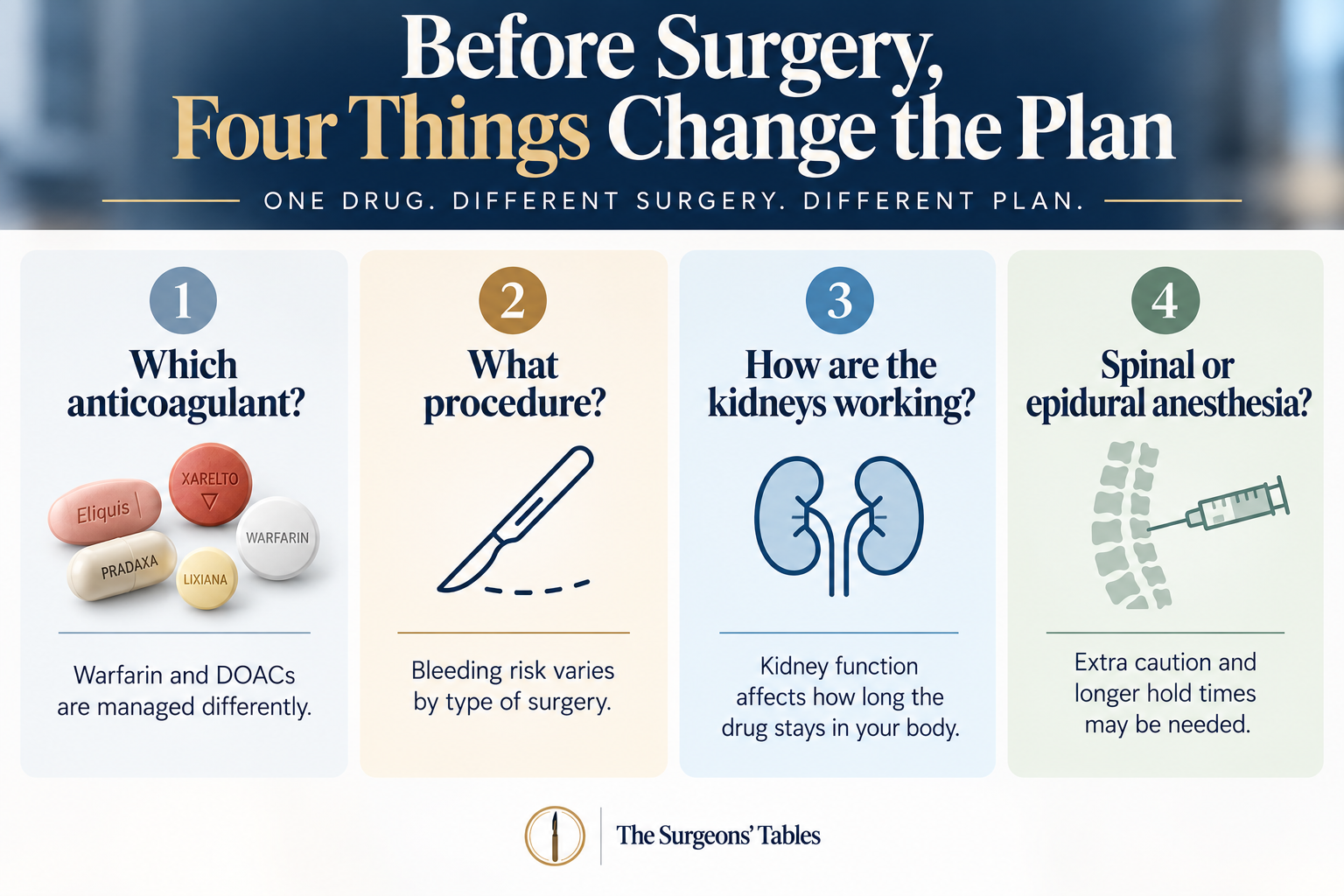
I explain that operations differ in how much bleeding they are likely to cause. Some carry a higher bleeding risk, while others have a lower risk. We decide whether and when to interrupt a blood thinner by considering the patient’s current condition, the planned procedure, and the specific medicine, along with other relevant factors. I try to reassure patients that this is an individualized decision we make carefully—not something they need to work out on their own.
The modern approach to perioperative anticoagulation is built around a simple idea: leave the patient without anticoagulation for as little time as necessary, but not so little that the operation is performed while clinically important anticoagulant effect remains.
For most people taking anticoagulation for atrial fibrillation, that balance no longer requires routine heparin bridging.
Why did doctors used to “bridge” warfarin?
Warfarin disappears slowly. It is commonly stopped several days before an operation, and after it is restarted, its full anticoagulant effect also takes several days to return.
That created an intuitive solution: replace warfarin temporarily with a shorter-acting injectable anticoagulant such as low-molecular-weight heparin.
The problem was that intuition did not translate into better outcomes for most patients with atrial fibrillation.
In the randomized BRIDGE trial, arterial thromboembolism occurred in 0.4% of patients who did not receive bridging and 0.3% of those who did. Major bleeding, however, occurred in 1.3% without bridging and 3.2% with bridging. (1)
That changed practice.
The lesson was not that clotting risk does not matter. It was that adding full-dose heparin during a short warfarin interruption can create a meaningful bleeding penalty without providing a measurable benefit for the typical atrial-fibrillation patient studied.
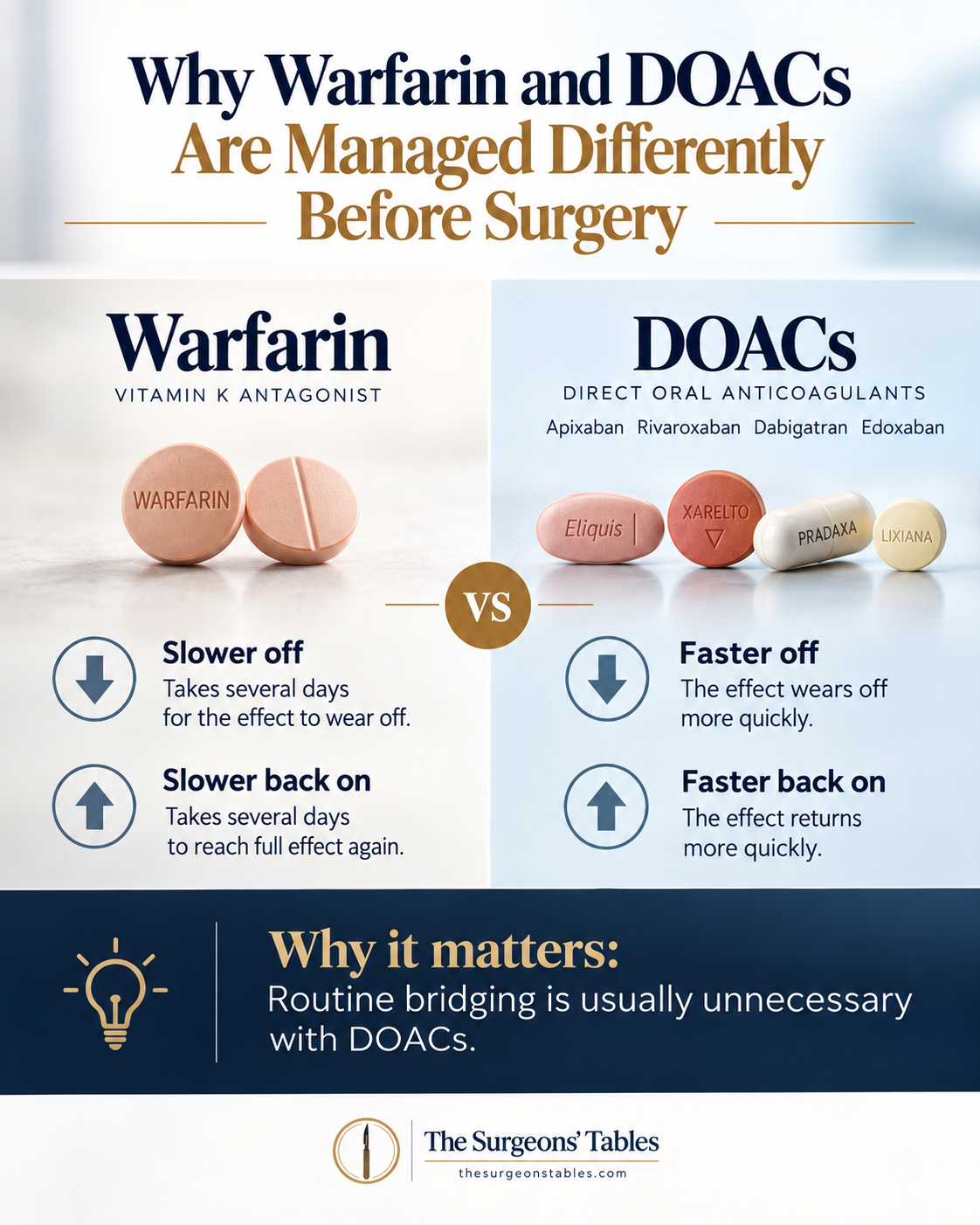
Does the same rule apply to Eliquis, Xarelto, and Pradaxa?
The case against routine bridging is even stronger with direct oral anticoagulants, or DOACs, such as apixaban (Eliquis), rivaroxaban (Xarelto), dabigatran (Pradaxa), and edoxaban.
These drugs turn off and back on much faster than warfarin.
That means the period without anticoagulation is usually short enough that inserting Lovenox into the gap adds little practical advantage and may increase bleeding.
In the PAUSE study, more than 3,000 patients with atrial fibrillation underwent elective procedures using a standardized DOAC interruption strategy without heparin bridging. Major bleeding and arterial thromboembolism remained uncommon during 30-day follow-up. (2)
Those numbers should not be translated into a patient’s exact probability of having a stroke during the one or two days the medication is held. PAUSE measured events over the postoperative follow-up period, not an hour-by-hour or day-by-day risk during the medication interruption.
The useful message is simpler: brief, protocol-based interruption without bridging has performed well in large prospective cohorts of typical atrial-fibrillation patients.
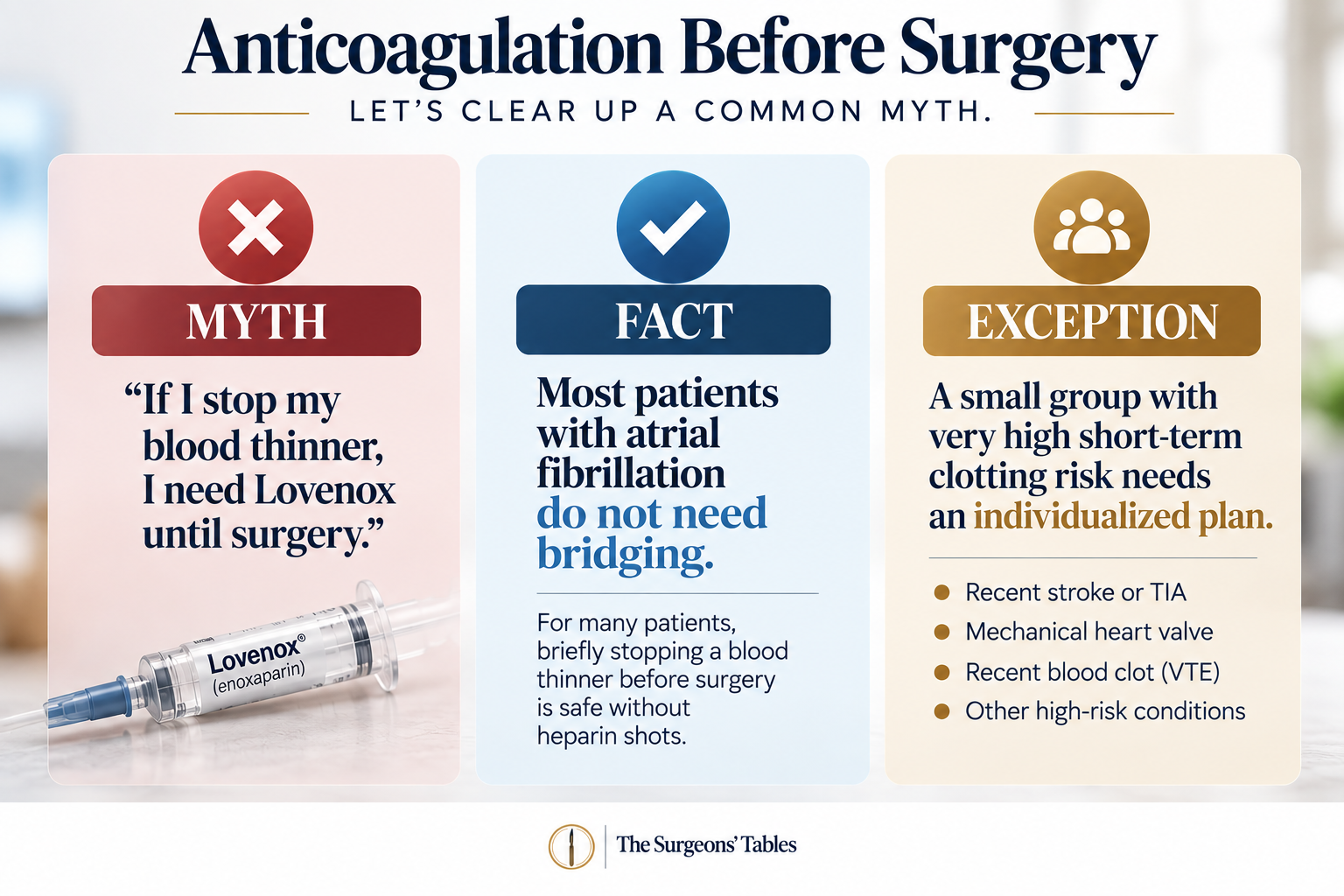
A patient can have a high long-term stroke risk and still not have a high enough short-term risk during a brief interruption to justify bridging.
So how long is the medication usually held?
There is no single “blood thinner rule.”
For many atrial-fibrillation patients with adequate kidney function, current guidance uses roughly one full day without a DOAC before a lower-bleeding-risk procedure and roughly two full days before a higher-bleeding-risk procedure. (3)
Dabigatran is the important exception because kidney function has a much larger effect on how quickly it leaves the body. When renal function is reduced, the interruption may need to be longer.
Warfarin works differently. When it needs to be interrupted, approximately five days is commonly required before higher-bleeding-risk surgery so that the INR falls adequately. (4)
But there is an important detail patients rarely hear: a “one-day hold” does not always mean exactly 24 hours between the last pill and the procedure. Depending on the dosing schedule and operation time, the actual interval may be longer.
That is why a written instruction such as “last dose Monday evening” is safer than a vague instruction such as “hold for one day.”
Do I have to stop it for cataract surgery, dental work, or an endoscopy?
Not necessarily.
The first question a surgeon or proceduralist asks is not simply, “Is the patient taking anticoagulation?”
It is, “What happens if this particular procedure bleeds?”
Some procedures have minimal bleeding risk or allow bleeding to be controlled easily with local pressure or other local measures. Cataract surgery and some minor dental and dermatologic procedures are examples in which complete anticoagulant interruption may not be necessary. (5)
Other operations are fundamentally different. Major abdominal, pelvic, orthopedic, cardiac, and neurosurgical procedures may have substantial consequences if anticoagulant effect remains.
This is why a friend who stayed on a blood thinner for a tooth extraction cannot tell you what to do before a bowel resection.
Why does spinal or epidural anesthesia change the rules?
Because the consequence of bleeding matters as much as the amount of bleeding.
A small amount of bleeding from a skin incision can usually be seen and controlled.
A small collection of blood around the spinal cord or nerve roots can compress neurologic structures in a confined space. Although this complication is uncommon, the consequences can be severe.
For that reason, neuraxial procedures such as spinal and epidural anesthesia follow more conservative anticoagulation timing rules than many operations themselves.
This is also an area where older internet charts can be misleading. Updated ASRA guidance distinguishes between high-dose and low-dose DOAC regimens and incorporates drug-specific factors and kidney function rather than applying one universal interruption interval to every patient. (6)
So if an anesthesiologist asks for a longer hold than the surgeon expected, that may reflect the anesthesia technique rather than disagreement about the operation.
Who might still need bridging?
This is where “never bridge” becomes too simple.
Most atrial-fibrillation patients do not need it. But guidelines preserve individualized consideration for patients whose risk of thrombosis over a very short interruption is unusually high. (4) (3) (5)
Examples can include certain patients with a mechanical mitral valve, a very recent stroke or transient ischemic attack, a recent thromboembolic event, some older-generation mechanical valves, or other exceptional high-risk circumstances.
Even here, bridging is not a reflex.
The team has to compare two short-term hazards: the chance of a serious clot while anticoagulation is interrupted and the chance that perioperative heparin will cause bleeding that delays surgery, requires transfusion or reoperation, or prevents safe healing.
This is one of the most important distinctions in modern perioperative anticoagulation: a patient can have a high long-term stroke risk and still not have a high enough short-term risk during a brief interruption to justify bridging.
What if I recently had a DVT or pulmonary embolism?
That is a different clinical problem from stable atrial fibrillation.
A recent venous thromboembolism can place a patient into a higher perioperative thrombotic-risk category, particularly during the early treatment period. If surgery is elective, the team may consider whether it is safer to delay the operation rather than force an interruption during a vulnerable period.
If surgery cannot reasonably wait, hematology, cardiology, anesthesia, and the procedural team may need an individualized plan.
This is exactly why “my neighbor takes Eliquis and stopped it for two days” is not enough information.
The reason you take the anticoagulant matters.
What happens after surgery may matter as much as what happens before it
Patients often focus on the last dose before surgery. Surgeons often worry just as much about the first dose afterward.
DOACs regain anticoagulant effect rapidly after they are taken.
After a lower-bleeding-risk procedure, resumption is commonly considered the next day. After higher-bleeding-risk surgery, waiting roughly two to three days may be appropriate. (2) (3)
But the calendar does not overrule the operative field.
Active bleeding, difficult intraoperative hemostasis, drains producing concerning bloody output, another planned procedure, or other postoperative complications may change the timing.
Conversely, delaying anticoagulation unnecessarily also carries risk.
The best restart time is therefore not simply “48 hours.” It is “48 hours if the patient’s bleeding risk and actual surgical hemostasis make that safe.”
What if I accidentally take a dose too close to surgery?
Tell the surgical and anesthesia teams immediately.
Do not hide the dose because you are worried the operation will be canceled.
Whether surgery must be delayed depends on the medication, dose, time since the last dose, kidney function, bleeding consequences of the procedure, anesthesia plan, and urgency of surgery.
Routine measurement of DOAC drug levels is not recommended for ordinary elective cases. Selected urgent or unusual circumstances may be different. (3) (6)
Why am I getting different instructions from different doctors?
Sometimes the instructions truly conflict.
More often, each person is looking at a different piece of the problem.
The prescribing clinician thinks about why you need anticoagulation. The surgeon thinks about whether bleeding can be controlled. The anesthesiologist thinks about the anesthesia technique and the consequences of bleeding in locations such as the spinal canal.
The solution should not be for you to choose which physician to believe.
Ask for one reconciled plan that states:
the last dose before the procedure, whether bridging is required, and when anticoagulation is expected to restart.
If those three items are not clear, the perioperative plan is not finished.

Bottom Line
For most patients taking Eliquis, Xarelto, Pradaxa, or warfarin for atrial fibrillation, temporary interruption before an operation does not automatically mean Lovenox bridging is needed.
Modern evidence has shifted practice away from routine bridging because, in typical atrial-fibrillation patients, it adds bleeding without showing a meaningful reduction in perioperative thromboembolism.
The exceptions matter. Mechanical valves, recent stroke or thromboembolism, impaired kidney function, neuraxial anesthesia, and operations in which even a small amount of bleeding could be catastrophic can change the plan.
The safest question to bring to your preoperative visit is therefore not simply, “When do I stop my blood thinner?”
“What is my exact last dose, do I need bridging for my specific clotting risk, and what has to be true before I restart it?”
References
- (1) Douketis JD, Spyropoulos AC, Kaatz S, et al. Perioperative Bridging Anticoagulation in Patients with Atrial Fibrillation. N Engl J Med. 2015;373(9):823-833. DOI: 10.1056/NEJMoa1501035. PubMed PMID: 26095867.
- (2) Douketis JD, Spyropoulos AC, Duncan J, et al. Perioperative Management of Patients With Atrial Fibrillation Receiving a Direct Oral Anticoagulant. JAMA Intern Med. 2019;179(11):1469-1478. DOI: 10.1001/jamainternmed.2019.2431. PubMed PMID: 31380891.
- (3) Joglar JA, Chung MK, Armbruster AL, et al. 2023 ACC/AHA/ACCP/HRS Guideline for the Diagnosis and Management of Atrial Fibrillation. Circulation. 2024;149(1):e1-e156. DOI: 10.1161/CIR.0000000000001193. PubMed PMID: 38033089.
- (4) Douketis JD, Spyropoulos AC, Murad MH, et al. Perioperative Management of Antithrombotic Therapy: An American College of Chest Physicians Clinical Practice Guideline. Chest. 2022;162(5):e207-e243. DOI: 10.1016/j.chest.2022.07.025. CHEST guideline.
- (5) Thompson A, Fleischmann KE, Smilowitz NR, et al. 2024 AHA/ACC/ACS/ASNC/HRS/SCA/SCCT/SCMR/SVM Guideline for Perioperative Cardiovascular Management for Noncardiac Surgery. Circulation. 2024;150(19):e351-e442. DOI: 10.1161/CIR.0000000000001285. PubMed PMID: 39316661.
- (6) Kopp SL, Vandermeulen E, McBane RD, Perlas A, Leffert L, Horlocker T. Regional anesthesia in the patient receiving antithrombotic or thrombolytic therapy: American Society of Regional Anesthesia and Pain Medicine Evidence-Based Guidelines, fifth edition. Reg Anesth Pain Med. 2025. DOI: 10.1136/rapm-2024-105766. PubMed PMID: 39880411.