
A scan can show a severely narrowed leg artery without answering the question that matters most: will opening it now improve your walking and quality of life enough to justify the procedure?
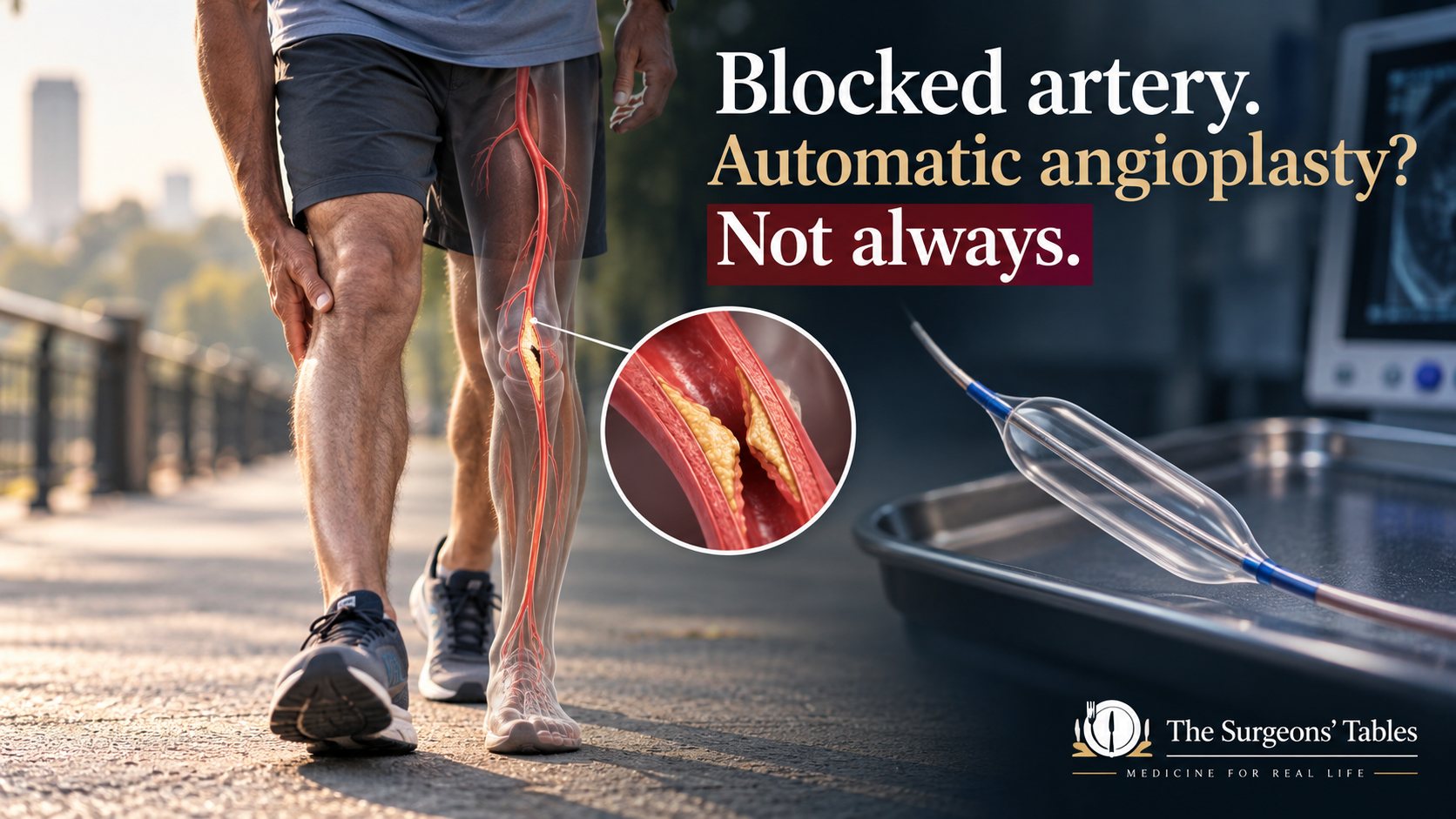
When patients tell me their legs hurt after walking, I ask them to describe the pattern. Someone who rarely walks may develop soreness after an unusually active day sightseeing or traveling. What makes me look more closely is a different story: “After about one block, my leg feels as though it will burst, and I have to stop. If I rest for five minutes, I can walk another block—but then it happens again.” That repeated cycle of walking, pain, rest, and relief raises my suspicion of an arterial circulation problem. It is a reason to investigate, rather than a diagnosis by itself.
Testing may identify peripheral artery disease, or PAD, and an imaging study may describe a severe narrowing or blockage.
The natural reaction is: If the artery is blocked, why not just open it?
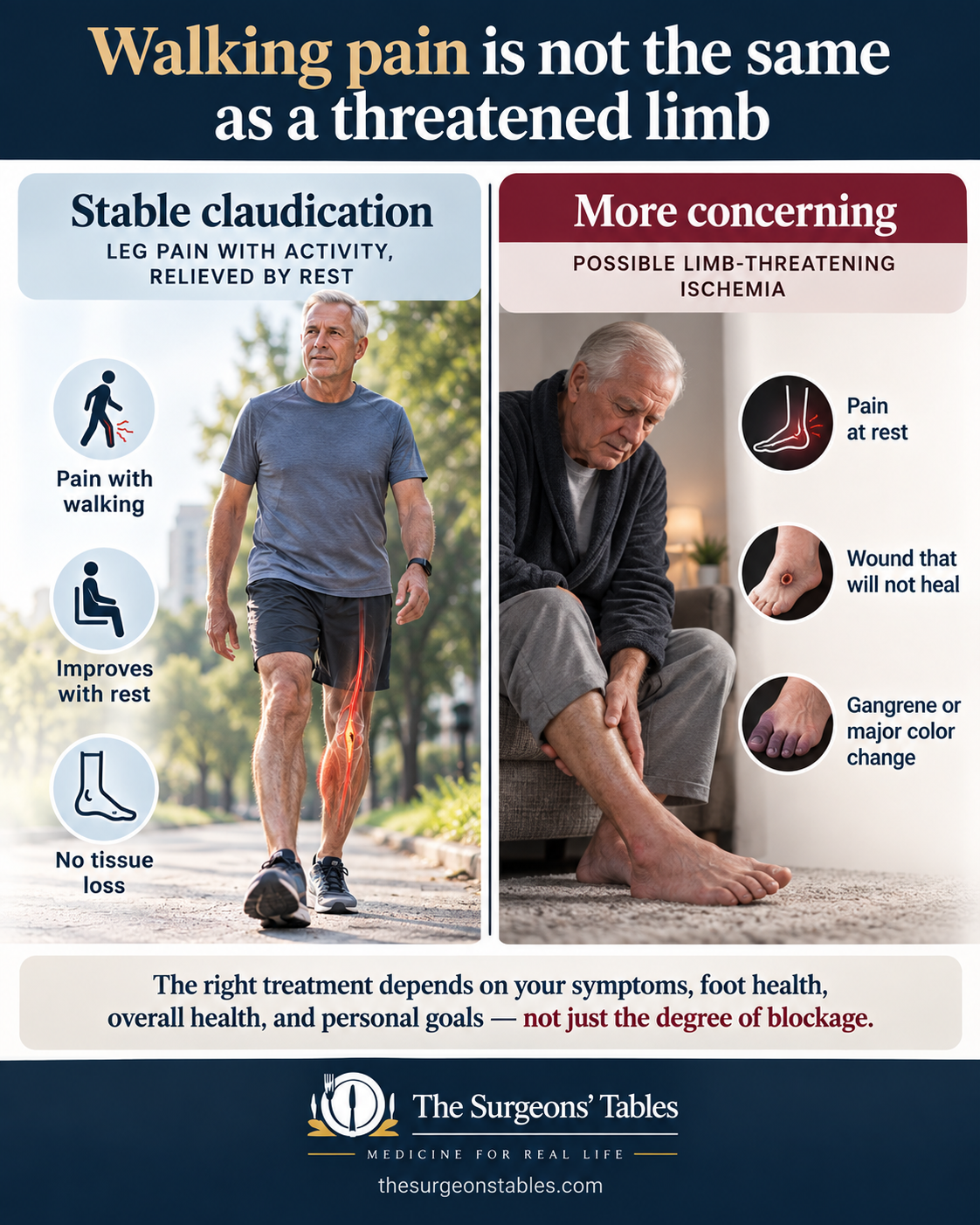
Sometimes opening it is exactly the right treatment. But in stable claudication, the decision is usually not based on the scan alone. Current U.S. guidelines place medical treatment and structured exercise at the center of care, with revascularization used to improve walking and quality of life when symptoms remain functionally limiting despite those measures. (1)
The treatment decision is whether opening the artery now is likely to improve your symptoms or protect your leg enough to justify the procedure’s risks.
My artery is blocked. Why not just open it?
Because an abnormal-looking artery and a good reason for a procedure are not the same thing.
Surgeons and vascular specialists care about anatomy, but they also care about what the blockage is actually doing to you. How far can you walk? Can you work, shop, travel, exercise, or care for yourself? Have your symptoms improved with treatment? Where is the blockage? How durable is a procedure likely to be in that particular artery? And how much improvement matters to you?
Those questions explain why two people with similarly dramatic scans may reasonably receive different recommendations.
A person whose symptoms have improved and no longer meaningfully limit daily life generally does not need revascularization simply because a stenosis remains visible. A person whose claudication continues to prevent essential activities despite appropriate treatment may have much more to gain from an intervention. (1)
If I wait, could I lose my leg?
This is often the fear behind the request for immediate angioplasty.
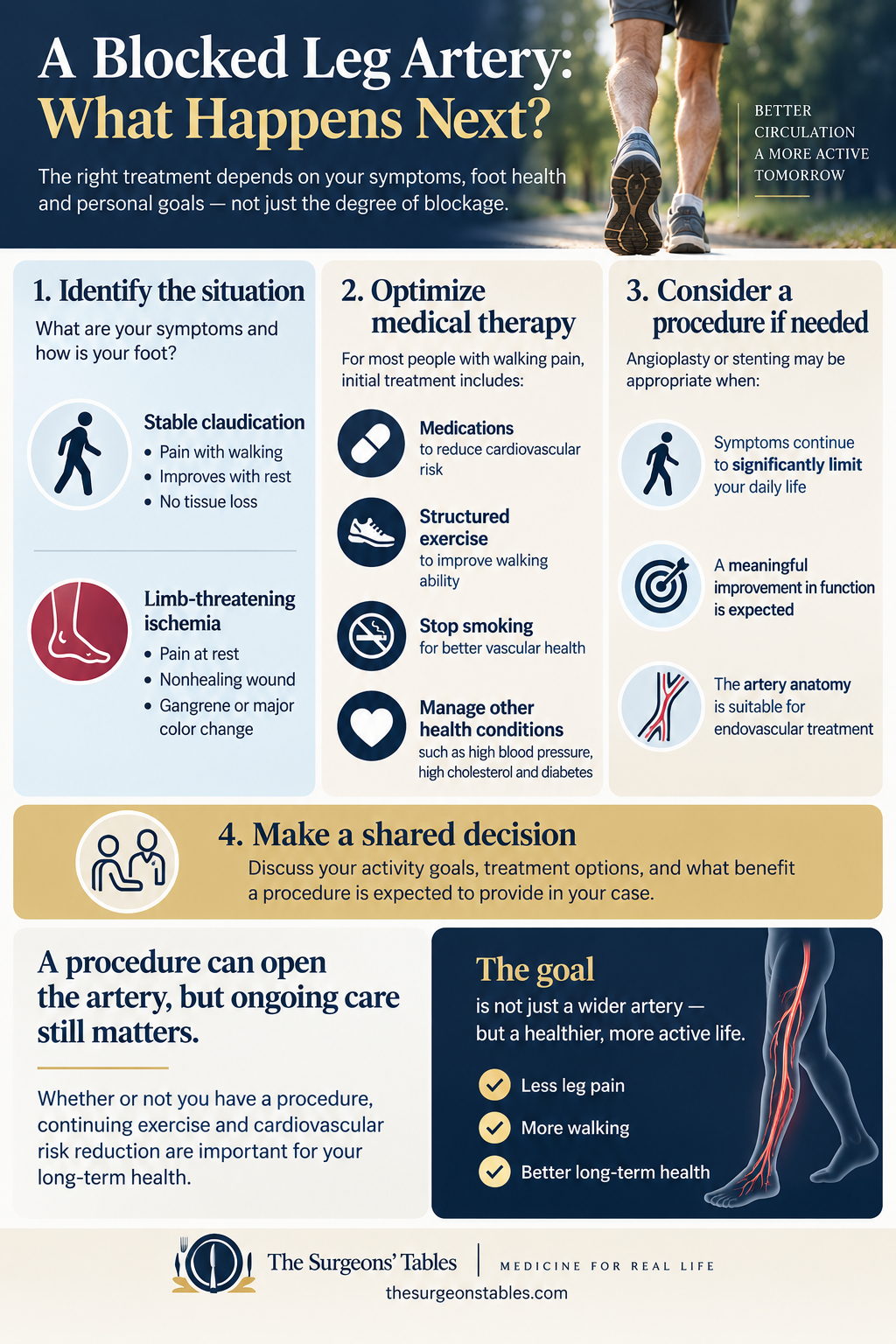
Stable intermittent claudication is different from chronic limb-threatening ischemia, or CLTI. Claudication typically causes reproducible discomfort with activity that improves when you stop. CLTI is a more serious clinical syndrome in which inadequate blood flow is associated with problems such as ischemic pain at rest, a nonhealing ulcer, or gangrene. Objective blood-flow testing helps confirm and stage the problem. (2)
I also ask whether a foot wound is healing as expected. When a wound is unusually slow to heal or keeps getting worse, I explain that we need to consider the blood supply as well as diabetes. I do not want a patient to assume that a persistent wound is “just because of diabetes” and overlook a circulation problem that also needs assessment.
That distinction matters because revascularization has different goals in these two situations. In stable claudication, a procedure is primarily being considered to improve function and quality of life. In CLTI, restoring blood flow may be important for wound healing and limb preservation. (1) (2)
Am I damaging my leg when I walk through the pain?
For typical stable claudication, walking discomfort during a structured exercise program does not mean you are tearing the artery or dislodging a clot.
In fact, intermittent walking is a treatment. A common supervised program uses repeated periods of walking until claudication discomfort develops, followed by rest and then another walking interval. The 2024 ACC/AHA guideline describes supervised programs that commonly provide at least 30 to 45 minutes of exercise per session, at least three times a week, for a minimum of 12 weeks. (1)
The benefit is also more complicated than simply “growing natural bypass vessels.” Exercise produces multiple adaptations involving skeletal muscle performance, endothelial function, walking efficiency, conditioning, and how the leg uses limited blood flow. The mechanisms are multifactorial, and meaningful improvement can occur without a major change in the ankle-brachial index. (1)
This advice applies to stable, previously evaluated claudication. A new pattern of severe pain, pain occurring at rest, a suddenly cold or numb foot, weakness, or a wound that is not healing deserves medical reassessment rather than simply pushing through it.
Can exercise really compete with a procedure?
It can – which is one reason exercise should not be dismissed as “just walking.”
In the CLEVER randomized trial of patients with aortoiliac PAD, both supervised exercise and stent-based revascularization produced durable improvements. At 18 months, improvement in peak treadmill walking time was not significantly different between the exercise and stent groups, although some patient-reported quality-of-life measures favored stenting. (3)
But that does not mean exercise always replaces intervention. In the ERASE trial, patients improved with supervised exercise alone, while patients who received endovascular revascularization plus supervised exercise improved even more in walking distance and health-related quality of life at one year. (4)
The practical message is not “exercise good, angioplasty bad.” It is that structured exercise is a real therapy, and angioplasty is another real therapy. They may be used sequentially or together depending on what the patient still needs.
The first question is not “Balloon or stent?” It is “Does this artery need to be opened now?”
Do I have to wait exactly three months before angioplasty?
No single stopwatch determines when every patient should have a procedure.
Twelve weeks is a common minimum duration used in supervised exercise programs, but the revascularization decision is based on whether symptoms remain functionally limiting despite guideline-directed treatment and structured exercise – not simply whether a calendar has reached day 84. (1)
A person who can barely perform an essential job, cannot complete normal daily activities, or cannot participate effectively in a walking program because of another major physical limitation may need a more individualized discussion. The expected benefit of intervention, arterial anatomy, procedural risk, other medical conditions, and the patient’s priorities all matter.
| Situation | What it usually means | Typical next discussion |
|---|---|---|
| Walking pain improves with rest and daily life is manageable | Stable claudication without obvious limb-threatening features | Continue PAD risk reduction and structured exercise; reassess symptoms |
| Walking remains severely limited despite appropriate treatment | The potential quality-of-life benefit of revascularization becomes more important | Discuss anatomy, expected benefit, durability, and endovascular or surgical options |
| Rest pain, nonhealing wound, or gangrene | Possible chronic limb-threatening ischemia | Prompt vascular evaluation and limb-preservation planning |
| Sudden severe pain with a cold, numb, or weak limb | Possible acute limb ischemia | Emergency vascular assessment |
If I need angioplasty, does that automatically mean a stent?
No. This is an important distinction.
Angioplasty is part of a broader endovascular approach to restoring blood flow. Depending on the artery and the lesion, treatment may involve conventional balloon angioplasty, a drug-coated balloon, a stent, or another endovascular strategy. Open surgical bypass remains appropriate in selected patients and anatomies.
A balloon can expand a narrowed segment. A drug-coated balloon also delivers medication to the vessel wall without leaving behind the permanent metallic scaffold of a stent. A stent leaves a scaffold inside the artery to support the treated segment when that strategy is appropriate.
Which option is best cannot be decided from the word “PAD” alone. Location, lesion length, calcification, vessel diameter, whether the artery is narrowed or completely occluded, previous interventions, and the expected durability of the result all influence the technical plan.
The 2024 ACC/AHA guideline deliberately emphasizes individualized revascularization planning rather than prescribing one device for every lesion. It also notes that restenosis, recurrent symptoms, and the possible need for repeat procedures are part of the tradeoff patients should understand before intervention. (1)
What if my scan says the artery is 80% or 90% blocked?
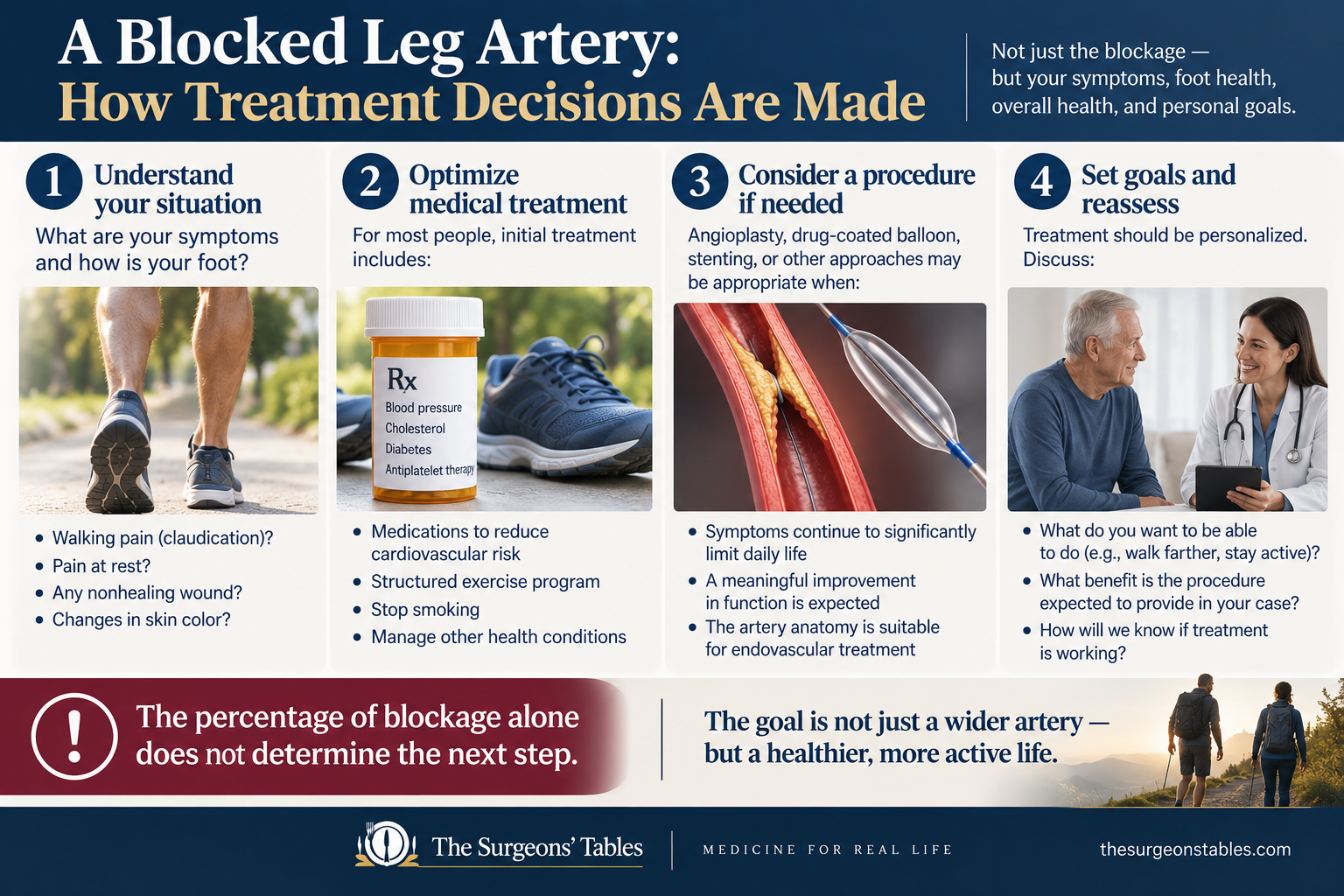
A percentage can sound decisive. Clinically, it is not the whole decision.
Before revascularization for claudication, clinicians combine symptoms and functional limitation with physiologic testing and anatomic imaging. Imaging becomes especially important when a procedure is being considered because it helps determine whether the visible disease actually matches the symptoms and whether treatment is technically likely to help. (1)
This is why “90% blocked” does not translate automatically into “90% need for angioplasty.” What matters is the entire patient, not just the narrowest picture on the scan.
If we are not doing angioplasty, are we actually treating my PAD?
Yes. And this may be the most important misconception to correct.
PAD is not only a leg problem. It is a manifestation of systemic atherosclerosis, which is why treatment also focuses on reducing the risk of heart attack, stroke, and other vascular events. Guideline-directed care may include smoking cessation, cholesterol lowering, blood-pressure and diabetes management when appropriate, antithrombotic therapy in appropriate patients, exercise, and preventive foot care. The exact prescription plan should be individualized by the treating clinician. (1)
In other words, choosing not to perform angioplasty today is not the same as choosing not to treat the disease.
The 2024 European guidelines take a similar broad approach: lifestyle measures and supervised exercise remain cornerstones of PAD management, while revascularization is considered in symptomatic patients when appropriate medical therapy and exercise have not provided enough improvement. (5)
When should I contact my vascular team sooner?
Stable claudication usually follows a predictable pattern. A meaningful change in that pattern deserves attention.
- New pain in the foot or toes while resting, particularly at night
- A sore, blister, or wound on the foot that is not healing
- New gangrene or major persistent color change of a toe or foot
- A sudden major reduction in walking ability
- Sudden severe leg or foot pain with new coldness, numbness, or weakness
Chronic limb-threatening ischemia warrants prompt specialist assessment. Sudden symptoms suggesting acute limb ischemia are an emergency. (1) (2)
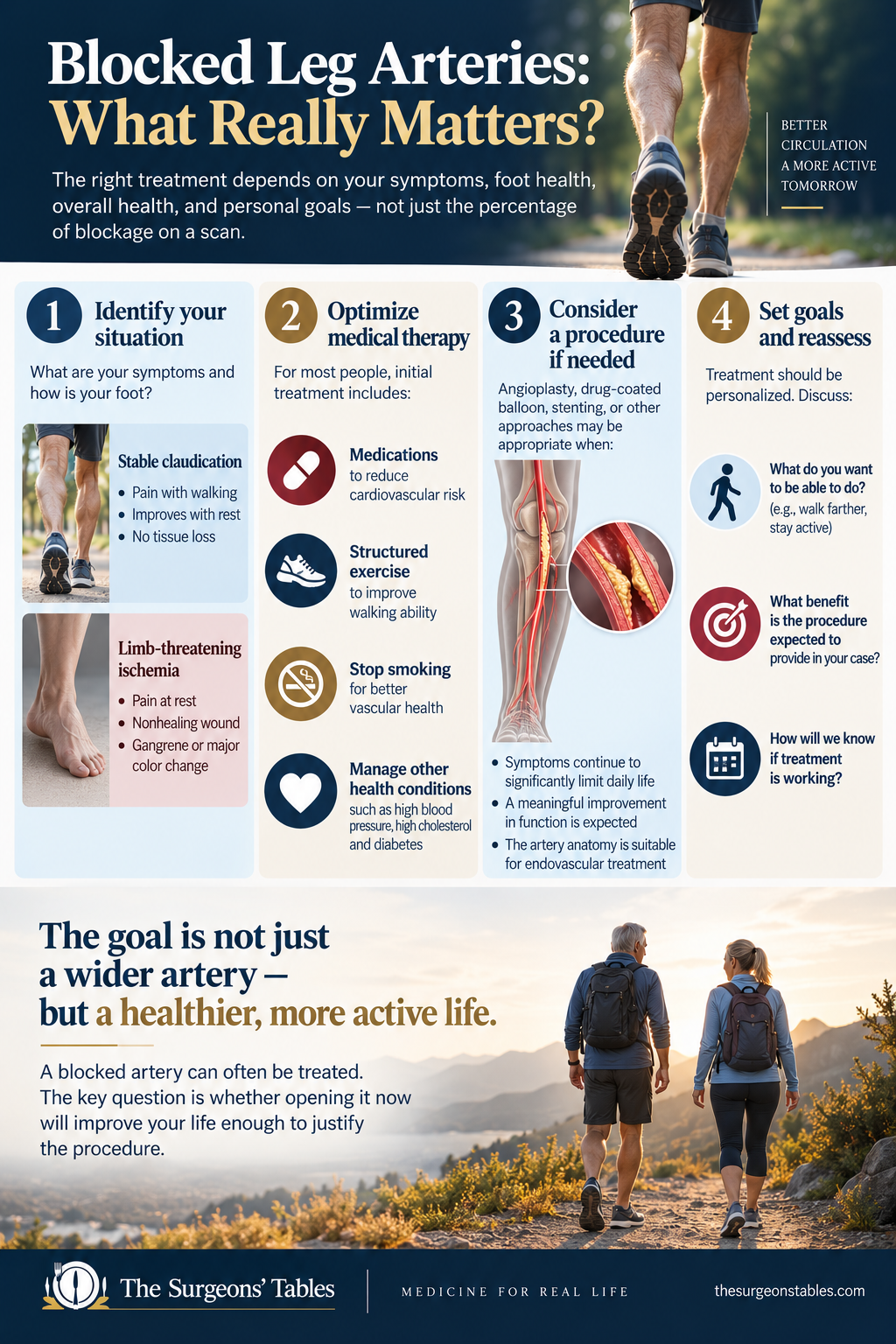
The decision is not simply balloon versus stent
That question comes later.
First comes the indication: does restoring blood flow now offer enough benefit to justify intervention? If the answer is yes, the next question is how best to restore it. That may mean a balloon, a drug-coated balloon, a stent, another endovascular technique, or sometimes surgical bypass.
This order matters. It prevents the image of a blockage – or the availability of a device – from becoming the reason for the procedure.
Bottom Line
A blocked leg artery can often be opened. That does not mean it needs to be opened immediately.
If you have stable claudication, the first priorities are appropriate PAD medical treatment, cardiovascular risk reduction, and structured exercise. If walking still limits the life you need or want to live, revascularization deserves a serious discussion. And if you develop rest pain, a nonhealing wound, gangrene, or sudden severe ischemic symptoms, the urgency changes.
The most useful question is not “Can they open my artery?” It is “What will I gain by opening it now?”
References
- (1) Gornik HL, Aronow HD, Goodney PP, et al. 2024 ACC/AHA/AACVPR/APMA/ABC/SCAI/SVM/SVN/SVS/SIR/VESS Guideline for the Management of Lower Extremity Peripheral Artery Disease. Circulation. 2024;149:e1313-e1410. Full guideline. PMID: 38743805.
- (2) Conte MS, Bradbury AW, Kolh P, et al. Global vascular guidelines on the management of chronic limb-threatening ischemia. Journal of Vascular Surgery. 2019;69(6S):3S-125S.e40. DOI: 10.1016/j.jvs.2019.02.016. PMID: 31159978.
- (3) Murphy TP, Cutlip DE, Regensteiner JG, et al. Supervised exercise, stent revascularization, or medical therapy for claudication due to aortoiliac peripheral artery disease: the CLEVER study. Journal of the American College of Cardiology. 2015;65(10):999-1009. DOI: 10.1016/j.jacc.2014.12.043. PMID: 25766947.
- (4) Fakhry F, Spronk S, van der Laan L, et al. Endovascular Revascularization and Supervised Exercise for Peripheral Artery Disease and Intermittent Claudication: A Randomized Clinical Trial. JAMA. 2015;314(18):1936-1944. DOI: 10.1001/jama.2015.14851. PMID: 26547267.
- (5) Mazzolai L, Teixido-Tura G, Lanzi S, et al. 2024 ESC Guidelines for the management of peripheral arterial and aortic diseases. European Heart Journal. 2024;45:3538-3700. European Heart Journal. ESC guideline page.