
Another flare does not automatically mean another course of antibiotics – or that you are one attack away from colon surgery. The more useful questions are how severe this episode is, whether you have higher-risk features, and how much recurrent diverticulitis is actually disrupting your life.

The CT says diverticulitis again. Your first episode brought antibiotics. Maybe your second did too. Now you are wondering whether every flare means another prescription – and whether a third or fourth episode means a surgeon will eventually tell you that part of your colon has to come out.
For many patients, neither conclusion is correct.
Modern treatment of diverticulitis has moved away from two old reflexes: antibiotics for everyone and surgery after a certain number of attacks. The decisions are now much more individualized.
The key is the word uncomplicated. If imaging shows localized inflammation without an abscess, fistula, obstruction, or free perforation, and you are otherwise clinically stable, antibiotics may add little. And if the disease keeps returning, surgery is usually discussed because of what it is doing to your life – not because you have reached a predetermined attack count. (1) (2) (3) (4) (5)
Do I really need antibiotics this time?
Not necessarily.
Several randomized trials have compared antibiotics with observation in carefully selected patients with CT-confirmed uncomplicated diverticulitis. They did not find a meaningful advantage from routine antibiotics in recovery, serious complications, or recurrence. (4) (5) (6)
That evidence now appears directly in U.S. guidance. The 2026 American College of Gastroenterology guideline suggests against routine antibiotics for low-risk patients with acute uncomplicated diverticulitis. (1)
But that sentence has an important qualifier: low risk.
A CT report saying “uncomplicated diverticulitis” tells your doctor that major local complications such as an abscess or free perforation were not found. It does not answer every other question about you.
Why might my doctor still prescribe antibiotics?
Because clinicians are looking beyond the label on the scan.
Antibiotics become more reasonable when a patient is immunocompromised, frail, considerably ill, unable to maintain hydration, difficult to monitor safely outside the hospital, or has other findings suggesting a greater chance of progression. Previous AGA guidance also identifies refractory symptoms, vomiting, markedly elevated inflammatory markers, a fluid collection, or a longer inflamed segment on CT as features that push treatment toward antibiotics. (1) (2)
So two people can both have “uncomplicated diverticulitis” and appropriately receive different treatment.
| More likely to be considered for observation without routine antibiotics | More likely to need antibiotics or closer evaluation |
|---|---|
| Mild symptoms and clinically stable | Significant or worsening systemic illness |
| Normal immune function | Immunocompromised |
| Able to drink and manage symptoms at home | Persistent vomiting or dehydration |
| Reliable follow-up and ability to return if worse | Frailty, important comorbidities, or unreliable outpatient monitoring |
| No concerning complication on CT | Fluid collection, complicated disease, or other concerning imaging features |
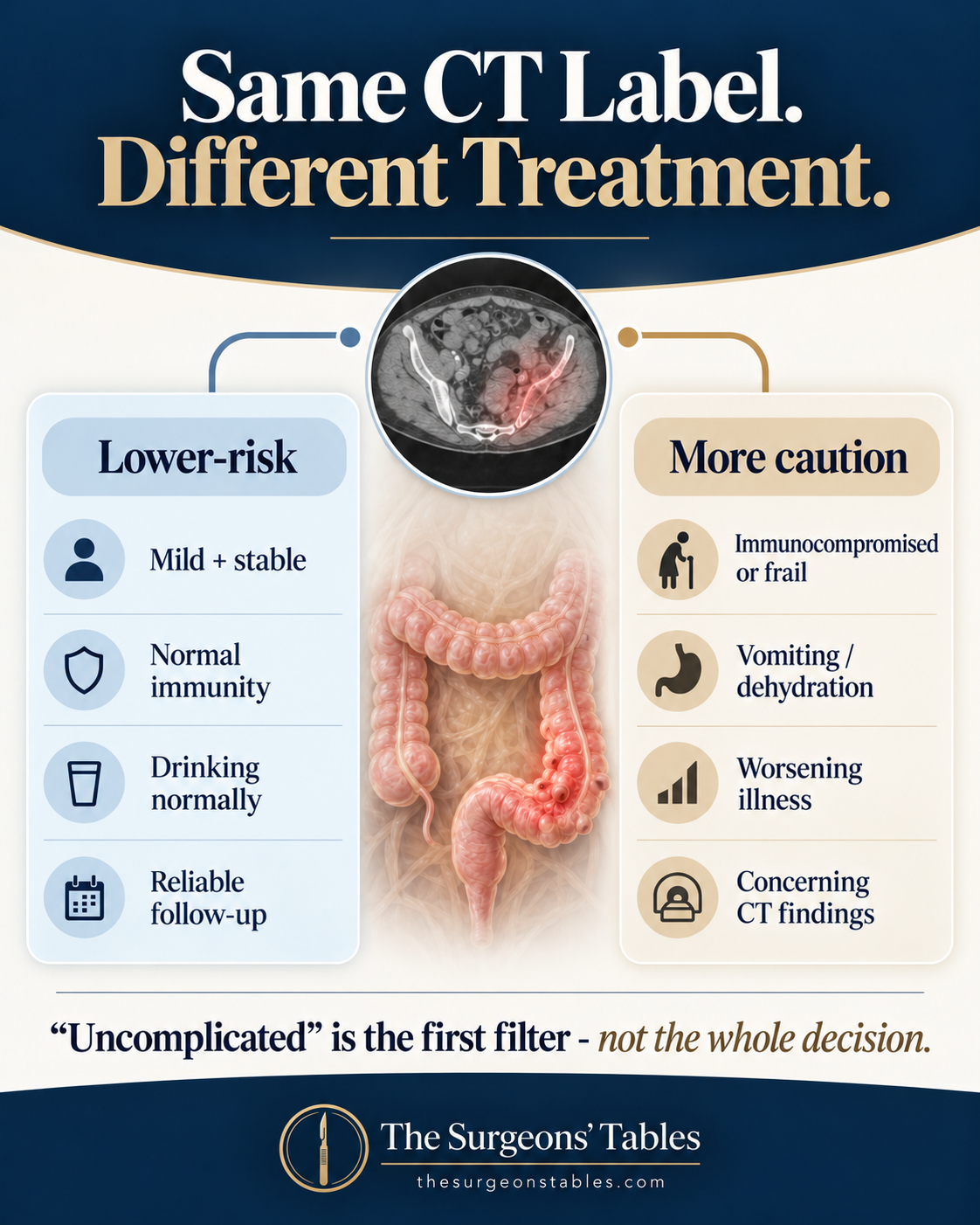
This is also why you should not independently stop antibiotics that have already been prescribed. The useful question is: “What feature in my case makes antibiotics helpful or unnecessary?”
If antibiotics are optional, does that mean diverticulitis is not an infection?
That explanation is too simple.
Diverticulitis involves inflammation around a diverticulum, one of the small pouches that can form in the colon wall. Gut bacteria may participate in that process. But mild uncomplicated diverticulitis does not behave like an uncontrolled bacterial infection that necessarily improves when every patient receives antibiotics.
That distinction explains an apparent contradiction: bacteria may be involved, yet randomized trials can still find little benefit from routinely adding antibiotics in carefully selected patients.
The message is not “diverticulitis is never an infection.”
It is “not every uncomplicated episode requires antimicrobial treatment.”
What if I skip antibiotics and my colon ruptures?
This fear drives a great deal of overtreatment.
A recurrent episode can certainly become serious, and severe or worsening symptoms should never be ignored. But the natural history is not simply:
attack one – attack two – attack three – perforation.
Current ACG and AGA guidance emphasizes a counterintuitive point: complicated diverticulitis is most likely to present during an initial episode, while the risk of complicated disease decreases with recurrent episodes. (1) (2)
That does not make later attacks harmless. It means that having another uncomplicated episode does not necessarily mean you are progressively marching toward a catastrophic rupture.
This distinction also helps explain why surgeons no longer recommend preventive colon removal simply because a patient has reached attack number two.
How many attacks before I need surgery?
There is no magic number.
The old “two attacks and then surgery” concept has been replaced by individualized decision-making. Both contemporary gastroenterology guidance and colorectal surgery guidance reject episode count alone as a reason for elective sigmoid colectomy. (1) (2) (3)
A colorectal surgeon is more interested in questions such as:
- How often are these episodes actually happening?
- Were they convincingly documented as diverticulitis?
- Have you had an abscess or another complication?
- Are symptoms fully resolving between episodes?
- How much work, travel, eating, exercise, and normal life are you losing?
- How anxious have you become about the next flare?
- What is your individual operative risk?
- What do you expect surgery to fix?
That last question matters more than many patients realize.
When does elective surgery actually make sense?
Surgery makes the most sense when the burden of the disease begins to outweigh the burden and risk of the operation.
Imagine two patients who have each had three episodes.
One had three relatively mild flares over six years, recovers completely each time, and otherwise lives normally.
The other has had three attacks in 12 months, repeatedly misses work, cancels travel, continues to have pain between attacks, and feels that the disease is controlling everyday decisions.
The attack count is identical. The surgical decision may be very different.
The 2026 ACG guideline recommends surgical referral when recurrent uncomplicated diverticulitis significantly impairs quality of life. (1)
Long-term randomized evidence reinforces why that decision should be individualized. In the 2025 four-year analysis of the LASER trial, elective sigmoid resection substantially reduced recurrent diverticulitis. But surgery did not produce a statistically clear overall quality-of-life advantage at four years in the original randomized comparison. Importantly, almost one-third of patients initially assigned to conservative management ultimately underwent surgery, and those patients tended to have worse quality of life. (7)
That is a much more useful way to think about elective surgery than counting attacks.
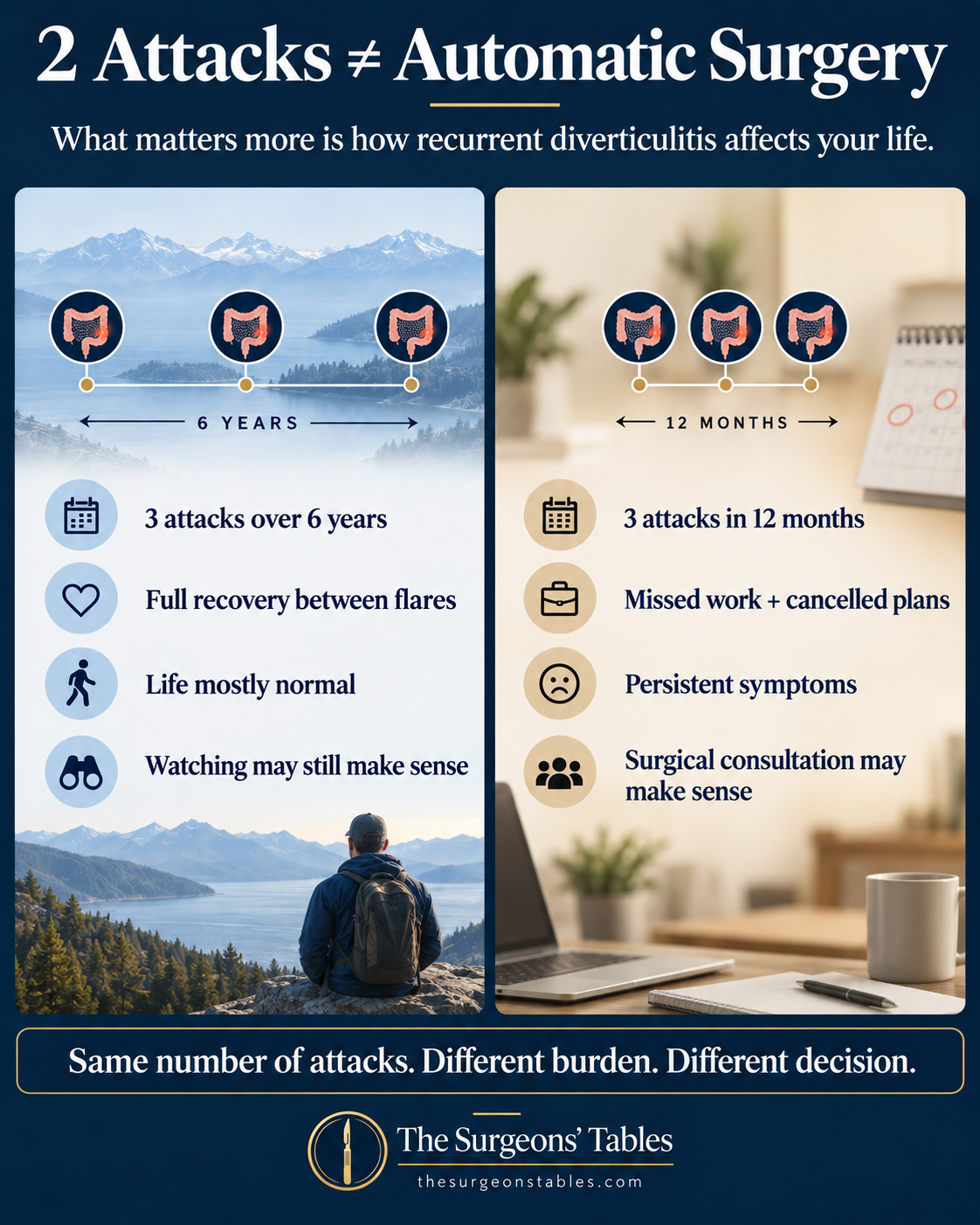
The question is not “Have I had enough attacks for surgery?” It is “Has this disease become burdensome enough that the benefits of surgery may now outweigh its risks?”
If I have surgery, can diverticulitis still come back?
Yes.
Removing the diseased sigmoid segment can markedly reduce recurrence, but it does not make the risk zero. In the LASER follow-up, recurrent diverticulitis still occurred in some patients after surgery. (7)
Surgery also cannot guarantee that every chronic abdominal symptom will disappear. Some patients continue to experience altered bowel habits, abdominal discomfort, or other gastrointestinal symptoms even after the inflamed segment has been removed. AGA guidance specifically advises patients that surgery reduces rather than eliminates recurrence and that chronic gastrointestinal symptoms do not always improve after resection. (2)
This is one reason the best elective surgical consultation is not simply about whether an operation can be performed. It is about whether the operation is likely to solve your particular problem.
Why do I still hurt when the diverticulitis seems to be gone?
Persistent pain does not automatically mean you still have an infection – and it does not automatically mean you need more antibiotics or surgery.
Some patients develop ongoing gastrointestinal symptoms after an acute attack. If symptoms persist, clinicians may need to determine whether there is continuing inflammation, a stricture or another structural problem, or a different diagnosis entirely.
When imaging and lower endoscopy do not show ongoing diverticulitis or another explanation, visceral hypersensitivity – an increased sensitivity of the gut after inflammation – can be part of the problem. (2)
That distinction matters. Treating every persistent ache as another active infection can lead to unnecessary antibiotics and may delay investigation of the real cause.
If it happens again, do I need another CT every time?
Usually not automatically.
CT is especially useful when the diagnosis has never been imaging-confirmed, when the presentation is severe, when complications are suspected, or when symptoms are not improving as expected. Imaging is also useful before contemplating surgery after multiple recurrences because the team needs to confirm that diverticulitis really is the source and identify where the disease is located. (1) (2)
If you have already had CT-confirmed diverticulitis and later develop a mild, very typical recurrence, your clinician may not need to repeat a CT every single time.
But a previous diagnosis should not become a reason to assume that every future episode of abdominal pain is diverticulitis. New, unusually severe, or atypical symptoms deserve reassessment.
Do I need a colonoscopy after the attack?
Sometimes – but not everyone needs the same answer.
This is an area where recommendations have evolved.
The 2026 ACG guideline recommends colonoscopy after complicated diverticulitis. After uncomplicated diverticulitis, it suggests colonoscopy particularly when a patient has alarm symptoms or is not up to date with colorectal cancer screening. (1)
Earlier AGA guidance was somewhat broader, advising colonoscopy after a first uncomplicated episode unless a recent high-quality colonoscopy had already been performed. (2)
So if two clinicians give slightly different advice, it does not necessarily mean one has made a mistake. The decision can reasonably depend on:
- whether the episode was complicated,
- your age and colorectal cancer screening status,
- how recently you had a high-quality colonoscopy,
- whether symptoms have completely resolved,
- and whether you have alarm symptoms such as rectal bleeding, iron-deficiency anemia, unexplained weight loss, or a significant change in bowel habits.
If colonoscopy is needed after an acute attack, it is generally performed after the inflammation has settled rather than during the painful acute phase. (2)
What should I eat during the attack?
You do not need to prove your toughness by forcing a normal meal, and you generally do not need to starve your colon either.
During the painful acute phase, many patients are more comfortable temporarily using liquids or lighter foods and then advancing their diet as symptoms improve. AGA guidance specifically allows a clear liquid diet for comfort during the acute phase, with progression as the patient improves. (2)
If you cannot maintain hydration, are repeatedly vomiting, or cannot advance your diet as symptoms should be improving, contact your treating team.
Do nuts, seeds, corn, or popcorn cause another attack?
No convincing evidence supports avoiding them.
The long-standing theory was that small food particles could lodge inside diverticula and trigger inflammation. A large prospective U.S. cohort found no increased risk of diverticulitis from nuts, corn, or popcorn. (8)
The 2026 ACG guideline specifically includes a healthy diet without avoiding nuts, seeds, corn, or popcorn among long-term recommendations. (1)
The larger preventive picture matters more: dietary quality, regular physical activity, maintaining a healthy weight, avoiding smoking, limiting heavy alcohol use, and limiting nonsteroidal anti-inflammatory drugs when possible may help reduce recurrence risk. (1) (2)
None of these measures can guarantee another attack will not occur. Genetics also contributes substantially to susceptibility. (2)
When should I stop watching this at home?
The “no routine antibiotics” message applies to selected, stable patients. It should never become a reason to ignore deterioration.
Seek prompt medical reassessment if you develop worsening or severe abdominal pain, persistent vomiting or inability to drink, fever or systemic illness, faintness or significant weakness, abdominal distention, inability to pass stool or gas, significant rectal bleeding, or symptoms that are failing to improve as expected.
Immunocompromised patients should have a particularly low threshold for reassessment because diverticulitis can be more severe and its presentation less predictable. (1) (2)
What This Means for You
If another episode occurs, these are more useful questions than simply asking for another antibiotic prescription:
- Was this actually confirmed as uncomplicated diverticulitis?
- Do I have any high-risk feature that changes the antibiotic decision?
- If I am being treated at home, what worsening symptoms should trigger reevaluation?
- If these attacks keep recurring, is the issue frequency alone – or is my quality of life now poor enough to justify a colorectal surgery consultation?
- Am I up to date on colorectal cancer screening, or do I need colonoscopy after recovery?
Bottom Line
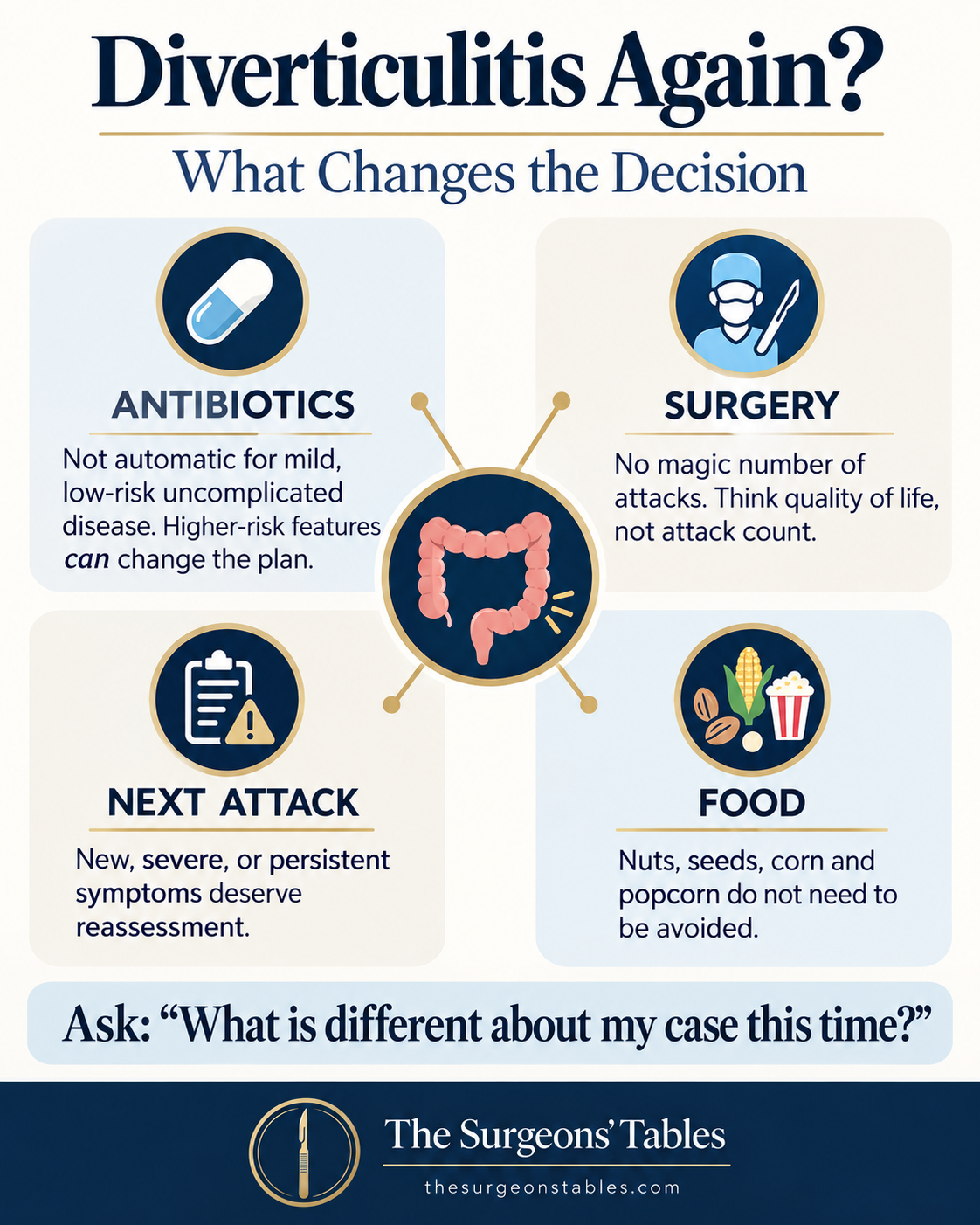
Another uncomplicated diverticulitis attack does not automatically mean another course of antibiotics, and it does not move you one fixed step closer to colon surgery.
For a clinically stable, low-risk patient, observation without routine antibiotics may be appropriate. If attacks recur, surgery is usually a quality-of-life decision rather than a counting exercise. And if the pattern of pain changes, symptoms persist, or you become sicker, the right response is not to assume it is “just another flare” – it is to be reassessed.
The best question after a recurrence is therefore not simply, “Is this attack number two or three?”
It is: “What is different about this episode, and is diverticulitis now affecting my life enough that the treatment strategy should change?”
References
- (1) Peery AF, Strate LL, Stollman N, et al. ACG Clinical Guideline: Colonic Diverticulitis. Am J Gastroenterol. 2026;121(7):1549-1561. PMID: 42390126. DOI: 10.14309/ajg.0000000000004047. PubMed.
- (2) Peery AF, Shaukat A, Strate LL. AGA Clinical Practice Update on Medical Management of Colonic Diverticulitis: Expert Review. Gastroenterology. 2021;160(3):906-911.e1. PMID: 33279517. DOI: 10.1053/j.gastro.2020.09.059. PubMed.
- (3) Hall J, Hardiman K, Lee S, et al. The American Society of Colon and Rectal Surgeons Clinical Practice Guidelines for the Treatment of Left-Sided Colonic Diverticulitis. Dis Colon Rectum. 2020;63(6):728-747. PMID: 32384404. DOI: 10.1097/DCR.0000000000001679. PubMed.
- (4) Qaseem A, et al. Diagnosis and Management of Acute Left-Sided Colonic Diverticulitis: A Clinical Guideline From the American College of Physicians. Ann Intern Med. 2022. PubMed.
- (5) Chabok A, Pahlman L, Hjern F, et al. Randomized clinical trial of antibiotics in acute uncomplicated diverticulitis. Br J Surg. 2012;99(4):532-539. PMID: 22290281. DOI: 10.1002/bjs.8688. PubMed.
- (6) Daniels L, Unlu C, de Korte N, et al. Randomized clinical trial of observational versus antibiotic treatment for a first episode of CT-proven uncomplicated acute diverticulitis. Br J Surg. 2017;104(1):52-61. PMID: 27686365. DOI: 10.1002/bjs.10309. PubMed.
- (7) Santos A, Mentula P, Pinta T, et al. Sigmoid Resection vs Conservative Treatment After Diverticulitis: Prespecified 4-Year Analysis of the LASER Randomized Clinical Trial. JAMA Surg. 2025;160(6):615-622. PMID: 40202724. DOI: 10.1001/jamasurg.2025.0572. PubMed.
- (8) Strate LL, Liu YL, Syngal S, Aldoori WH, Giovannucci EL. Nut, corn, and popcorn consumption and the incidence of diverticular disease. JAMA. 2008;300(8):907-914. PMID: 18728264. DOI: 10.1001/jama.300.8.907. PubMed.