
An ultrasound found gallstones you did not know you had. The next question is not simply whether stones are there – but whether they have ever caused trouble, and whether there is any reason to treat them now.
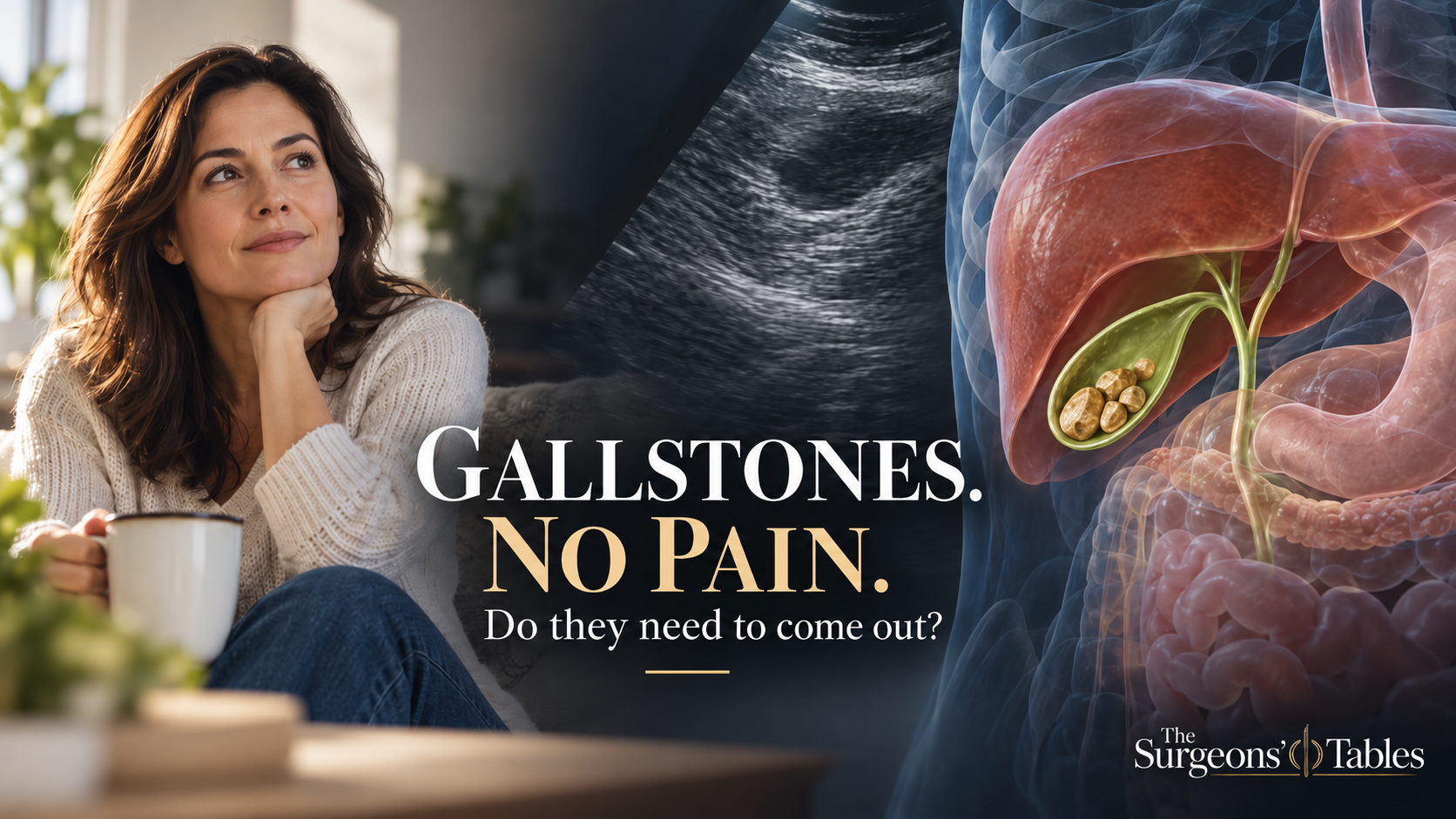
You had an ultrasound for something unrelated. Then the report came back with an unexpected finding: gallstones.
For most people with truly silent, uncomplicated gallstones, the answer is reassuring: finding gallstones does not automatically mean you need your gallbladder removed.
Major guidelines favor observation when stones are found incidentally in an otherwise normal gallbladder and biliary tree and have not been causing symptoms. NICE specifically recommends reassurance without treatment for asymptomatic gallbladder stones found in a normal gallbladder and normal biliary tree unless symptoms develop. (1)
The reason is not that gallstones are harmless. It is that most silent stones never create enough trouble to justify exposing every patient who has them to an operation.
But before a surgeon calls your stones “silent,” there is another question to answer.
“I don’t hurt now – but what if I had an attack six months ago?”
This is one of the most important details to tell your doctor.
Being pain-free today is not the same thing as never having had symptomatic gallstones.
Imagine two patients. One had an ultrasound during a kidney evaluation, learned she had gallstones, and cannot remember ever having significant upper abdominal pain. The other feels perfectly well today too – but six months ago had a severe episode of upper abdominal pain that lasted two hours and then disappeared.
Those patients should not automatically be placed in the same category.
If you have previously had a convincing biliary-type attack, the fact that the pain resolved does not erase that history. The decision about surgery may be very different from the decision for someone whose stones have truly never caused symptoms.
So tell your clinician about old attacks even if they stopped on their own.
“Then how do I know whether my old stomach pain was actually from the gallstones?”
This is where the history becomes more important than the ultrasound.
Gallstones are common. So are indigestion, reflux, bloating, and irritable bowel symptoms. Finding both in the same person does not prove that one caused the other.
Pain that sounds more biliary is usually a distinct attack of significant pain in the upper-right or upper-middle abdomen. It tends to become fairly steady, lasts long enough to interrupt normal activity, and may extend toward the back or right shoulder. Bloating, belching, heartburn, and chronic vague indigestion are much less specific for gallstones. (2)
| More suggestive of biliary pain | Much less specific |
|---|---|
| Significant upper-right or upper-middle abdominal pain | Bloating |
| A distinct attack lasting at least about 30 minutes | Belching |
| Fairly steady pain that interrupts normal activity | Heartburn |
| Pain that may extend toward the back or right shoulder | Lower abdominal cramps |
| Separate attacks with relatively normal periods between them | Chronic vague indigestion |
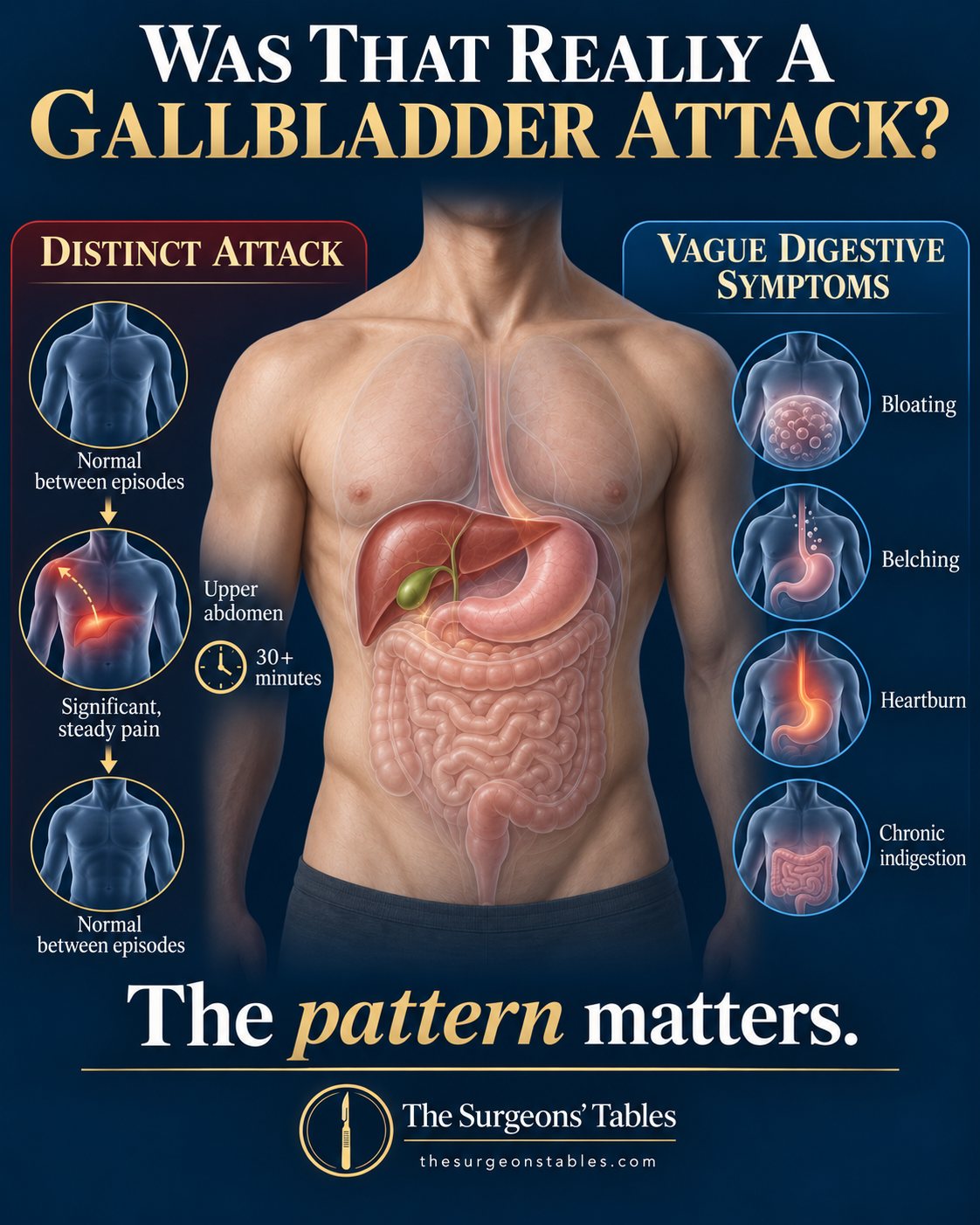
None of these features proves the diagnosis by itself. But the distinction matters enormously before surgery.
Removing a gallbladder can treat gallbladder disease. It cannot reliably fix unrelated reflux, irritable bowel symptoms, or functional indigestion simply because stones appeared on an ultrasound.
That is one reason a good surgical consultation may spend surprisingly little time asking, “How many stones are there?” and much more time asking, “Tell me exactly what the pain felt like.”
A gallstone on an ultrasound is an anatomical finding. Whether it represents a disease that needs treatment depends on the patient’s clinical story.
“Is the stone actually in the gallbladder – or in the bile duct?”
This is a distinction patients often never realize they need to ask about.
An uncomplicated stone sitting inside the gallbladder is not the same clinical problem as a stone that has moved into the common bile duct.
NICE recommends no treatment for uncomplicated asymptomatic gallbladder stones, but recommends bile duct clearance for common bile duct stones, including stones that are asymptomatic when discovered. (1)
That means the phrase “I have gallstones” is not quite enough. The location matters.
If your report mentions a common bile duct stone, bile duct dilation, jaundice, abnormal liver tests, or another biliary abnormality, your situation should not be treated as routine silent gallbladder stones.
“But aren’t silent gallstones eventually going to cause trouble?”
Most do not.
Long-term evidence and international guidelines suggest that only a minority of people with silent gallstones go on to develop symptoms. The European Association for the Study of the Liver estimates that symptoms develop in roughly 0.7% to 2.5% of asymptomatic patients per year, while complications occur less often. (2)
That is why observation became standard rather than preventive surgery for everyone.
But there is an important correction to overly reassuring internet advice: you should not be told that a serious complication can never happen without a prior warning attack.
The risk is low, not zero.
Watchful waiting is reasonable because the overall natural history favors observation for most truly asymptomatic patients – not because future complications are impossible.
“If we’re leaving them there, won’t the stones keep growing?”
Gallstones can change over time. They may remain stable, increase in size or number, or new stones may form.
But the goal of managing silent gallstones is not necessarily to keep every future ultrasound looking exactly the same.
The clinically important question is whether the stones begin causing symptoms or complications.
A change in the appearance of stones does not by itself prove that an otherwise well patient would have benefited from having the gallbladder removed years earlier.
That is why observation of uncomplicated silent stones is fundamentally symptom- and risk-based rather than an attempt to eliminate every stone visible on imaging.
“So do I need an ultrasound every year?”
Not necessarily.
This surprises many patients because “watching” sounds as though somebody should periodically measure the stones.
For uncomplicated asymptomatic gallbladder stones in a normal gallbladder and normal biliary tree, NICE recommends reassurance and no treatment unless symptoms develop. Its recommendation does not establish routine serial ultrasound surveillance for every patient with silent stones. (1)
So watchful waiting does not automatically mean annual ultrasound.
Another imaging finding, a new symptom, or an individual clinical circumstance can create a separate reason to repeat imaging. That is different from repeatedly scanning every uncomplicated silent gallstone simply because it exists.

“Should I stop eating fatty foods now?”
You do not automatically need to live on a fat-free diet because an ultrasound found silent gallstones.
A generally healthy eating pattern makes sense. NIDDK recommends foods rich in fiber, limiting refined carbohydrates and sugars, and choosing healthier fats as part of a balanced diet. (4)
One issue deserves particular attention: avoid crash dieting and very rapid weight loss. Rapid weight loss can promote gallstone formation and increase gallstone-related problems. (5)
If a particular type of meal repeatedly precedes convincing attacks, that is useful information to discuss with your clinician. But an incidental gallstone finding by itself is not a reason to become afraid of normal meals or eliminate entire food groups.
“Can I just dissolve the stones with medicine instead?”
There are medications capable of dissolving some cholesterol gallstones, but that does not make them a routine alternative for everyone.
Bile-acid medications such as ursodiol work only in selected circumstances, may require months or years, do not work for every type of stone, and stones can recur. Nonsurgical dissolution is generally reserved for specific patients rather than prescribed simply because an ultrasound has found asymptomatic stones. (6)
And if the stones are causing no problem, there is an even more basic question:
Why expose yourself to a treatment to remove something that may never need treatment?
“Can this stone be dissolved?” and “Does this stone need to be treated?” are two different questions.
“What about olive oil, lemon juice, or a gallbladder cleanse?”
A home gallbladder flush is not the same thing as medical dissolution therapy.
There is no reliable evidence that a gallbladder cleanse removes gallstones from the gallbladder. Mayo Clinic notes that the stone-like material people may see afterward can consist of oil, juice, and other material rather than gallstones, and cleanses can cause nausea, vomiting, diarrhea, and abdominal pain. (7)
So the useful distinction is simple: medical dissolution exists for selected circumstances. A home gallbladder cleanse is not the same treatment.
“If surgery is common, why not just remove the gallbladder now and never worry about it?”
Because a common operation is still an operation.
Laparoscopic gallbladder removal is generally safe, but it carries risks including bleeding, infection, bile leak, anesthesia-related complications, and uncommon but potentially serious bile duct injury. Contemporary surgical guidance reports major bile duct injury as an uncommon complication, but not a zero-risk event. (8)
The question therefore is not simply:
Can this operation be performed safely?
It usually can.
The better question is:
Does this particular patient have enough expected benefit from surgery to justify taking even a small operative risk?
For symptomatic gallstone disease, that balance may favor surgery. For a person who may live the rest of their life without a gallstone problem, the calculation is different.
“Then what exactly am I supposed to do while we wait?”
Watchful waiting should not feel like, We found something and now we’re doing nothing.
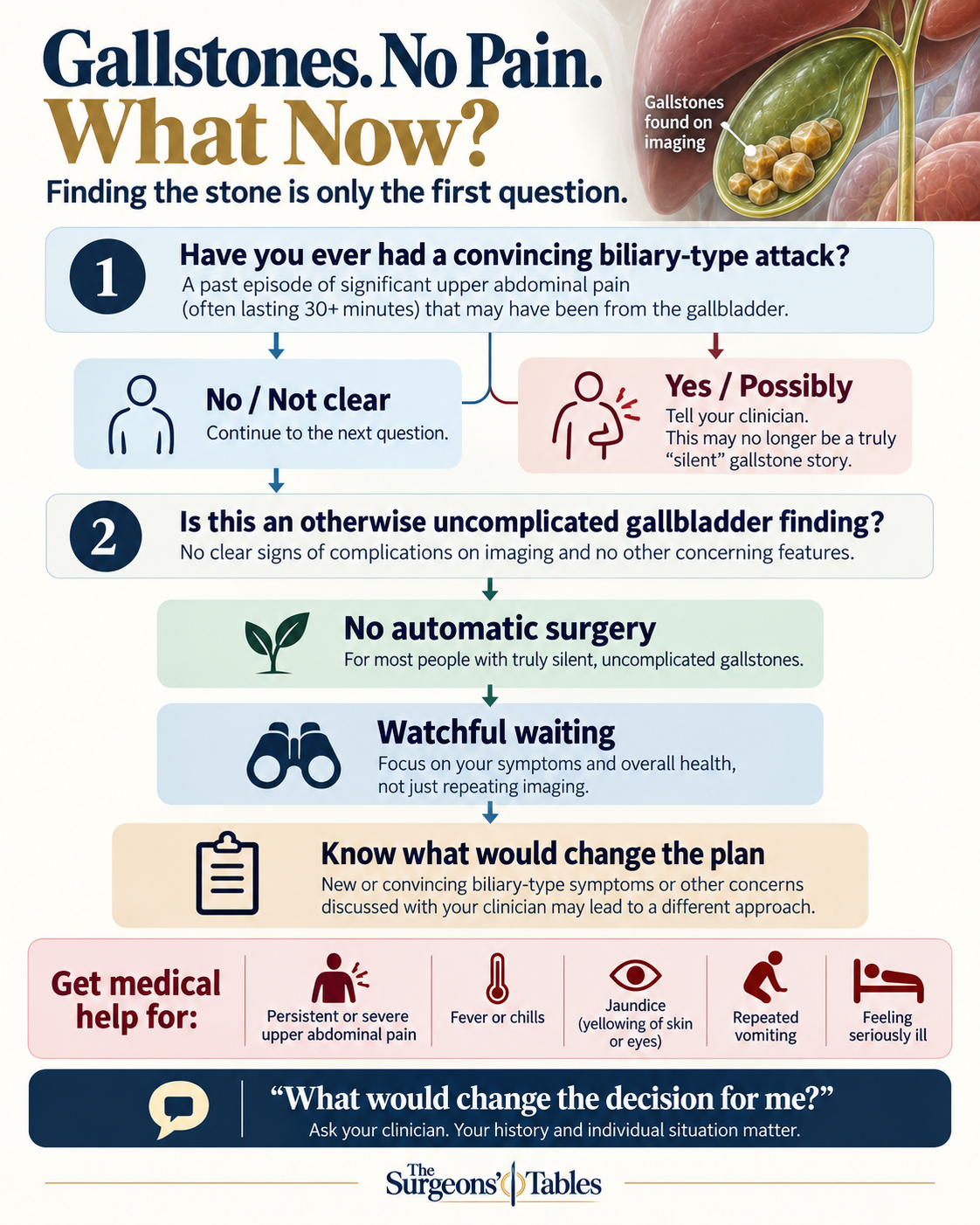
For an uncomplicated silent gallstone, it usually means something much more specific:
- Live normally. An incidental stone is not automatically a reason to restructure your life around your gallbladder.
- Remember previous attacks. Tell your clinician if you have ever had a distinct episode of significant upper abdominal pain, even if it happened months ago.
- Do not assume every digestive symptom is from the stones. Bloating, reflux, belching, and vague indigestion have many possible causes.
- Know what a meaningful biliary-type attack may feel like. A new, significant episode of upper abdominal pain should be discussed with your clinician.
- Know the warning signs. Persistent or severe pain, fever, jaundice, repeated vomiting, or feeling seriously ill deserves prompt medical assessment. (3)
That is active observation.
You are watching for a change in the clinical problem – not simply waiting for an ultrasound number to change.
Bottom Line
An incidental gallstone is a finding. It is not automatically a disease that needs to be fixed.
If you have never had convincing biliary symptoms and the rest of the gallbladder and biliary tree are uncomplicated, observation is usually the appropriate approach. Silent gallbladder stones generally do not require preventive surgery, medication to dissolve them, a special fat-free diet, or automatic annual ultrasounds. (1)
But do not confuse “I feel fine today” with “these stones have never caused symptoms.” Tell your clinician about previous attacks even if they disappeared months ago.
Also make sure the finding really is limited to the gallbladder. A common bile duct stone is a different clinical problem and should not be managed as though it were an uncomplicated silent gallbladder stone. (1)
And remember what watchful waiting actually means: you are not waiting for disaster. You are avoiding an operation that may never benefit you while knowing exactly what would change the decision.
References
- (1) National Institute for Health and Care Excellence. Gallstone disease: diagnosis and management (CG188). Recommendations. Updated guidance accessed September 9, 2026. NICE
- (2) European Association for the Study of the Liver. EASL Clinical Practice Guidelines on the prevention, diagnosis and treatment of gallstones. Journal of Hepatology. 2016;65(1):146-181. PubMed | DOI
- (3) National Institute of Diabetes and Digestive and Kidney Diseases. Symptoms & Causes of Gallstones. National Institutes of Health. NIDDK
- (4) National Institute of Diabetes and Digestive and Kidney Diseases. Eating, Diet, & Nutrition for Gallstones. National Institutes of Health. NIDDK
- (5) National Institute of Diabetes and Digestive and Kidney Diseases. Dieting & Gallstones. National Institutes of Health. NIDDK
- (6) National Institute of Diabetes and Digestive and Kidney Diseases. Treatment for Gallstones. National Institutes of Health. NIDDK
- (7) Mayo Clinic. Gallbladder cleanse: A “natural” remedy for gallstones? Mayo Clinic
- (8) Society of American Gastrointestinal and Endoscopic Surgeons. Safe Cholecystectomy Multi-Society Practice Guideline and State of the Art Consensus Conference on Prevention of Bile Duct Injury During Cholecystectomy. SAGES