
Antibiotics can help some patients with uncomplicated appendicitis avoid an operation. But “better without surgery” and “cured forever” are not the same thing – and one finding on your CT scan can substantially change the odds.

You are in the emergency department with right lower abdominal pain. The CT confirms appendicitis, but there is some good news: no obvious perforation, abscess, or diffuse infection.
Then the surgeon gives you a choice you may not have expected.
“You could have your appendix removed, or we could treat this with antibiotics.”
The obvious question is: If antibiotics work, why would I choose surgery?
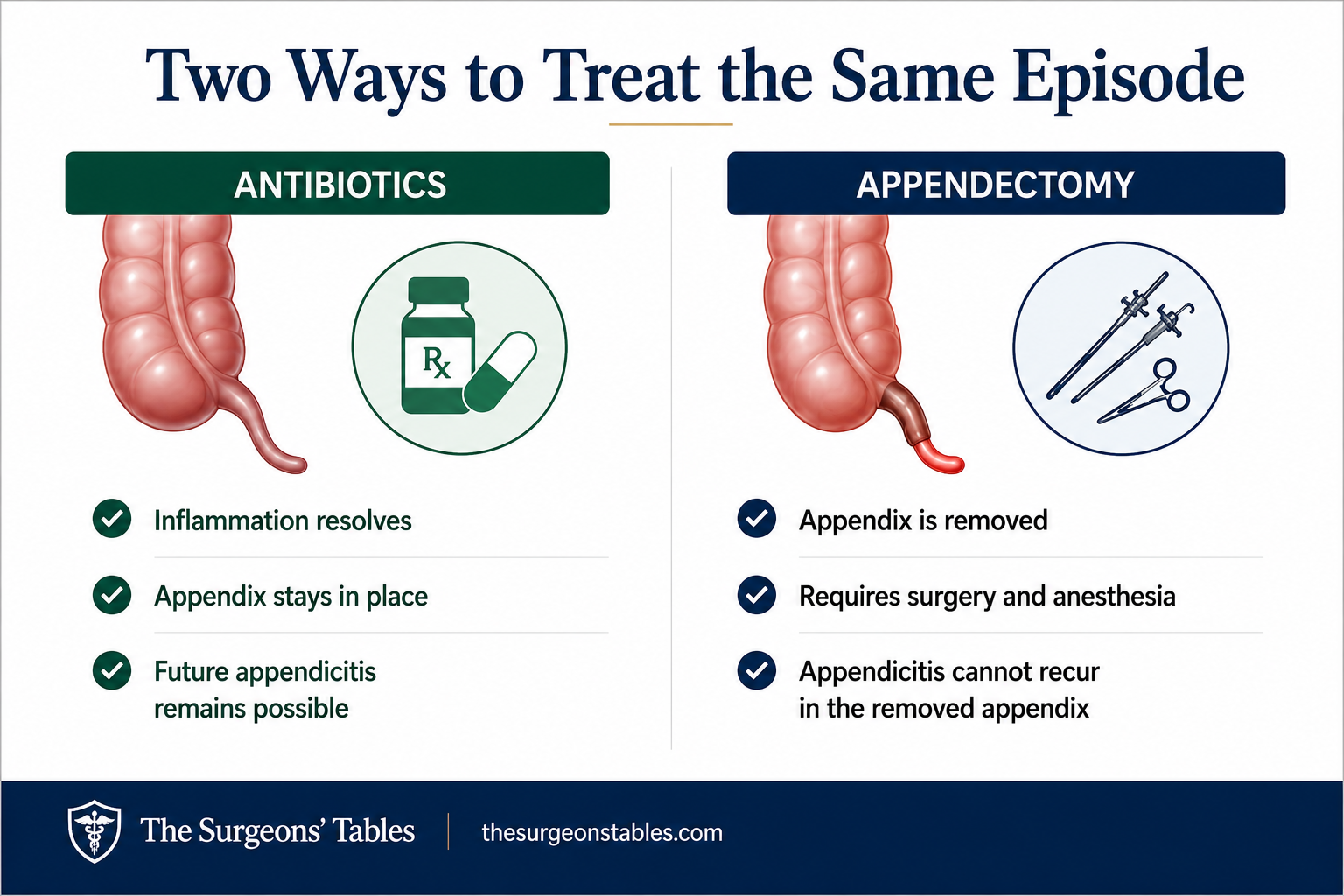
The answer is that antibiotics really can work – but “worked today” does not always mean “problem permanently solved.”
For carefully selected patients, antibiotics offer a meaningful chance of avoiding an operation. The trade-off is accepting the possibility that the appendix may become inflamed again or that surgery will still be needed later.
Before making that decision, there is one CT finding worth asking about by name: an appendicolith.
If antibiotics work now, how likely am I to need surgery later?
There is no single percentage that applies to everyone, because major trials enrolled different patients.
But the overall pattern is remarkably useful.
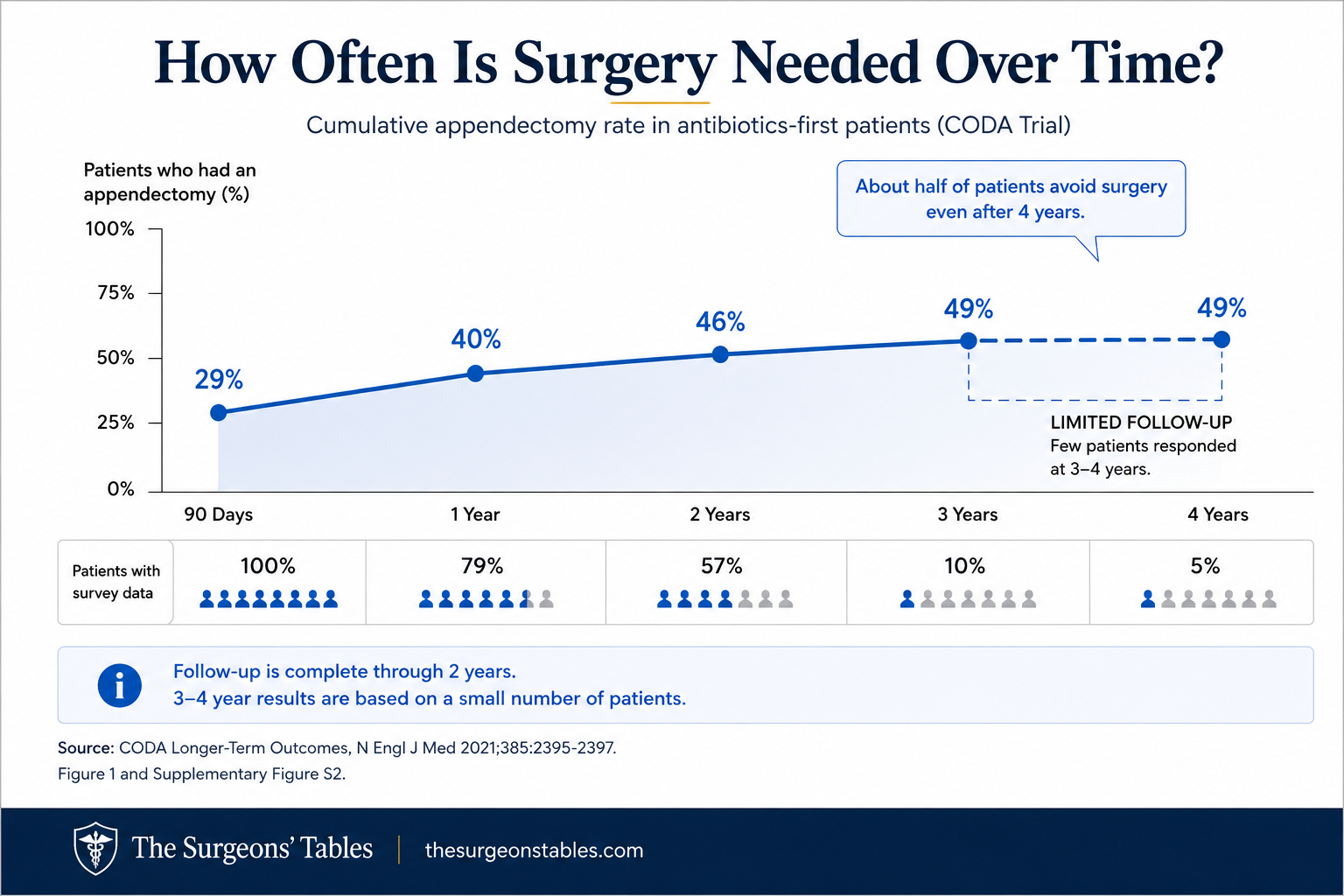
In the large U.S. CODA trial, 29% of patients assigned to antibiotics underwent appendectomy within 90 days. (1) Longer follow-up estimated that the cumulative proportion undergoing appendectomy reached about 40% at one year and 46% at two years. It was approximately 49% at three to four years, although follow-up at those later time points was limited. (2)
The Finnish APPAC trial studied a narrower group: adults with CT-confirmed uncomplicated appendicitis and no appendicolith. At five years, 39.1% had undergone appendectomy for suspected recurrence. (3) At ten years, cumulative appendectomy reached 44.3%. (4)
Importantly, 44.3% does not mean that every one of those patients had proven recurrent appendicitis. At ten years, histologically confirmed recurrence was 37.8%. (4)
So the most useful way to think about antibiotics is not that they simply “fail 40% of the time.”
Antibiotics may let you avoid surgery entirely – but choosing them means accepting a substantial long-term possibility that appendectomy will still become part of your story.
Most confirmed recurrences and later appendectomies in APPAC occurred during the first two years, so the uncertainty is greatest relatively early rather than being evenly distributed across the next decade. (4)
Why does an appendicolith change the conversation?
An appendicolith is a small hardened deposit seen inside the appendix on imaging. You may hear it described casually as an “appendix stone.”
Clinically, it is much more important than the name makes it sound.
CODA deliberately included patients with appendicoliths, allowing investigators to examine how they did with antibiotic treatment.
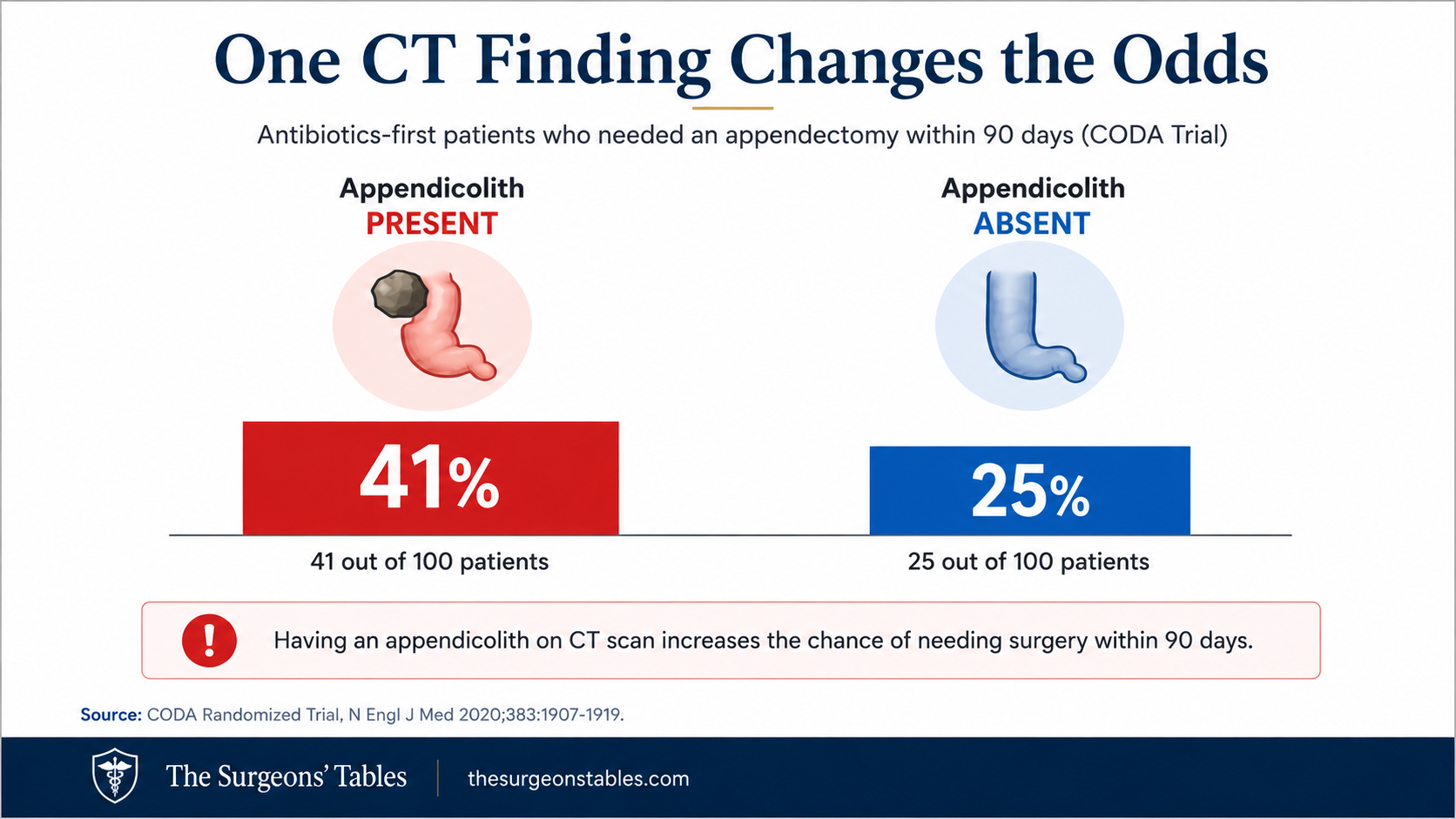
Among patients assigned to antibiotics, 41% of those with an appendicolith underwent appendectomy within 90 days, compared with 25% of those without one. (1)
The difference was not limited to later surgery.
Among patients with an appendicolith, NSQIP-defined morbidity events occurred at a rate of 20.2 per 100 participants in the antibiotic group versus 3.6 per 100 in the appendectomy group. (1)
That does not mean every patient with an appendicolith needs emergency surgery. It does mean that an appendicolith is a meaningful warning sign that should change the risk discussion.
This is why a surgeon may look at two patients who both have “uncomplicated appendicitis” and recommend antibiotics more comfortably to one than the other.
The CT label is only the beginning of the decision.
Antibiotics or appendectomy: what are you actually trading?
| Decision factor | Antibiotics first | Laparoscopic appendectomy |
|---|---|---|
| Immediate treatment | May avoid an operation and surgical incision | Requires anesthesia and surgery |
| What happens to the appendix? | The appendix remains in place | The inflamed appendix is removed |
| Future appendicitis | Recurrence or later appendectomy remains possible | Appendicitis recurrence is essentially eliminated |
| Recovery and work | Often fewer initial missed workdays | Initial postoperative recovery takes time |
| Later health care | Future emergency visits, imaging, hospitalization, or surgery may occur | Surgical complications are possible, but the treatment is definitive |
| Pathology | No entire appendix specimen is available for examination | The removed appendix is examined by pathology |
CODA illustrates this trade-off well.
Patients initially assigned to antibiotics missed fewer workdays on average than patients assigned to appendectomy. But the antibiotic strategy also produced more subsequent emergency department visits and hospitalizations. (1)
In other words, antibiotics do not simply remove risk.
Antibiotics exchange some of the immediate burden of surgery for more uncertainty afterward.
For one patient, that may be an excellent trade. For another, it may be exactly the opposite of what they want.
Who is a better candidate for antibiotics?
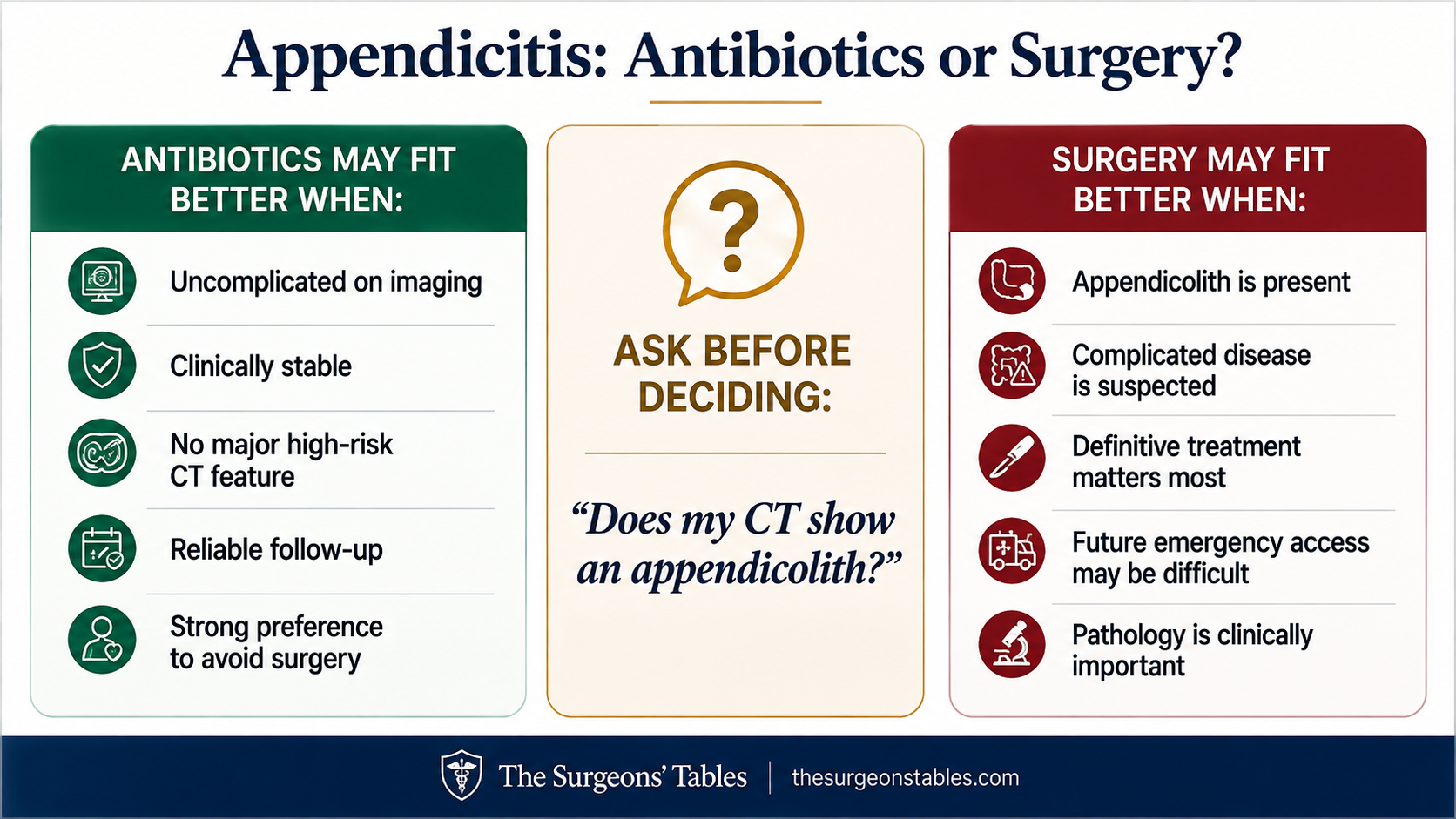
Antibiotics become more reasonable when the diagnosis is clearly uncomplicated, the patient is clinically stable, imaging does not show concerning complications, follow-up is reliable, and the patient understands that recurrence or later surgery remains possible.
The absence of an appendicolith makes that discussion more favorable.
Patient preference matters too. Someone with substantial reasons to avoid anesthesia or surgery may value even a moderate chance of avoiding appendectomy.
But there is another requirement that is easy to overlook: you need a realistic way back to medical care if the plan fails.
A person living close to an emergency department may experience the uncertainty differently from someone who routinely works offshore, travels to remote areas, serves in locations without immediate surgical access, or lives hours from emergency care.
Those circumstances are not formal contraindications to antibiotics. They are practical clinical factors because recurrence is not merely a statistic when urgent surgical care is difficult to reach.
When does surgery become the more attractive option?
The clearest answer is when appendicitis is no longer truly uncomplicated.
Perforation, generalized peritonitis, sepsis, or other evidence of complicated disease changes the problem and requires a different treatment strategy.
Even within uncomplicated appendicitis, several features can shift the balance.
An appendicolith is one of the strongest.
So is a patient’s desire for definitive treatment. If the idea of another attack, another CT scan, or another emergency visit is unacceptable, appendectomy solves a problem that antibiotics cannot: it removes the organ that can become inflamed again.
Current professional guidance reflects this tension rather than pretending there is one correct choice for everyone.
The 2025 World Society of Emergency Surgery guideline supports nonoperative antibiotic management as an alternative for appropriately selected and monitored adults with uncomplicated appendicitis, with shared decision-making central to the choice. (5)
The U.S.-based Society of American Gastrointestinal and Endoscopic Surgeons guideline takes a somewhat more operative position. It conditionally favors surgery for uncomplicated appendicitis while acknowledging low-certainty evidence. (6)
That difference is useful.
It tells us that the evidence supports a choice – but does not make the choice for you.
What about pregnancy or older adults?
These groups deserve more individualized discussion.
Current WSES guidance prefers laparoscopic appendectomy for uncomplicated appendicitis during pregnancy. Antibiotic treatment may still be considered when surgery poses greater risk or is not immediately available, but the evidence supporting that alternative is very uncertain. (5)
That is more nuanced than simply saying antibiotics are always “contraindicated” during pregnancy.
Older adults raise a different issue.
Appendectomy does something antibiotics cannot: it provides the entire appendix for microscopic examination.
Appendiceal tumors are uncommon, but they are real. A recent U.S. multicenter cohort found incidental appendiceal neoplasms in 1.3% of adults presenting with appendicitis after cases with a mass already suspected on imaging were excluded. (7) A systematic review estimated a neoplasm rate of approximately 1.49% among patients classified as having uncomplicated appendicitis, although definitions and populations varied. (8)
That does not mean every older patient must undergo surgery solely to obtain pathology. It does mean that the possibility of an underlying lesion becomes part of the conversation, particularly when imaging or the clinical presentation is atypical.
Do not compare modern laparoscopy with yesterday’s surgery
There is another important detail behind some of the statistics patients encounter online.
The Finnish APPAC trial found substantially fewer long-term treatment-related complications after antibiotic treatment than after appendectomy. (3)
That finding is real.
But the original surgical group underwent predominantly open appendectomy, while contemporary U.S. surgery for uncomplicated appendicitis is usually laparoscopic.
This does not invalidate APPAC. It means its long-term complication comparison should not be treated as a precise estimate of antibiotics versus modern laparoscopic surgery.
What should happen if you choose antibiotics?
Antibiotic-first treatment should be a plan, not simply a prescription.
The treating team should explain how improvement will be judged, when follow-up is needed, and what symptoms require urgent reassessment. The exact antibiotic regimen may vary with local protocols, allergies, resistance patterns, and the patient’s clinical condition.
Do not independently start, stop, or change prescription antibiotics. Contact the treating team if the planned course is unclear or side effects make it difficult to continue.
Seek urgent medical reassessment for worsening or persistent abdominal pain, repeated vomiting, increasing fever, fainting, confusion, a rigid or increasingly swollen abdomen, or an inability to drink enough fluids. Symptoms that improve and then return also deserve prompt evaluation.
Bottom Line
Antibiotics are a legitimate treatment option for selected adults with uncomplicated appendicitis. They can allow some patients to avoid surgery for years or permanently, but they do not remove the appendix and cannot eliminate the possibility of recurrence or later appendectomy.
The most important next question is not simply, “Do antibiotics work?”
It is: “Given my CT findings, my priorities, and my ability to return for urgent care, which risk would I rather accept?”
Ask specifically whether the CT shows an appendicolith. That single finding can substantially change the odds and may change which treatment makes the most sense for you.
References
- (1) The CODA Collaborative. A Randomized Trial Comparing Antibiotics with Appendectomy for Appendicitis. N Engl J Med. 2020;383:1907-1919. doi:10.1056/NEJMoa2014320.
- (2) The CODA Collaborative. Antibiotics versus Appendectomy for Acute Appendicitis – Longer-Term Outcomes. N Engl J Med. 2021;385:2395-2397. doi:10.1056/NEJMc2116018.
- (3) Salminen P, Tuominen R, Paajanen H, et al. Five-Year Follow-up of Antibiotic Therapy for Uncomplicated Acute Appendicitis in the APPAC Randomized Clinical Trial. JAMA. 2018;320(12):1259-1265. doi:10.1001/jama.2018.13201.
- (4) Salminen P, Salminen R, Kallio J, et al. Antibiotic Therapy for Uncomplicated Acute Appendicitis: Ten-Year Follow-Up of the APPAC Randomized Clinical Trial. JAMA. 2026;335(12):1041-1049. doi:10.1001/jama.2025.25921.
- (5) Podda M, Ceresoli M, De Simone B, et al. Diagnosis and Treatment of Acute Appendicitis: 2025 Edition of the World Society of Emergency Surgery Jerusalem Guidelines. JAMA Surg. Published online 2026. doi:10.1001/jamasurg.2025.6218.
- (6) Society of American Gastrointestinal and Endoscopic Surgeons. Guideline for the Diagnosis and Treatment of Appendicitis. Accessed September 3, 2026.
- (7) Incidental appendiceal neoplasms in a multicenter registry of appendicitis management. Surgery. Full article. Published 2026.
- (8) Limaiem F, et al. Incidence Rate and Histology of Appendiceal Neoplasms in Complicated Versus Uncomplicated Appendicitis: A Meta-analysis and Systematic Review. 2023.